. 2009 Aug;19(8):1429-40.
doi: 10.1101/gr.089854.108. Epub 2009 Jul 7.

Clusters and superclusters of phased small RNAs in the developing inflorescence of rice

Affiliations

Clusters and superclusters of phased small RNAs in the developing inflorescence of rice

Cameron Johnson et al. Genome Res. 2009 Aug.

Erratum in

  • Genome Res. 2012 Mar;22(3):592

Abstract

To address the role of small regulatory RNAs in rice development, we generated a large data set of small RNAs from mature leaves and developing roots, shoots, and inflorescences. Using a spatial clustering algorithm, we identified 36,780 genomic groups of small RNAs. Most consisted of 24-nt RNAs that are expressed in all four tissues and enriched in repeat regions of the genome; 1029 clusters were composed primarily of 21-nt small RNAs and, strikingly, 831 of these contained phased RNAs and were preferentially expressed in developing inflorescences. Thirty-eight of the 24-mer clusters were also phased and preferentially expressed in inflorescences. The phased 21-mer clusters derive from nonprotein coding, nonrepeat regions of the genome and are grouped together into superclusters containing 10-46 clusters. The majority of these 21-mer clusters (705/831) are flanked by a degenerate 22-nt motif that is offset by 12 nt from the main phase of the cluster. Small RNAs complementary to these flanking 22-nt motifs define a new miRNA family, which is conserved in maize and expressed in developing reproductive tissues in both plants. These results suggest that the biogenesis of phased inflorescence RNAs resembles that of tasiRNAs and raise the possibility that these novel small RNAs function in early reproductive development in rice and other monocots.


Figures

Figure 1.
Figure 1.
Distribution of 21-mer superclusters and phased 24-mer clusters in the rice genome. Regions of 21-mer clusters are represented as black lines (<10 clusters) or if they are superclusters as red lines (≥10 clusters). Phased 24-mer clusters are represented as cyan lines. The number of individual clusters within a region is indicated next to the line.
Figure 2.
Figure 2.
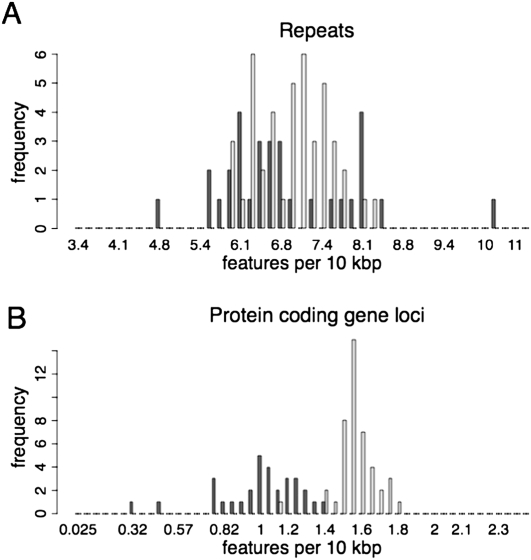
Density of TIGR annotated features in 21-mer superclusters versus sequences between superclusters. The frequency of annotated repeats (A) or annotated protein coding genes (B) per 10 kbp is plotted for 21-mer superclusters (dark gray) versus the sequences between the 21-mer superclusters (light gray). The difference in the frequency is statistically significant for protein coding gene loci (P < 2.2 × 10⁻¹⁶), but not statistically significant for the repeats (P = 0.29).
Figure 3.
Figure 3.
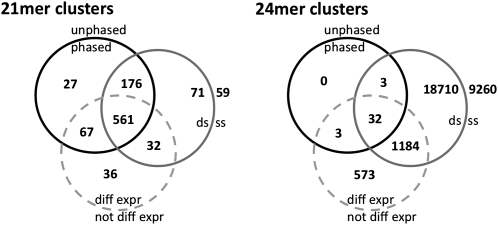
Classification of clusters with regard to strandedness, differential expression, and phasing. Venn diagrams indicating the classification of 21-mer clusters (left) and 24-mer clusters (right) according to three binary criteria: origin from dsRNA (ds) versus origin from ssRNA (ss) (solid gray circle), differentially expressed (diff expr) versus not differentially expressed (not diff expr) (dashed gray circle), and phased versus unphased (black circle). Small RNAs were classified as having originated from ssRNA if >80% of the small RNAs in the cluster were of the same polarity. Classification as differentially expressed was at the 99.9% confidence level and classification as phased was with a FDR of 1.2% for 21-mer clusters and 10% for 24-mer clusters.
Figure 4.
Figure 4.
The 22-nt motif associated with the phased 21-mer clusters. (A) The phased and unphased small RNAs comprising a representative 21-mer cluster are shown. The location of the motif is shown by the arrow at the top, below “motif.” The polarity of the small RNAs is indicated by the arrows, and the number of times the small RNA was sequenced is indicated above the arrow. This 21-mer cluster is located at chr1:34554118..34554411. The probability that this cluster is phased by chance alone is 2.6 × 10⁻¹⁷, and the probability that the indicated motif matches the consensus by chance alone is 2.4 × 10⁻⁸. (B) The approximate probability of a nucleotide occurring at specific positions of the motif is shown in the top matrix, and the consensus sequence of the motif is shown below the matrix. (C) The positions of the 705 motifs that are offset 12 nt from the phase of the 21-mer clusters are shown.
Figure 5.
Figure 5.
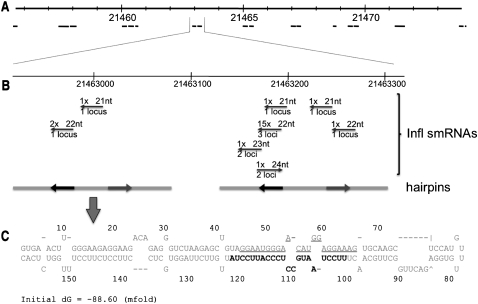
The genomic origins of the motif-targeting small RNAs, miR2118, and potential folding of transcripts containing these miRNAs. (A) The ∼20-kb region that codes for most of the motif-targeting small RNAs. This region contains nine degenerate repeats each comprised of two to three inverted repeats. Inverted repeats are indicated by black lines below. (B) An enlargement of the indicated region. The small RNAs potentially derived from this region are displayed. The polarity of the small RNAs is indicated by the arrows, and the number of times the small RNA was sequenced and the size of the small RNA are indicated above the arrow. The number of loci potentially encoding each small RNA is shown below the arrow. The positions of the motif-targeting small RNA (black) and the motif-targeting small RNA* (gray) are shown on the gray line representing the inverted repeat. The left inverted repeat contains the motif-targeting 22-nt small RNA (smRNA165692) while the right inverted repeat contains a 22-nt motif-targeting small RNA (smRNA165598) that maps to an additional two locations in the overall region. (C) The predicted hairpin structure of the indicated inverted repeat. The motif-targeting small RNA, miR2118, is shown in black and the motif-targeting RNA*, miR2118*, is underlined.
Figure 6.
Figure 6.
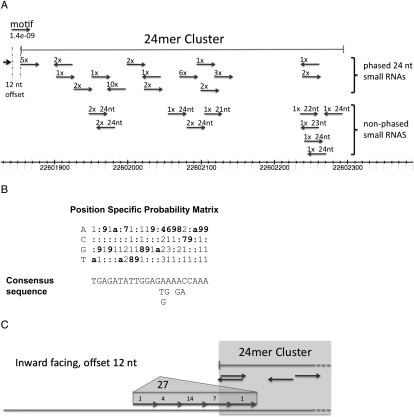
The 22-nt motif associated with the phased 24-mer clusters. (A) The phased and unphased small RNAs that comprise a representative phased 24-mer cluster are shown, and the 22-nt motif is shown by the arrow at the top, below “motif.” The polarity of the small RNAs is indicated by the arrows, and the number of times the small RNA was sequenced is indicated above the arrow. This 24-mer cluster is located at chr11:22601855..22602293. The probability that this cluster is phased by chance alone is 6.8 × 10⁻¹⁵, and the probability that the indicated motif matches the consensus by chance alone is 1.4 × 10⁻⁹. (B) The probability of a nucleotide occurring at specific positions of the motif is shown in the top matrix, and the consensus sequence of the motif is shown below the matrix. The letter “a” represents a probability of 100%. (C) The positions of the 27 motifs that are offset 12 nt from the phase of the phased 24-mer clusters are shown.

References

    1. Alleman M, Sidorenko L, McGinnis K, Seshadri V, Dorweiler JE, White J, Sikkink K, Chandler VL. An RNA-dependent RNA polymerase is required for paramutation in maize. Nature. 2006;442:295–298. - PubMed
    1. Allen E, Xie Z, Gustafson AM, Carrington JC. microRNA-directed phasing during trans-acting siRNA biogenesis in plants. Cell. 2005;121:207–221. - PubMed
    1. Ambros V, Chen X. The regulation of genes and genomes by small RNAs. Development. 2007;134:1635–1641. - PubMed
    1. Archak S, Nagaraju J. Computational prediction of rice (Oryza sativa) miRNA targets. Genomics Proteomics Bioinformatics. 2007;5:196–206. - PMC - PubMed
    1. Arenas-Huertero C, Pérez B, Rabanal F, Blanco-Melo D, De la Rosa C, Estrada-Navarrete G, Sanchez F, Covarrubias AA, Reyes JL. Conserved and novel miRNAs in the legume Phaseolus vulgaris in response to stress. Plant Mol Biol. 2009;70:385–401. - PubMed

Publication types

MeSH terms