Genetic variants associated with cardiac structure and function: a meta-analysis and replication of genome-wide association data
- PMID: 19584346
- PMCID: PMC2975567
- DOI: 10.1001/jama.2009.978-a
Genetic variants associated with cardiac structure and function: a meta-analysis and replication of genome-wide association data
Abstract
Context: Echocardiographic measures of left ventricular (LV) structure and function are heritable phenotypes of cardiovascular disease.
Objective: To identify common genetic variants associated with cardiac structure and function by conducting a meta-analysis of genome-wide association data in 5 population-based cohort studies (stage 1) with replication (stage 2) in 2 other community-based samples.
Design, setting, and participants: Within each of 5 community-based cohorts comprising the EchoGen consortium (stage 1; n = 12 612 individuals of European ancestry; 55% women, aged 26-95 years; examinations between 1978-2008), we estimated the association between approximately 2.5 million single-nucleotide polymorphisms (SNPs; imputed to the HapMap CEU panel) and echocardiographic traits. In stage 2, SNPs significantly associated with traits in stage 1 were tested for association in 2 other cohorts (n = 4094 people of European ancestry). Using a prespecified P value threshold of 5 x 10(-7) to indicate genome-wide significance, we performed an inverse variance-weighted fixed-effects meta-analysis of genome-wide association data from each cohort.
Main outcome measures: Echocardiographic traits: LV mass, internal dimensions, wall thickness, systolic dysfunction, aortic root, and left atrial size.
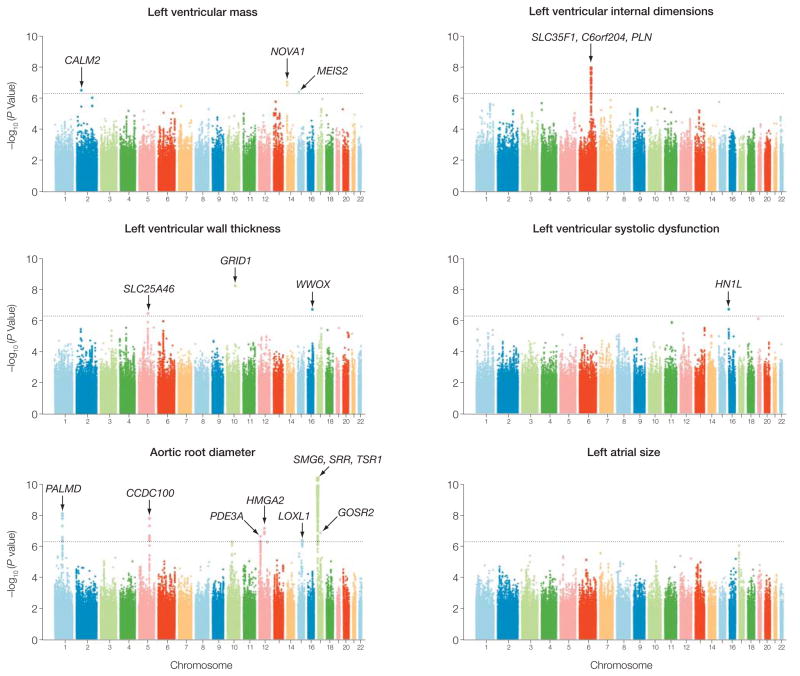
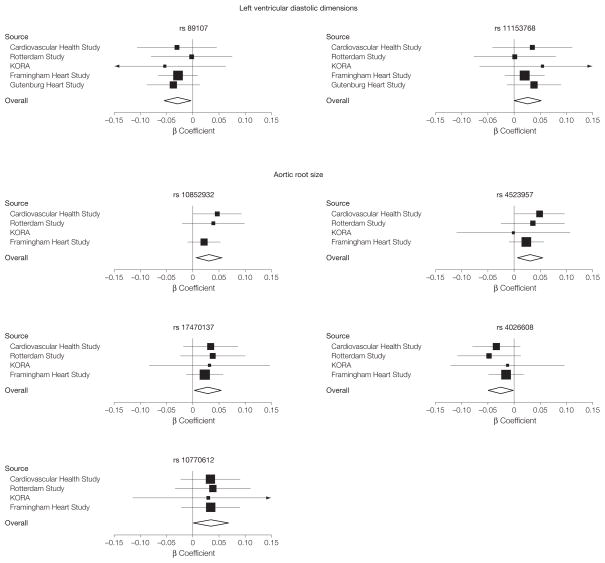
Results: In stage 1, 16 genetic loci were associated with 5 echocardiographic traits: 1 each with LV internal dimensions and systolic dysfunction, 3 each with LV mass and wall thickness, and 8 with aortic root size. In stage 2, 5 loci replicated (6q22 locus associated with LV diastolic dimensions, explaining <1% of trait variance; 5q23, 12p12, 12q14, and 17p13 associated with aortic root size, explaining 1%-3% of trait variance).
Conclusions: We identified 5 genetic loci harboring common variants that were associated with variation in LV diastolic dimensions and aortic root size, but such findings explained a very small proportion of variance. Further studies are required to replicate these findings, identify the causal variants at or near these loci, characterize their functional significance, and determine whether they are related to overt cardiovascular disease.
Figures
References
-
- Levy D, Garrison RJ, Savage DD, Kannel WB, Castelli WP. Left ventricular mass and incidence of coronary heart disease in an elderly cohort: the Framingham Heart Study. Ann Intern Med. 1989;110(2):101–107. - PubMed
-
- Gardin JM, McClelland R, Kitzman D, et al. M-mode echocardiographic predictors of six- to seven-year incidence of coronary heart disease, stroke, congestive heart failure, and mortality in an elderly cohort (the Cardiovascular Health Study) Am J Cardiol. 2001;87(9):1051–1057. - PubMed
-
- Bikkina M, Levy D, Evans JC, et al. Left ventricular mass and risk of stroke in an elderly cohort: the Framingham Heart Study. JAMA. 1994;272(1):33–36. - PubMed
-
- Levy D, Garrison RJ, Savage DD, Kannel WB, Castelli WP. Prognostic implications of echocardiographically determined left ventricular mass in the Framingham Heart Study. N Engl J Med. 1990;322(22):1561–1566. - PubMed
-
- Vasan RS, Larson MG, Levy D, Evans JC, Benjamin EJ. Distribution and categorization of echocardiographic measurements in relation to reference limits: the Framingham Heart Study: formulation of a height- and sex-specific classification and its prospective validation. Circulation. 1997;96(6):1863–1873. - PubMed
Publication types
MeSH terms
Grants and funding
- N01-HC-25195/HC/NHLBI NIH HHS/United States
- N01 HC085086/HC/NHLBI NIH HHS/United States
- U01 HL080295/HL/NHLBI NIH HHS/United States
- N01-HC-85081/HC/NHLBI NIH HHS/United States
- N01 HC025195/HC/NHLBI NIH HHS/United States
- R01 HL087652/HL/NHLBI NIH HHS/United States
- P 20545/FWF_/Austrian Science Fund FWF/Austria
- N01 HC025195/HL/NHLBI NIH HHS/United States
- M01RR00069/RR/NCRR NIH HHS/United States
- DK063491/DK/NIDDK NIH HHS/United States
- N01-HC-85079/HC/NHLBI NIH HHS/United States
- R01 HL080124/HL/NHLBI NIH HHS/United States
- N01 HC045133/HC/NHLBI NIH HHS/United States
- N01 HC035129/HC/NHLBI NIH HHS/United States
- N01 HC085081/HC/NHLBI NIH HHS/United States
- R01HL077477/HL/NHLBI NIH HHS/United States
- R01 HL055502/HL/NHLBI NIH HHS/United States
- N02 HL064278/HL/NHLBI NIH HHS/United States
- N01 HC075150/HC/NHLBI NIH HHS/United States
- HHSN268200800007C/HL/NHLBI NIH HHS/United States
- N01 HC015103/HC/NHLBI NIH HHS/United States
- N01 HC085083/HC/NHLBI NIH HHS/United States
- M01 RR000069/RR/NCRR NIH HHS/United States
- N01 HC085086/HL/NHLBI NIH HHS/United States
- R01 HL077477/HL/NHLBI NIH HHS/United States
- N01 HC085085/HC/NHLBI NIH HHS/United States
- 2K24HL04334/HL/NHLBI NIH HHS/United States
- N01-HC-85086/HC/NHLBI NIH HHS/United States
- R01 DK033651/DK/NIDDK NIH HHS/United States
- K24 HL004334/HL/NHLBI NIH HHS/United States
- N01 HC085082/HC/NHLBI NIH HHS/United States
- N01-HC-85082/HC/NHLBI NIH HHS/United States
- R01HL093328/HL/NHLBI NIH HHS/United States
- P30 DK063491/DK/NIDDK NIH HHS/United States
- N01 HC085080/HC/NHLBI NIH HHS/United States
- R01HL080124/HL/NHLBI NIH HHS/United States
- N01 HC-55222/HC/NHLBI NIH HHS/United States
- N01 HC055222/HL/NHLBI NIH HHS/United States
- N01 HC055222/HC/NHLBI NIH HHS/United States
- R01 HL55502/HL/NHLBI NIH HHS/United States
- N01 HC085079/HL/NHLBI NIH HHS/United States
- N01-HC-85083/HC/NHLBI NIH HHS/United States
- N01-HC-75150/HC/NHLBI NIH HHS/United States
- N01-HC-85080/HC/NHLBI NIH HHS/United States
- N01 HC085084/HC/NHLBI NIH HHS/United States
- R01 HL093328/HL/NHLBI NIH HHS/United States
- N01 HC085079/HC/NHLBI NIH HHS/United States
- N01 HC075150/HL/NHLBI NIH HHS/United States
LinkOut - more resources
Full Text Sources
Other Literature Sources
Molecular Biology Databases