


Correlates and heritability of nonalcoholic fatty liver disease in a minority cohort
- PMID: 19584882
- PMCID: PMC2709735
- DOI: 10.1038/oby.2009.4
Correlates and heritability of nonalcoholic fatty liver disease in a minority cohort
Abstract
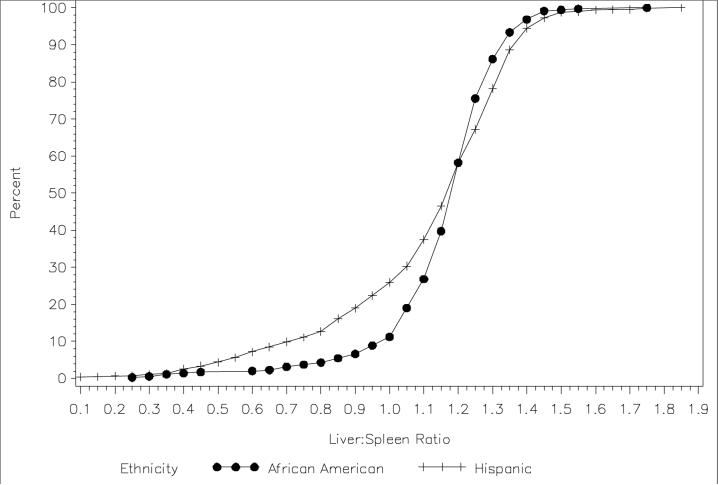
Nonalcoholic fatty liver disease (NAFLD) is associated with obesity and insulin resistance. The condition disproportionately affects Hispanic Americans. The aims of this study were to examine the risk factors and heritability of NAFLD in 795 Hispanic American and 347 African-American adults participating in the Insulin Resistance Atherosclerosis Study (IRAS) Family Study. Computed tomography (CT) scans of the abdomen were evaluated centrally for measures of liver-spleen (LS) density ratio and abdominal fat distribution. Other measures included insulin sensitivity (SI) calculated from a frequently sampled intravenous glucose tolerance test and various laboratory measures. Statistical models which adjust for familial relationships were estimated separately for the two ethnic groups. Heritability was calculated using a variance components approach. The mean age of the cohort was 49 years (range 22-84); 66% were female. NAFLD (LS ratio<1) was more common in Hispanic Americans (24%) than African Americans (10%). NAFLD was independently associated with SI and visceral adipose tissue (VAT) area in both ethnic groups, although the proportion of explained variance was considerably higher in the Hispanic models. Adiponectin contributed significantly in the African-American models whereas triglycerides (TGs) and plasminogen activator inhibitor 1 (PAI-1) contributed only in the Hispanic models. Liver density was modestly heritable in both ethnic groups (h2 approximately 0.35). In summary, the prevalence of NAFLD was twofold greater in Hispanic than African Americans. Certain correlates of NAFLD were similar between the ethnic groups, whereas others were distinct. NAFLD was modestly heritable. These findings suggest that NAFLD may have a differing environmental and/or genetic basis in these ethnic groups.
Figures
References
-
- Kelley DE, McKolanis TM, Hegazi RA, Kuller LH, Kalhan SC. Fatty liver in type 2 diabetes mellitus: relation to regional adiposity, fatty acids, and insulin resistance. Am J Physiol Endocrinol Metab. 2003;285:E906–E916. - PubMed
-
- Clark JM. The epidemiology of nonalcoholic fatty liver disease in adults. J Clin Gastroenterol. 2006;40:S5–S10. - PubMed
-
- Hamaguchi M, Kojima T, Takeda N, Nakagawa T, Taniguchi H, Fujii K, Omatsu T, Nakajima T, Sarui H, Shimazaki M, Kato T, Okuda J, Ida K. The metabolic syndrome as a predictor of nonalcoholic fatty liver disease. Ann Intern Med. 2005;143:722–728. - PubMed
-
- Ford ES, Giles WH, Mokdad AH. Increasing prevalence of the metabolic syndrome among U.S. adults. Diabetes Care. 2004;27:2444–2449. - PubMed
-
- Ogden CL, Carroll MD, Curtin LR, McDowell MA, Tabak CJ, Flegal KM. Prevalence of overweight and obesity in the United States, 1999−2004. JAMA. 2006;295:1549–1555. - PubMed
Publication types
MeSH terms
Substances
Grants and funding
- R01 HL061210/HL/NHLBI NIH HHS/United States
- R01HL060919/HL/NHLBI NIH HHS/United States
- R01HL061019/HL/NHLBI NIH HHS/United States
- R01HL060894/HL/NHLBI NIH HHS/United States
- R01 HL060944/HL/NHLBI NIH HHS/United States
- R01HL060944/HL/NHLBI NIH HHS/United States
- R01 HL060919/HL/NHLBI NIH HHS/United States
- R01 HL060894/HL/NHLBI NIH HHS/United States
- P30 AG021332/AG/NIA NIH HHS/United States
- P30-AG21332/AG/NIA NIH HHS/United States
- R01HL061210/HL/NHLBI NIH HHS/United States
- R01 HL061019/HL/NHLBI NIH HHS/United States
LinkOut - more resources
Full Text Sources
Medical
Miscellaneous
