


Impact of exercise in community-dwelling older adults
- PMID: 19584926
- PMCID: PMC2702830
- DOI: 10.1371/journal.pone.0006174
Impact of exercise in community-dwelling older adults
Abstract
Background: Concern has been expressed that preventive measures in older people might increase frailty by increasing survival without improving health. We investigated the impact of exercise on the probabilities of health improvement, deterioration and death in community-dwelling older people.
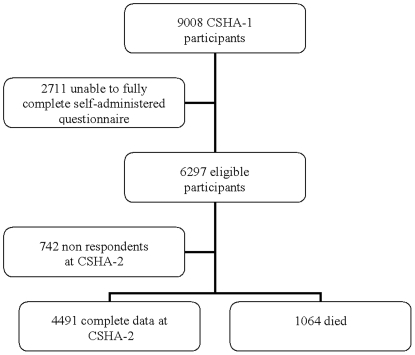
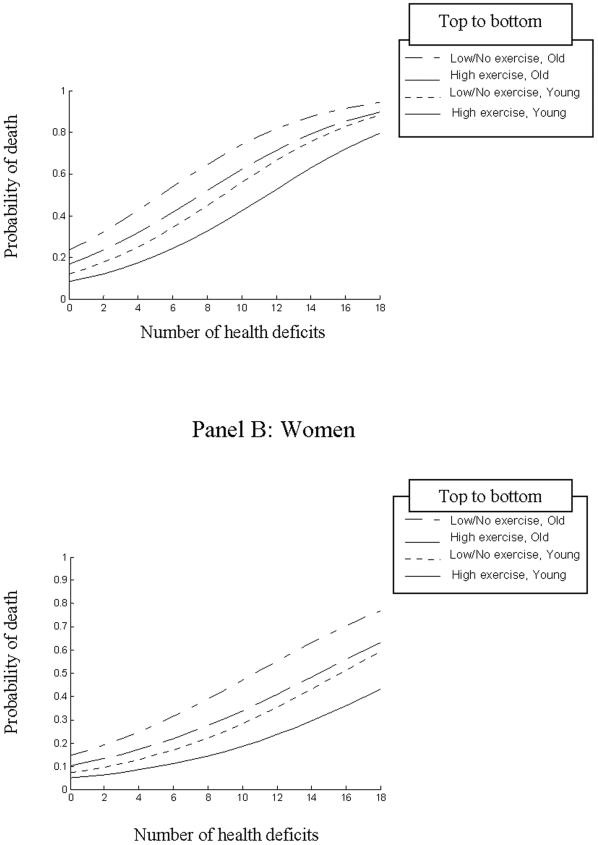
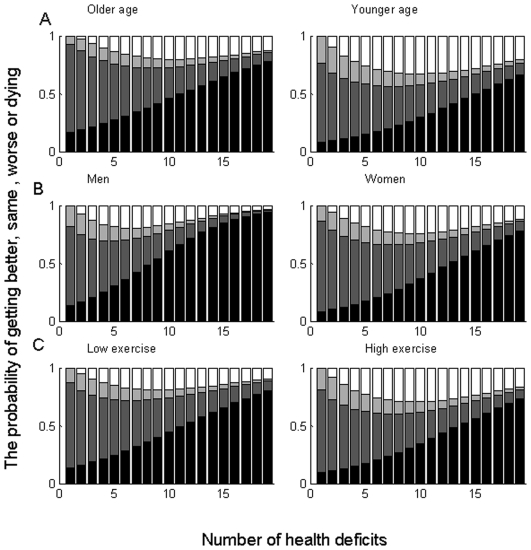
Methods and principal findings: In the Canadian Study of Health and Aging, health status was measured by a frailty index based on the number of health deficits. Exercise was classified as either high or low/no exercise, using a validated, self-administered questionnaire. Health status and survival were re-assessed at 5 years. Of 6297 eligible participants, 5555 had complete data. Across all grades of frailty, death rates for both men and women aged over 75 who exercised were similar to their peers aged 65 to 75 who did not exercise. In addition, while all those who exercised had a greater chance of improving their health status, the greatest benefits were in those who were more frail (e.g. improvement or stability was observed in 34% of high exercisers versus 26% of low/no exercisers for those with 2 deficits compared with 40% of high exercisers versus 22% of low/no exercisers for those with 9 deficits at baseline).
Conclusions: In community-dwelling older people, exercise attenuated the impact of age on mortality across all grades of frailty. Exercise conferred its greatest benefits to improvements in health status in those who were more frail at baseline. The net effect of exercise should therefore be to improve health status at the population level.
Conflict of interest statement
Figures
References
-
- Addison J. The Spectator, July 12, 1711. Available: http://www.fullbooks.com/The-Spectator-Volume-112.html Accessed March 3rd 2009.
-
- Latham NK, Bennett DA, Stretton CM, Anderson CS. Systematic review of progressive resistance strength training in older adults. J Gerontol A Biol Sci Med Sci. 2004;59:48–61. - PubMed
-
- Weerdesteyn V, Rijken H, Geurts AC, Smits-Engelsman BC, Mulder T, et al. A five-week exercise program can reduce falls and improve obstacle avoidance in the elderly. Gerontology. 2006;52:131–141. - PubMed
-
- Nelson ME, Fiatarone MA, Morganti CM, Trice I, Greenberg RA, et al. Effects of high-intensity strength training on multiple risk factors for osteoporotic fractures. A randomized controlled trial. JAMA. 1994;272:1909–1914. - PubMed
