


Localization of P. gingivalis in preterm delivery placenta
- PMID: 19587165
- PMCID: PMC3144059
- DOI: 10.1177/0022034509338032
Localization of P. gingivalis in preterm delivery placenta
Abstract
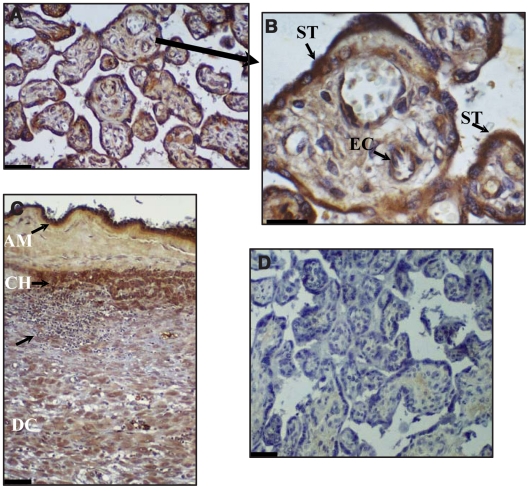
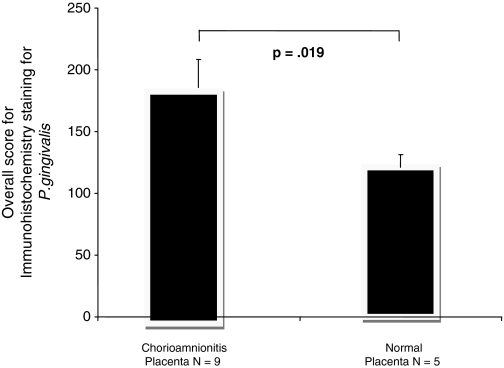
Increasing evidence suggests an association between periodontal disease and adverse pregnancy outcomes. Although infection is considered as a risk factor for preterm delivery, the localization of oral bacteria or their antigens in chorioamnionitis placental tissue has never been demonstrated. This study was devised to test the hypothesis that periodontal pathogens may be present and affect human placenta in cases of chorioamnionitis. Using immunocytochemistry, we have identified the presence of Porphyromonas gingivalis antigens in placental tissues. The antigens were detected in the placental syncytiotrophoblasts, chorionic trophoblasts, decidual cells, and amniotic epithelial cells, as well as the vascular cells. There was a substantial increase in immunostaining intensity of the tissues sectioned from women with chorioamnionitis compared to those experiencing normalterm pregnancy, p < 0.019 (Mann-Whitney test). These results suggest that P. gingivalis may commonly colonize placental tissue, and that the presence of the organism may contribute to preterm delivery.
Figures

References
-
- Bakardjiev AI, Stacy BA, Portnoy DA. (2005). Growth of Listeria monocytogenes in the guinea pig placenta and role of cell-to-cell spread in fetal infection. J Infect Dis 191:1889-1897 - PubMed
-
- Barak S, Oettinger-Barak O, Machtei EE, Sprecher H, Ohel G. (2007). Evidence of periopathogenic microorganisms in placentas of women with preeclampsia. J Periodontol 78:670-676 - PubMed
-
- Garcia RI, Henshaw M, Krall EA. (2001). Relationship between periodontal disease and systemic health. Periodontol 2000 25:21-36 - PubMed
-
- Geerts SO, Nys M, De Mol P, Charpentier J, Albert A, Legrand V, et al. (2002). Systemic release of endotoxins induced by gentle mastication: association with periodontitis severity. J Periodontol 73:73-78 - PubMed
-
- Goldenberg RL, Hauth JC, Andrews WW. (2000). Intrauterine infection and preterm delivery. N Engl J Med 342:1500-1507 - PubMed
Publication types
MeSH terms
Substances
Grants and funding
LinkOut - more resources
Full Text Sources
Other Literature Sources
Medical
