


Accelerating loss of seagrasses across the globe threatens coastal ecosystems
- PMID: 19587236
- PMCID: PMC2707273
- DOI: 10.1073/pnas.0905620106
Accelerating loss of seagrasses across the globe threatens coastal ecosystems
Abstract
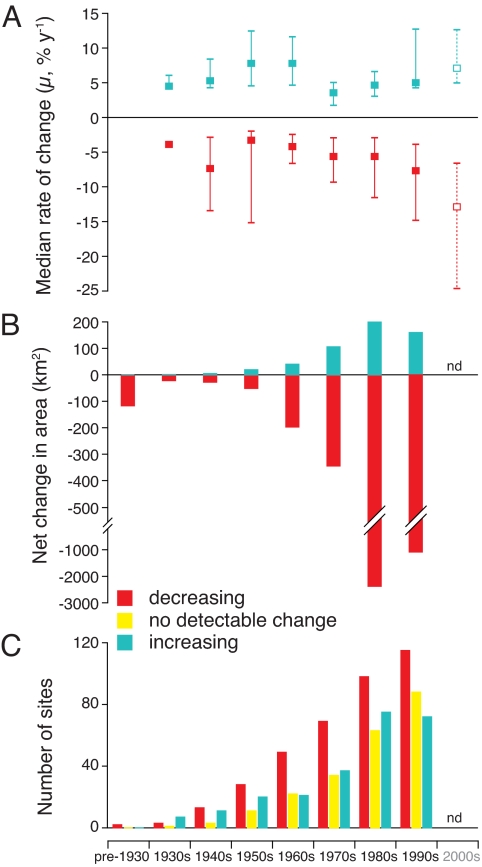
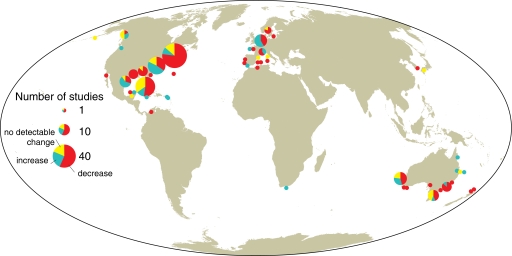
Coastal ecosystems and the services they provide are adversely affected by a wide variety of human activities. In particular, seagrass meadows are negatively affected by impacts accruing from the billion or more people who live within 50 km of them. Seagrass meadows provide important ecosystem services, including an estimated $1.9 trillion per year in the form of nutrient cycling; an order of magnitude enhancement of coral reef fish productivity; a habitat for thousands of fish, bird, and invertebrate species; and a major food source for endangered dugong, manatee, and green turtle. Although individual impacts from coastal development, degraded water quality, and climate change have been documented, there has been no quantitative global assessment of seagrass loss until now. Our comprehensive global assessment of 215 studies found that seagrasses have been disappearing at a rate of 110 km(2) yr(-1) since 1980 and that 29% of the known areal extent has disappeared since seagrass areas were initially recorded in 1879. Furthermore, rates of decline have accelerated from a median of 0.9% yr(-1) before 1940 to 7% yr(-1) since 1990. Seagrass loss rates are comparable to those reported for mangroves, coral reefs, and tropical rainforests and place seagrass meadows among the most threatened ecosystems on earth.
Conflict of interest statement
The authors declare no conflict of interest.
Figures
References
-
- Costanza R, et al. The value of the world's ecosystem services and natural capital. Nature. 1997;387:253–260.
-
- Halpern BS. A global map of human impact on marine ecosystems. Science. 2008;319:948–952. - PubMed
-
- Howarth R, et al. Nutrient pollution of coastal rivers, bays and seas. Issues in Ecology. 2000;7:1–14.
-
- Valiela I. Macroalgal blooms in shallow estuaries: Controls and ecophysiological and ecosystem consequences. Limnol Oceanogr. 1997;42:1105–1118.
-
- Worm B. Impacts of biodiversity loss on ocean ecosystem services. Science. 2006;314:787–790. - PubMed
Publication types
MeSH terms
LinkOut - more resources
Full Text Sources
