


Conversion of amyloid positive and negative MCI to AD over 3 years: an 11C-PIB PET study
- PMID: 19587325
- PMCID: PMC2830881
- DOI: 10.1212/WNL.0b013e3181b23564
Conversion of amyloid positive and negative MCI to AD over 3 years: an 11C-PIB PET study
Abstract
Background: Patients with amnestic mild cognitive impairment (MCI) represent an important clinical group as they are at increased risk of developing Alzheimer disease (AD). (11)C-PIB PET is an in vivo marker of brain amyloid load.
Objective: To assess the rates of conversion of MCI to AD during a 3-year follow-up period and to compare levels of amyloid deposition between MCI converters and nonconverters.
Methods: Thirty-one subjects with MCI with baseline (11)C-PIB PET, MRI, and neuropsychometry have been clinically followed up for 1 to 3 years (2.68 +/- 0.6 years). Raised cortical (11)C-PIB binding in subjects with MCI was detected with region of interest analysis and statistical parametric mapping.
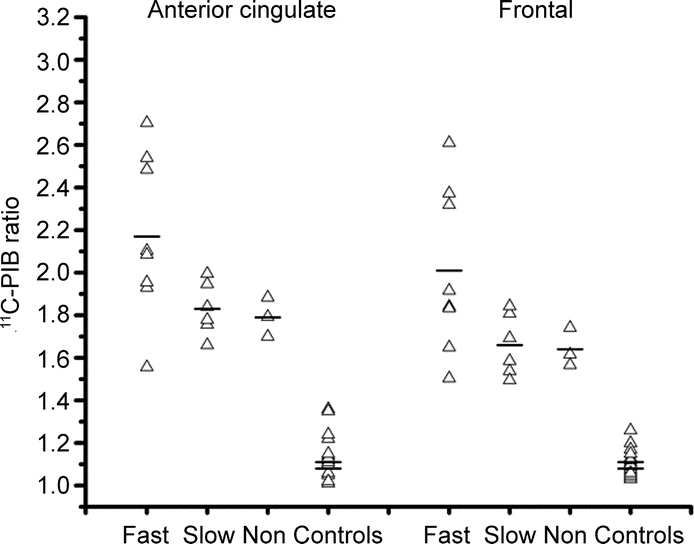
Results: Seventeen of 31 (55%) subjects with MCI had increased (11)C-PIB retention at baseline and 14 of these 17 (82%) clinically converted to AD during follow-up. Only one of the 14 PIB-negative MCI cases converted to AD. Of the PIB-positive subjects with MCI, half (47%) converted to AD within 1 year of baseline PIB PET, these faster converters having higher tracer-retention values than slower converters in the anterior cingulate (p = 0.027) and frontal cortex (p = 0.031). Seven of 17 (41%) subjects with MCI with known APOE status were epsilon4 allele carriers, this genotype being associated with faster conversion rates in PIB-positive subjects with MCI (p = 0.035).
Conclusions: PIB-positive subjects with mild cognitive impairment (MCI) are significantly more likely to convert to AD than PIB-negative patients, faster converters having higher PIB retention levels at baseline than slower converters. In vivo detection of amyloid deposition in MCI with PIB PET provides useful prognostic information.
Figures


Comment in
-
Amyloid imaging in the prediction of Alzheimer-type dementia in subjects with amnestic MCI.Neurology. 2009 Sep 8;73(10):744-5. doi: 10.1212/WNL.0b013e3181b61b5d. Epub 2009 Jul 29. Neurology. 2009. PMID: 19641169 No abstract available.
References
-
- Petersen RC, Parisi JE, Dickson DW, et al. Neuropathologic features of amnestic mild cognitive impairment. Arch Neurol 2006;63:665–672. - PubMed
-
- Mufson EJ, Chen EY, Cochran EJ, et al. Entorhinal cortex beta-amyloid load in individuals with mild cognitive impairment. Exp Neurol 1999;158:469–490. - PubMed
-
- Petersen RC, Doody R, Kurz A, et al. Current concepts in mild cognitive impairment. Arch Neurol 2001;58:1985–1992. - PubMed
-
- Boyle PA, Wilson RS, Aggarwal NT, et al. Mild cognitive impairment: risk of Alzheimer disease and rate of cognitive decline. Neurology 2006;67:441–445. - PubMed
-
- Tierney MC, Szalai JP, Snow WG, et al. Prediction of probable Alzheimer’s disease in memory-impaired patients: a prospective longitudinal study. Neurology 1996;46:661–665. - PubMed
Publication types
MeSH terms
Substances
Grants and funding
LinkOut - more resources
Full Text Sources
Other Literature Sources
Medical
Miscellaneous
