


The Nun study: clinically silent AD, neuronal hypertrophy, and linguistic skills in early life
- PMID: 19587326
- PMCID: PMC2734290
- DOI: 10.1212/WNL.0b013e3181b01077
The Nun study: clinically silent AD, neuronal hypertrophy, and linguistic skills in early life
Abstract
Background: It is common to find substantial Alzheimer disease (AD) lesions, i.e., neuritic beta-amyloid plaques and neurofibrillary tangles, in the autopsied brains of elderly subjects with normal cognition assessed shortly before death. We have termed this status asymptomatic AD (ASYMAD). We assessed the morphologic substrate of ASYMAD compared to mild cognitive impairment (MCI) in subjects from the Nun Study. In addition, possible correlations between linguistic abilities in early life and the presence of AD pathology with and without clinical manifestations in late life were considered.
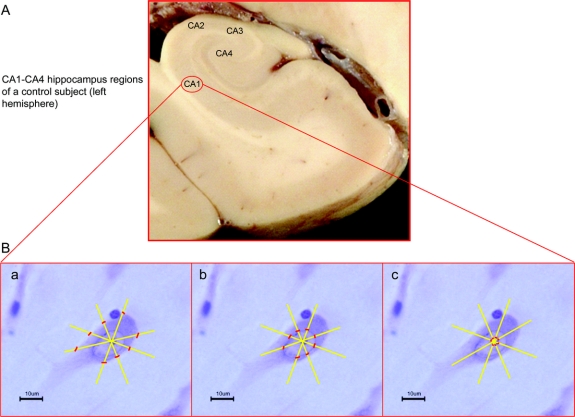
Methods: Design-based stereology was used to measure the volumes of neuronal cell bodies, nuclei, and nucleoli in the CA1 region of hippocampus (CA1). Four groups of subjects were compared: ASYMAD (n = 10), MCI (n = 5), AD (n = 10), and age-matched controls (n = 13). Linguistic ability assessed in early life was compared among all groups.
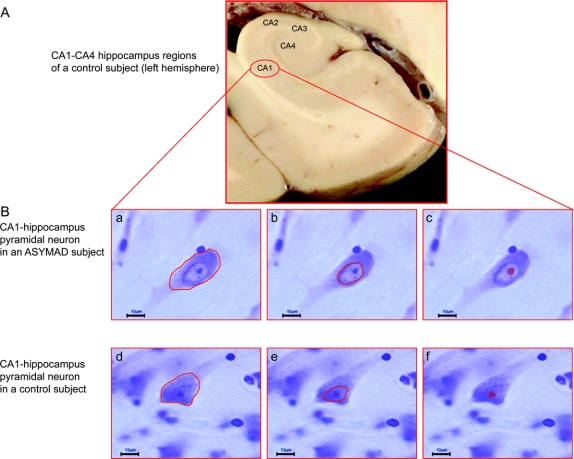
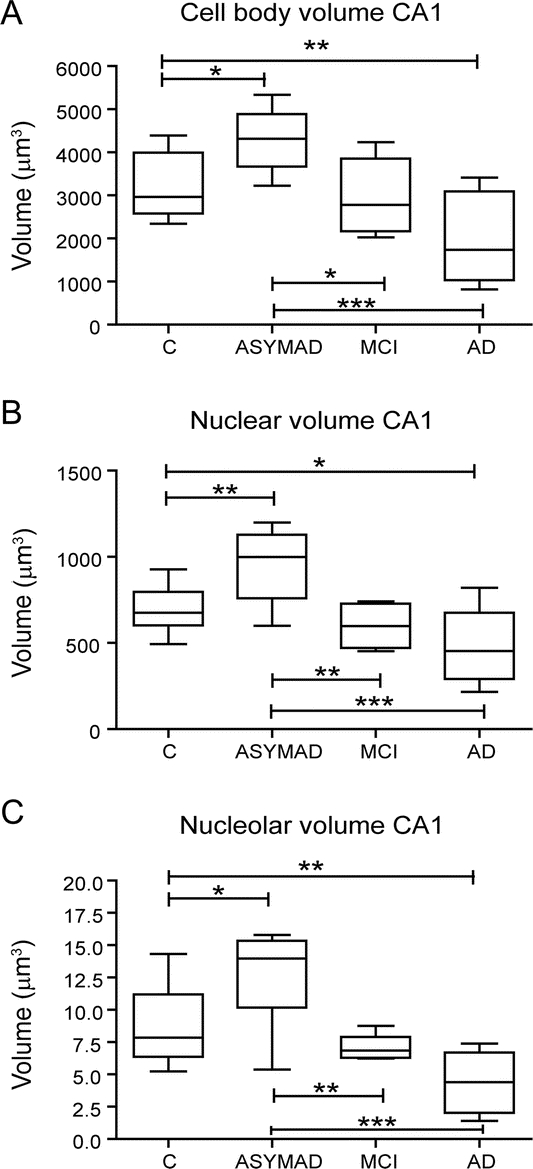
Results: A significant hypertrophy of the cell bodies (+44.9%), nuclei (+59.7%), and nucleoli (+80.2%) in the CA1 neurons was found in ASYMAD compared with MCI. Similar differences were observed with controls. Furthermore, significant higher idea density scores in early life were observed in controls and ASYMAD group compared to MCI and AD groups.
Conclusions: 1) Neuronal hypertrophy may constitute an early cellular response to Alzheimer disease (AD) pathology or reflect compensatory mechanisms that prevent cognitive impairment despite substantial AD lesions; 2) higher idea density scores in early life are associated with intact cognition in late life despite the presence of AD lesions.
Figures

Comment in
-
Compensating for Alzheimer lesions: evidence that size counts.Neurology. 2009 Sep 1;73(9):656-7. doi: 10.1212/WNL.0b013e3181b61b4c. Epub 2009 Jul 29. Neurology. 2009. PMID: 19641170 No abstract available.
References
-
- Petersen RC. Mild cognitive impairment as a diagnostic entity. J Intern Med 2004;256:183–194. - PubMed
-
- Tomlinson BE, Blessed G, Roth M. Observations on the brains of non-demented old people. J Neurol Sci 1968;7:331–356. - PubMed
-
- Katzman R, Terry R, DeTeresa R, et al. Clinical, pathological, and neurochemical changes in dementia: a subgroup with preserved mental status and numerous neocortical plaques. Ann Neurol 1988;23:138–144. - PubMed
-
- Lue LF, Brachova L, Civin WH, Rogers J. Inflammation, A beta deposition, and neurofibrillary tangle formation as correlates of Alzheimer’s disease neurodegeneration. J Neuropathol Exp Neurol 1996;55:1083–1088. - PubMed
-
- Price JL, Morris JC. Tangles and plaques in nondemented aging and “preclinical” Alzheimer’s disease. Ann Neurol 1999;45:358–368. - PubMed
Publication types
MeSH terms
Grants and funding
LinkOut - more resources
Full Text Sources
Medical
Miscellaneous
