


Introducing intermediate filaments: from discovery to disease
- PMID: 19587451
- PMCID: PMC2701876
- DOI: 10.1172/JCI38339
Introducing intermediate filaments: from discovery to disease
Abstract
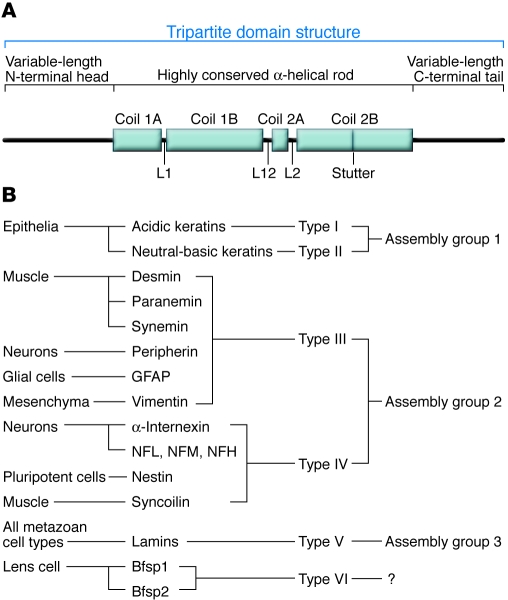
It took more than 100 years before it was established that the proteins that form intermediate filaments (IFs) comprise a unified protein family, the members of which are ubiquitous in virtually all differentiated cells and present both in the cytoplasm and in the nucleus. However, during the past 2 decades, knowledge regarding the functions of these structures has been expanding rapidly. Many disease-related roles of IFs have been revealed. In some cases, the molecular mechanisms underlying these diseases reflect disturbances in the functions traditionally assigned to IFs, i.e., maintenance of structural and mechanical integrity of cells and tissues. However, many disease conditions seem to link to the nonmechanical functions of IFs, many of which have been defined only in the past few years.
Figures
References
-
- Wilson, E.B. 1928.The cell in development and heredity . 3rd edition. Macmillan Company. New York, New York, USA. 1232 pp.
-
- Astbury W.T., Street A. X-ray studies of the structure of hair, wool, and related fibres. I. General. Philos. Trans. R. Soc. Lond. A. 1930;230:75–101. doi: 10.1098/rsta.1932.0003. - DOI
-
- Crick F.H. Is alpha-keratin a coiled coil? Nature. 1952;170:882–883. - PubMed
-
- Fraser R.D., Macrae T.P. The molecular configuration of alpha-keratin. J. Mol. Biol. 1961;3:640–647. - PubMed
Publication types
MeSH terms
Substances
LinkOut - more resources
Full Text Sources
Miscellaneous
