


Comment
doi: 10.1038/emboj.2009.132.
Nonconformity in ubiquitin compliance
Affiliations
- PMID: 19587678
- PMCID: PMC2711179
- DOI: 10.1038/emboj.2009.132
Item in Clipboard
Comment
Nonconformity in ubiquitin compliance
EMBO J.
.
No abstract available
Conflict of interest statement
The authors declare that they have no conflict of interest.
Figures
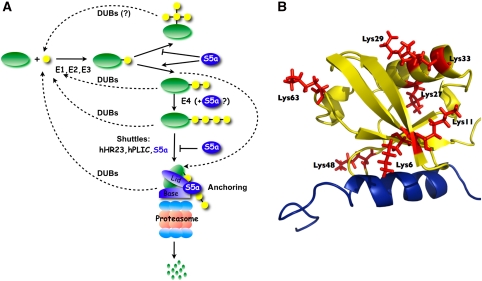
The ubiquitin-binding protein, S5a/Rpn10, trails ubiquitin conjugates along their trajectory. (A) A general scheme of the ubiquitin–proteasome pathway updated with new results described by Kim et al (2009) in this issue. Ubiquitination enzymes (E1, E2, and E3) conjugate the carboxy terminus of ubiquitin (yellow) to a lysine residue on a substrate (green) selected for degradation. Subsequent conjugation might be sequential, leading to extended polymeric ubiquitin (lower arrow), or simultaneous at multiple lysines on a single ubiquitin link forming branched chains (upward arrow). The presence of S5a (blue) during conjugation promotes extended chains over branched ones (Kim et al, 2009). Polyubiquitin-binding proteins, among them S5a, shuttle elongated chains to the proteasome (Elsasser et al, 2004; Grabbe and Dikic, 2009; Verma et al, 2004). However, S5a also imposes a threshold on substrate delivery by competing with other polyUb shuttles for proteasome binding (Matiuhin et al, 2008). In some cases (Kim et al, 2009), S5a might aid E3s in transfering the conjugates directly to the proteasome, bypassing the downstream steps. At the proteasome, S5a partakes in anchoring the substrate while it is processed and unfolded for proteolysis (Deveraux et al, 1994; Glickman et al, 1998). At any number of junctions, deubiquitinating enzymes shave or trim polyubiquitin chains, thereby reversing conjugation and enforcing quality control. (B) Structure of S5a UIM in complex with Ub based on published NMR structure (pdb 1YX6 (Walters et al, 2002), generated with Pymol). Hydrophobic residues on the UIM region of S5a (blue ribbon) interact with a patch of hydrophobic residues on Ub (yellow backbone), exposing most of the seven lysines on the far side of Ub. With the possible exception of Lys6 (and to a lesser extent Lys48), access to most lysines is not shielded on anchoring of a single Ub to S5a; therefore, S5a might restrict build-up of forked chains in another manner by co-ordinating access of components of the ubiquination machinery.
Comment on
-
S5a promotes protein degradation by blocking synthesis of nondegradable forked ubiquitin chains.EMBO J. 2009 Jul 8;28(13):1867-77. doi: 10.1038/emboj.2009.115. Epub 2009 Apr 23. EMBO J. 2009. PMID: 19387488 Free PMC article.
References
-
- Deveraux Q, Ustrell V, Pickart C, Rechsteiner M (1994) A 26S subunit that binds ubiquitin conjugates. J Biol Chem 269: 7059–7061 - PubMed
-
- Elsasser S, Chandler-Militello D, Muller B, Hanna J, Finley D (2004) Rad23 and Rpn10 serve as alternative ubiquitin receptors for the proteasome. J Biol Chem 279: 26817–26822 - PubMed
-
- Glickman MH, Rubin DM, Coux O, Wefes I, Pfeifer G, Cjeka Z, Baumeister W, Fried VA, Finley D (1998) A subcomplex of the proteasome regulatory particle required for ubiquitin-conjugate degradation and related to the COP9/Signalosome and eIF3. Cell 94: 615–623 - PubMed
-
- Grabbe C, Dikic I (2009) Functional roles of ubiquitin-like domain (ULD) and ubiquitin-binding domain (UBD) containing proteins. Chem Rev 109: 1481–1494 - PubMed
Publication types
MeSH terms
Substances
LinkOut - more resources
Full Text Sources
Molecular Biology Databases
