


doi: 10.1038/460197a.
Synthesis at the molecular frontier
Affiliations
- PMID: 19587760
- PMCID: PMC2857510
- DOI: 10.1038/460197a
Item in Clipboard
Synthesis at the molecular frontier
Nature.
.
Abstract
Driven by remarkable advances in the understanding of structure and reaction mechanisms, organic synthesis will be increasingly directed to producing bioinspired and newly designed molecules.
Figures
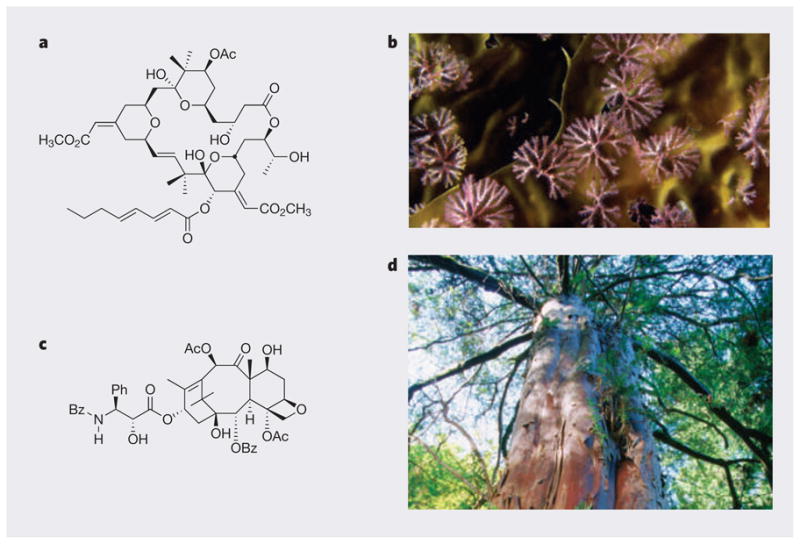
Bryostatin 1 (a) is putatively an antifeedant compound produced in the marine bryozoan Bugula neritina (b). This ornate natural product also has useful anticancer activity. Taxol (c) was isolated from the bark of the Pacific yew (d). It interferes with cytoskeletal dynamics to arrest the cell cycle and is used for the treatment of breast and ovarian cancers. Ac, acetyl; Bz, benzoyl; Ph, phenyl.
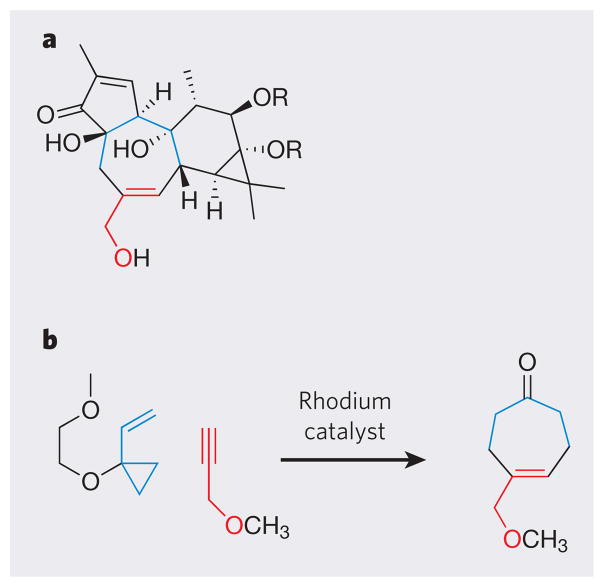
Examination of the structures of phorbol esters (a) — remarkably active tumour promoters used in studies of carcinogenesis — inspired the development of a new rhodium-catalysed reaction for the synthesis of seven-membered rings (b).
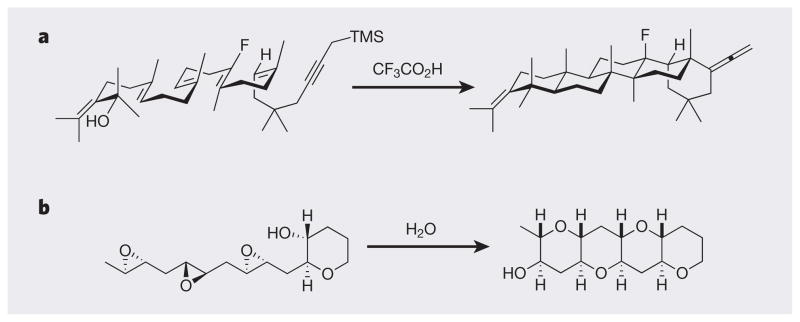
a, A biomimetic complexity-building process involving carbocation intermediates (not shown) provides a powerful strategy for terpene and steroid synthesis. b, A related process that can be used to access complex polyethers via an epoxide-opening cascade initiated by water.
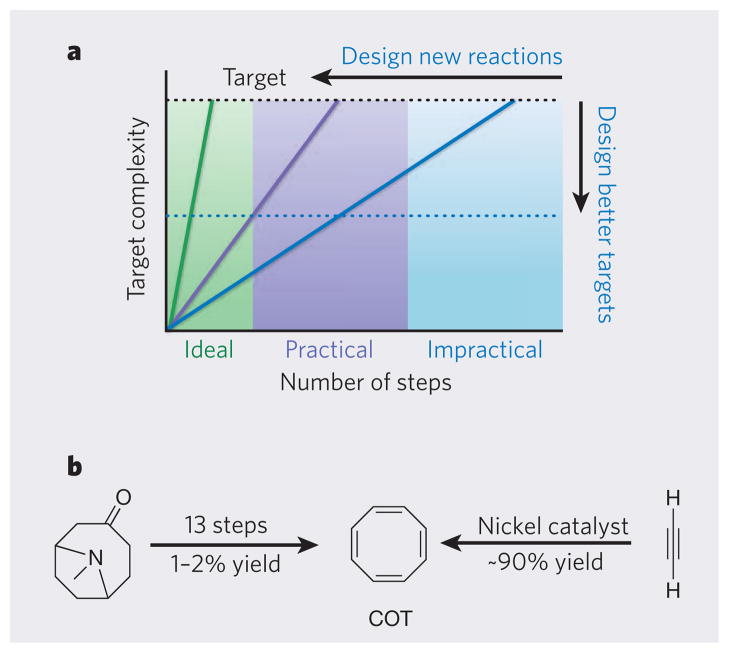
a, In an ideal synthesis (green line), a single step converts simple reactants into a structurally complex product. The syntheses of complex natural products often require too many steps (blue line), rendering them impractical for making large quantities of product. Reactions that generate a large increase in structural complexity per step allow shorter, more practical syntheses to be developed (purple line). For natural products that have valuable functional properties, another way to achieve step economy is to target structurally simpler compounds (blue dotted line) that have the same (or better) biological properties than the natural product. b, The first published synthesis of cyclooctatetraene (COT) required 13 steps, and the overall yield was very low. The discovery of a nickel-catalysed reaction allowed COT to be made in 90% yield in one step.
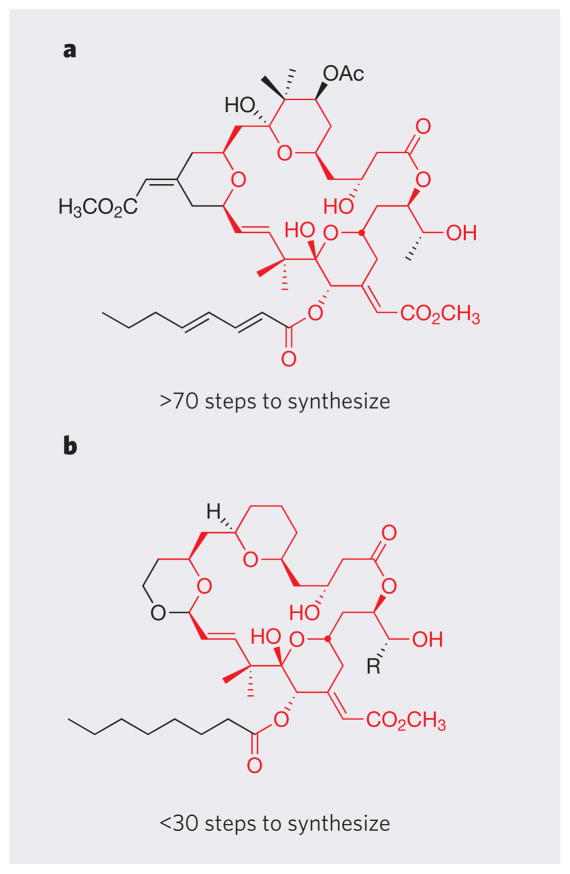
Currently available syntheses of bryostatin 1 (a) involve more than 70 steps, meaning that they will have no impact on supply and are as yet impractical for industrial-scale production of the compound. An analysis of the complex structural features of bryostatin suggested which parts of the molecule are essential for the compound’s biological activity and which parts are not. This allowed a structurally simpler analogue of bryostatin 1 to be designed (b), which was made in fewer than 30 steps. In cell and animal assays, this compound (and related designed analogues) performed as well as bryostatin in binding to cellular protein targets and in arresting the growth of cancer cells. Bonds and atom labels shown in red have been used to highlight parts of the two molecules that are identical.
References
-
- Seebach D. Angew Chem Int Edn. 1990;29:1320–1367.
-
- Cornforth JW. Aust J Chem. 1993;46:157–170.
-
- Wender PA, Miller BL. In: Connectivity Analysis and Multibond-forming Processes in Organic Synthesis: Theory and Applications. Hudlicky T, editor. JAI Press; 1993. pp. 27–66.
-
- Tietze LF. Domino Reactions in Organic Synthesis. Wiley-VCH; 2006. - PubMed
-
- Nicolaou KC. Tetrahedron. 2003;59:6683–6738.
MeSH terms
Substances
Grants and funding
LinkOut - more resources
Full Text Sources
