


Classification of event-related potentials associated with response errors in actors and observers based on autoregressive modeling
- PMID: 19587809
- PMCID: PMC2705112
- DOI: 10.2174/1874431100903010032
Classification of event-related potentials associated with response errors in actors and observers based on autoregressive modeling
Abstract
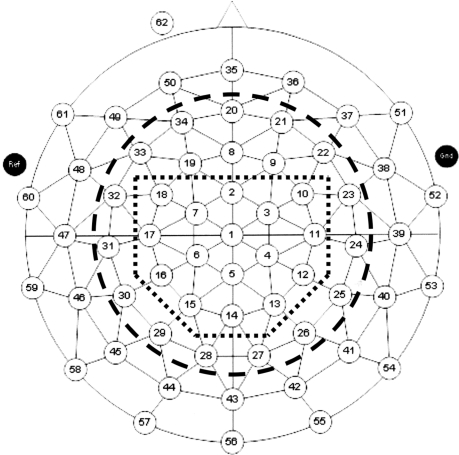
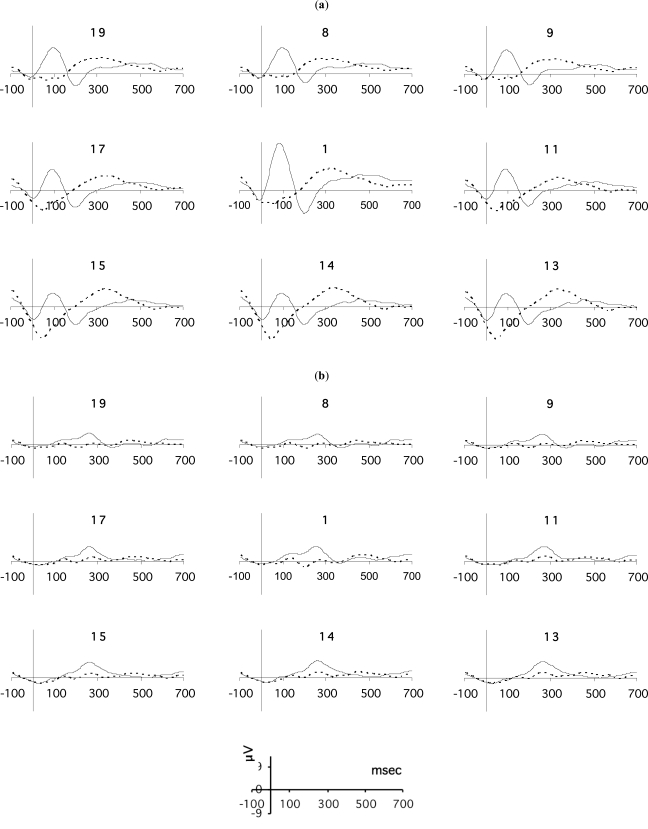
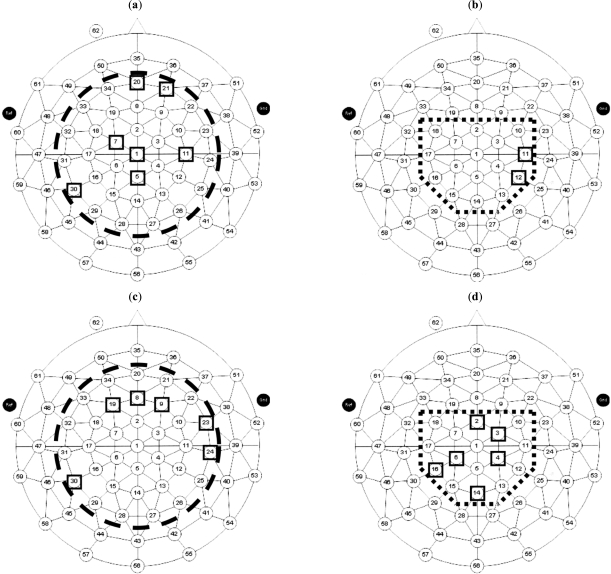
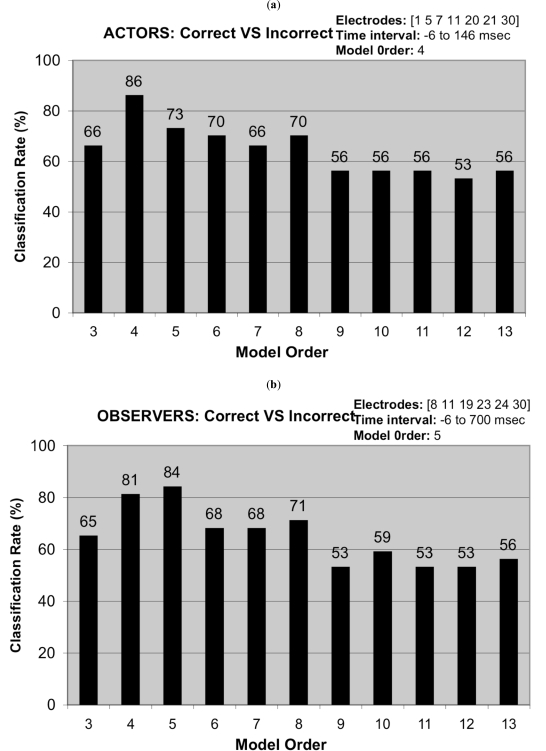
Event-Related Potentials (ERPs) provide non-invasive measurements of the electrical activity on the scalp related to the processing of stimuli and preparation of responses by the brain. In this paper an ERP-signal classification method is proposed for discriminating between ERPs of correct and incorrect responses of actors and of observers seeing an actor making such responses. The classification method targeted signals containing error-related negativity (ERN) and error positivity (Pe) components, which are typically associated with error processing in the human brain. Feature extraction consisted of Multivariate Autoregressive modeling combined with the Simulated Annealing technique. The resulting information was subsequently classified by means of an Artificial Neural Network (ANN) using back-propagation algorithm under the "leave-one-out cross-validation" scenario and the Fuzzy C-Means (FCM) algorithm. The ANN consisted of a multi-layer perceptron (MLP). The approach yielded classification rates of up to 85%, both for the actors' correct and incorrect responses and the corresponding ERPs of the observers. The electrodes needed for such classifications were situated mainly at central and frontal areas. Results provide indications that the classification of the ERN is achievable. Furthermore, the availability of the Pe signals, in addition to the ERN, improves the classification, and this is more pronounced for observers' signals. The proposed ERP-signal classification method provides a promising tool to study error detection and observational-learning mechanisms in performance monitoring and joint-action research, in both healthy and patient populations.
Figures

References
-
- Johnson R Jr., editor. Event-Related Brain Potentials and Cognition, Handbook of Neuropsychology. Vol. 10. Amsterdam, The Netherlands: Elsevier; 1995. (Sec. 14)
-
- Fabiani M, Gratton G, Coles M. Event-related potentials: Methods, theory, and applications. In: Cacioppo J, Tassinary L, Bernston G, editors. Handbook of psychophysiology. New York, NY: Cambridge University Press; 2000. pp. 53–84.
-
- Falkenstein M, Hohnsbein J, Hoormann J, Blanke L. Effects of errors in choice reaction tasks on the ERP under focused and divided attention. In: Brunia CHM, Gaillard AWK, Kok A, editors. Psychophysiological Brain Research. Tilburg, The Netherlands: Tilburg University Press; 1990. pp. 192–5.
-
- Gehring WJ, Goss B, Coles MGH, Meyer DE, Donchin E. A neural system for error detection and compensation. Psychol Sci. 1993;4:385–90.
-
- Falkenstein M, Hohnsbein J, Hoormann J, Blanke L. Effects of cross-modal divided attention on late ERP components: II. Error processing in choice reaction tasks. Electroencephalogr Clin Neurophysiol. 1991;78:447–55. - PubMed
LinkOut - more resources
Full Text Sources