


Interventions in the management of serum lipids for preventing stroke recurrence
- PMID: 19588332
- PMCID: PMC6664829
- DOI: 10.1002/14651858.CD002091.pub2
Interventions in the management of serum lipids for preventing stroke recurrence
Abstract
Background: Studies have shown that interventions which reduce total and low-density lipoprotein cholesterol levels also reduce coronary heart disease (CHD) and stroke events in those with a history of CHD. However, it is uncertain whether treatment to alter cholesterol levels can prevent recurrence of either stroke or subsequent cardiovascular events and whether differences in outcomes exist between classes of lipid-lowering therapy. This is an update of a Cochrane review first published in 2002.
Objectives: To investigate the effect of altering serum lipids pharmacologically for preventing subsequent cardiovascular disease and stroke recurrence in patients with a history of stroke.
Search strategy: We searched the Cochrane Stroke Group Trials Register (last searched December 2008), the Cochrane Central Register of Controlled Trials (The Cochrane Library Issue 3, 2008), MEDLINE (1966 to December 2008) and EMBASE (1980 to December 2008). We contacted pharmaceutical companies known to produce a lipid-lowering agent for information on relevant publications or unpublished work.
Selection criteria: Unconfounded randomised trials of participants aged 18 years and over with a history of stroke or transient ischaemic attack (TIA).
Data collection and analysis: Two review authors independently selected trials, assessed quality and extracted data.
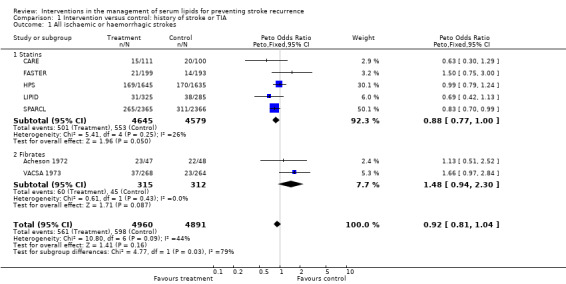
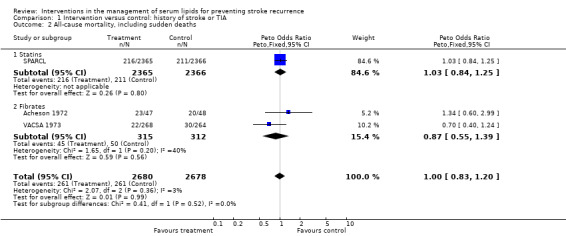
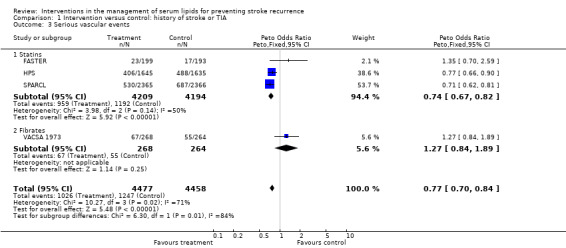
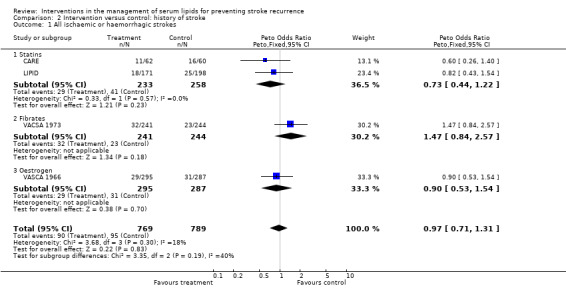
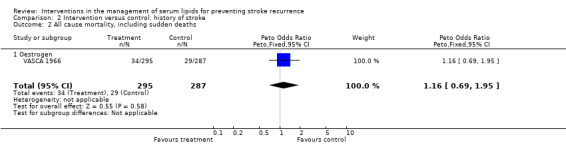
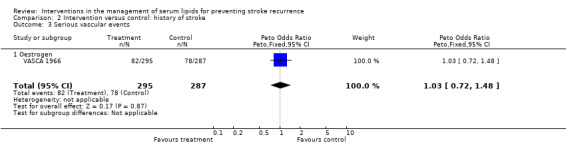
Main results: We included eight studies involving approximately 10,000 participants. The active interventions were pravastatin, atorvastatin, simvastatin, clofibrate, and conjugated oestrogen. Fixed-effect analysis showed no overall effect on stroke recurrence but statin therapy alone had a marginal benefit in reducing subsequent cerebrovascular events in those with a previous history of stroke or TIA (odds ratio (OR) 0.88, 95% confidence interval (CI) 0.77 to 1.00). There was no evidence that such intervention reduced all-cause mortality or sudden death (OR 1.00, 95% CI 0.83 to 1.20). Three statin trials showed a reduction in subsequent serious vascular events (OR 0.74, 95% CI 0.67 to 0.82).
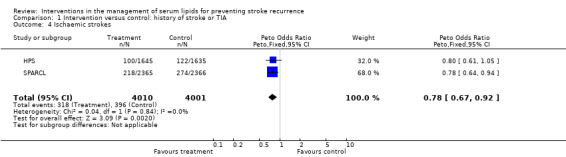
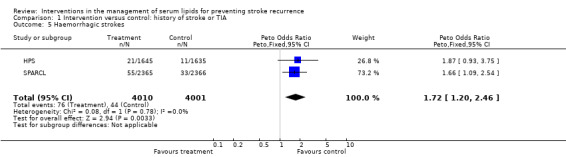
Authors' conclusions: There is evidence that statin therapy in patients with a history of ischaemic stroke or TIA significantly reduces subsequent major coronary events but only marginally reduces the risk of stroke recurrence. There is no clear evidence of beneficial effect from statins in those with previous haemorrhagic stroke and it is unclear whether statins should be started immediately post stroke or later. In view of this and the evidence of the benefit of statin therapy in those with a history of CHD, patients with ischaemic stroke or TIA, with or without a history of established CHD, should receive statins.
Conflict of interest statement
JF Potter has received honoraria from MSD, Sanofi and Boehringer Ingelheim for attending Advisory Boards or giving lectures at meetings sponsored by these companies.
Figures
Update of
-
Interventions in the management of serum lipids for preventing stroke recurrence.Cochrane Database Syst Rev. 2002;(3):CD002091. doi: 10.1002/14651858.CD002091. Cochrane Database Syst Rev. 2002. Update in: Cochrane Database Syst Rev. 2009 Jul 08;(3):CD002091. doi: 10.1002/14651858.CD002091.pub2. PMID: 12137644 Updated.
References
References to studies included in this review
Acheson 1972 {published data only}
CARE {published data only}
-
- Plehn JF, Davis BR, Sacks FM, Rouleau JL, Pfeffer MA, Bernstein V, et al. Reduction of stroke incidence after myocardial infarction with pravastatin: the Cholesterol and Recurrent Events (CARE) Study. Circulation 1999;99(2):216‐23. [MEDLINE: ] - PubMed
-
- Sacks FM, Pfeffer MA, Moye L, Brown LE, Hamm P, Cole TG, et al. Rationale and design of a secondary prevention trial of lowering normal plasma cholesterol levels after acute myocardial infarction: the Cholesterol and Recurrent Events Trial (CARE). American Journal of Cardiology 1991;68:1436‐46. - PubMed
-
- Sacks FM, Pfeffer MA, Moye LA, Rouleau JL, Rutherford JD, Cole TG, et al. The effect of pravastatin on coronary events after myocardial infarction in patients with average cholesterol levels. New England Journal of Medicine 1996;335:1001‐9. - PubMed
FASTER {published data only}
-
- Kennedy J, Eliasziw M, Hill MD, Buchan AM. The Fast Assessment of Stroke and Transient Ischemic Attack to Prevent Early Recurrence (FASTER) Trial. Seminars in Cerebrovascular Diseases and Stroke 2003;3(1):25‐30.
-
- Kennedy J, Hill MD, Ryckborst KJ, Eliasziw M, Demchuk AM, Buchan AM. Fast assessment of stroke and transient ischaemic attack to prevent early recurrence (FASTER): a randomised controlled pilot trial. Lancet Neurology 2007;6:961‐9. - PubMed
HPS {published data only}
-
- MRC/BHF Heart Protection Study. http://www.ctsu.ox.ac.uk/˜hps/.
-
- Collins R, Peto R. MRC/BHF Heart Protection Study. Stroke 1994;25(2):543.
-
- Heart Protection Study Collaborative Group. Effects of cholesterol‐lowering with simvastatin on stroke and other major vascular events in 20,536 people with cerebrovascular disease or other high‐risk conditions. Lancet 2004;363:757‐67.
-
- Heart Protection Study Collaborative Group. MRC/BHF Heart Protection Study of cholesterol lowering with simvastatin in 20,536 high‐risk individuals: a randomised placebo‐controlled trial. Lancet 2002;360:7‐22.
-
- Heart Protection Study Collaborative Group. The MRC/BHF Heart Protection Study: preliminary results. International Journal of Clinical Practice 2002;56(1):53‐6. - PubMed
LIPID {published data only}
-
- Kirby A. Personal communication. Unpublished.
-
- The LIPID Study Group. Long‐term effectiveness and safety of pravastatin in 9014 patients with coronary heart disease and average cholesterol concentrations: the LIPID trial follow‐up. Lancet 2002;359:1379‐87. - PubMed
-
- White HD, Simes J, Anderson NE, Hankey GJ, Watson JDG, Hunt D, et al. Pravastatin therapy and the risk of stroke. New England Journal of Medicine 2000;343(5):317‐26. - PubMed
SPARCL {published data only}
-
- Amarenco P, Bogousslavsky J, Callahan A, Goldstein L, Hennerici M, Sillesen H, et al. Effect of atorvastatin compared with placebo on cerebrovascular end points in patients with previous stroke or transient ischemic attack ‐ The SPARCL Study. Cerebrovascular Diseases 1999;9 Suppl 1:108.
-
- SPARCL Investigators. Design and baseline characteristics of the Stroke Prevention by Aggressive Reduction in Cholesterol Levels (SPARCL) study. Cerebrovascular Diseases 2003;16:389‐95. - PubMed
-
- SPARCL Investigators. High‐dose atorvastatin after stroke or transient ischemic attack. New England Journal of Medicine 2006;355(6):549‐59. [MEDLINE: ] - PubMed
-
- Welch KMA. Stroke prevention by aggresive reduction in cholesterol levels (SPARCL). Stroke 2000;31(11):2541.
VACSA 1973 {published data only}
-
- Hirsch SB, Wechsler AF, Tourtellotte WW. Clofibrate for the treatment of occlusive cerebrovascular disease. New England Journal of Medicine 1972;287(13):671. [MEDLINE: ] - PubMed
-
- The Veterans Administration Cooperative Study Group. The treatment of cerebrovascular disease with clofibrate. Final report of the Veterans Administration Cooperative Study of Atherosclerosis, Neurology Section. Stroke 1973;4:684‐93. [MEDLINE: ] - PubMed
VASCA 1966 {published data only}
-
- The Veterans Administration Cooperative Study of Atherosclerosis. An evaluation of estrogenic substances in the treatment of cerebral vascular disease. Circulation 1966;33(5 Suppl):II3‐9. [MEDLINE: ] - PubMed
References to ongoing studies
J‐STARS {published data only}
-
- Kohriyama T, Nomura E, Matsumoto M, Ohtsuki T. J‐STARS (Japan Statin Treatment Against Recurrent Stroke). Nippon Rinsho ‐ Japanese Journal of Clinical Medicine 2006;64 Suppl 7:511‐8. - PubMed
Additional references
ALLHAT 2002
-
- ALLHAT Collaborative Research Group. Major cardiovascular events in hypertensive patients randomized to doxazosin vs chlorthalidone: The Antihypertensive and Lipid‐Lowering Treatment to Prevent Heart Attack Trial (ALLHAT). Journal of the American Medical Association 2002;288(23):2998‐3007.
ASCOT 2003
-
- Sever PS, Dahlof B, Poulter NR, for the ASCOT investigators. Prevention of coronary and stroke events with atorvastatin in hypertensive patients who have average or lower‐than‐average cholesterol concentrations, in the Anglo‐Scandinavian Cardiac Outcomes Trial ‐ Lipid Lowering Arm (ASCOT‐LLA): a multicentre randomized controlled trial. Lancet 2003;361:1149‐58. - PubMed
Atkins 1993
-
- Atkins D, Psaty BM, Koepsell TD, Longstreth WT, Larson EB. Cholesterol reduction and the risk for stroke in men. A meta‐analysis of randomized, controlled trials. Annals of Internal Medicine 1993;199(2):136‐45. [MEDLINE: ] - PubMed
Blauw 1997
-
- Blauw GJ, Lagaay AM, Smelt AHM, Westendorp RGJ. Stroke, statins, and cholesterol. A meta‐analysis of randomized, placebo‐controlled, double‐blind trials with HMG‐CoA reductase inhibitors. Stroke 1997;28(5):946‐50. [MEDLINE: ] - PubMed
Bucher 1998
-
- Bucher HC, Griffith LE, Guyatt GH. Effect of HMGcoA reductase inhibitors on stroke: a meta‐analysis of randomized, controlled trials. Annals of Internal Medicine 1998;128(2):89‐95. [MEDLINE: ] - PubMed
Butterworth 1997
-
- Butterworth RJ, Marshall WJ, Bath PMW. Changes in serum lipid measurements following acute ischemic stroke. Cerebrovascular Diseases 1997;7:10‐3.
Byington 2001
-
- Byington RP, Davis BR, Plehn JF, White HD, Baker J, Cobbe SM, et al. Reduction of stroke events with Pravastatin: the Prospective Pravastatin Pooling (PPP) Project. Circulation 2001;103(3):387‐92. - PubMed
Candelise 1986
-
- Candelise L, Vigotti M, Fieschi C, Brambilla GL, Bono G, Conforti P, et al. Italian multicenter study on reversible cerebral ischemic attacks: VI ‐ prognostic factors and follow‐up results. Stroke 1986;17(5):842‐8. [MEDLINE: ] - PubMed
Crouse 1997
-
- Crouse JR 3rd, Byington RP, Hoen HM, Furberg CD. Reductase inhibitor monotherapy and stroke prevention. Archives of Internal Medicine 1997;157(12):1305‐10. [MEDLINE: ] - PubMed
CTT 2005
-
- Cholesterol Treatment Trialists' (CTT) Collaboration. Efficacy and safety of cholesterol‐lowering treatment: prospective meta‐analysis of data from 90,056 participants in 14 randomised trials of statins. Lancet 2005;366:1267‐78. [MEDLINE: ] - PubMed
Di Mascio 2000
-
- Mascio R, Marchioli R, Tognoni G. Cholesterol reduction and stroke occurrence: an overview of randomized clinical trials. Cerebrovacular Diseases 2000;10:85‐92. - PubMed
Dyker 1997
Eliasziw 1995
-
- Eliasziw M, Streifler JY, Spence JD, Fox AJ, Hachinski VC, Barnett HJM. Prognosis for patients following a transient ischemic attack with and without a cerebral infarction on brain CT. Neurology 1995;45:428‐31. [MEDLINE: ] - PubMed
ESCHD 1998
-
- Eastern Stroke and Coronary Heart Disease Collaborative Research Group. Blood pressure, cholesterol, and stroke in eastern Asia. Lancet 1998;352:1801‐7. - PubMed
Hebert 1995
-
- Hebert PR, Gaziano JM, Hennekens CH. An overview of trials of cholesterol lowering and risk of stroke. Archives of Internal Medicine 1995;155(1):50‐5. [MEDLINE: ] - PubMed
Hebert 1997
-
- Hebert PR, Gaziano JM, Chan KS, Hennekens CH. Cholesterol lowering with statin drugs, risk of stroke, and total mortality. An overview of randomized trials. Journal of the American Medical Association 1997;278(4):313‐21. [MEDLINE: ] - PubMed
JBS2 2005
Jorgensen 1997
-
- Jorgensen HS, Nakayama H, Reith J, Raaschou HO, Olsen TS. Stroke recurrence: predictors, severity, and prognosis. The Copenhagen Stroke Study. Neurology 1997;48:891‐5. [MEDLINE: ] - PubMed
Law 2003
Marshall 1961
McNaughton 2002
-
- McNaughton H. Lowering lipids after a stroke or transient ischaemic attack. Hospital Medicine 2002;63(2):88‐91. - PubMed
Mendez 1987
-
- Mendez I, Hachinski V, Wolfe B. Serum lipids after stroke. Neurology 1987;37:507‐11. [MEDLINE: ] - PubMed
Moroney 1997
-
- Moroney JT, Bagiella E, Tatemichi TK, Paik MC, Stern Y, Desmond DW. Dementia after stroke increases the risk of long‐term stroke recurrence. Neurology 1997;48:1317‐25. [MEDLINE: ] - PubMed
Neau 1997
-
- Neau J‐P, Ingrand P, Couderq C, Rosier MP, Bailbe M, Dumas P, et al. Recurrent intracerebral hemorrhage. Neurology 1997;49:106‐13. [MEDLINE: ] - PubMed
Passero 1995
-
- Passero S, Burgalassi L, D'Andrea P, Battistini N. Recurrence of bleeding in patients with primary intracerebral hemorrhage. Stroke 1995;26(7):1189‐92. [MEDLINE: ] - PubMed
Prencipe 1998
-
- Prencipe M, Culasso F, Rasura M, Anzini A, Beccia M, Cao M, et al. Long‐term prognosis after a minor stroke. 10‐year mortality and major stroke recurrence rates in a hospital‐based cohort. Stroke 1998;29:126‐32. [MEDLINE: ] - PubMed
PROSPER 2002
-
- Shepherd J, Blauw GJ, Murphy MB, Bollen ELEM, Buckley BM, Cobbe SM, et al. Pravastatin in elderly individuals at risk of vascular disease (PROSPER): a randomised controlled trial. Lancet 2002;360:1623‐30. - PubMed
PSC 2007
-
- Prospective Studies Collaboration. Blood cholesterol and vascular mortality by age, sex, and blood pressure: a meta‐analysis of individual data from 61 prospective studies with 55000 vascular deaths. Lancet 2007;370:1829‐39. - PubMed
RevMan 2008 [Computer program]
-
- The Nordic Cochrane Centre. The Cochrane Collaboration. Review Manager (RevMan). Version 5.0. Copenhagen: The Nordic Cochrane Centre. The Cochrane Collaboration, 2008.
Sandercock 2001
-
- Sandercock P. Statins for stroke prevention?. Lancet 2001;357:1548‐9. - PubMed
Sorensen 1989
-
- Sorensen PS, Marquardsen J, Pedersen H, Heltberg A, Munck O. Long‐term prognosis and quality of life after reversible cerebral ischemic attacks. Acta Neurologica Scandinavica 1989;79:204‐13. [MEDLINE: ] - PubMed
van Latum 1995
-
- Latum JC, Koudstaal PJ, Venables GS, Gijn J, Kappelle LJ, Algra A. Predictors of major vascular events in patients with a transient ischemic attack or minor ischemic stroke and with nonrheumatic atrial fibrillation. Stroke 1995;26(5):801‐6. [MEDLINE: ] - PubMed
Vauthey 2000
-
- Vauthey C, Freitas GR, Melle G, Devuyst G, Bogousslavsky J. Better outcome after stroke with higher serum cholesterol levels. Neurology 2000;54(10):1944‐9. - PubMed
Williams 2004
-
- Williams B, Poulter NR, Brown MJ, Davis M, McInnes GT, Potter JF, et al. Guidelines for management of hypertension: report of the fourth working party of the British Hypertension Society, 2004 ‐ BHS IV. Journal of Human Hypertension 2004;18(3):139‐85. - PubMed
References to other published versions of this review
Manktelow 2002
-
- Manktelow BN, Gillies C, Potter J. Interventions in the management of serum lipids for preventing stroke recurrence. Cochrane Database of Systematic Reviews 2002, Issue 3. [Art. No.: CD002091. DOI: 10.1002/14651858.CD002091] - PubMed
Publication types
MeSH terms
Substances
LinkOut - more resources
Full Text Sources
Other Literature Sources
Medical
