


Therapeutic interventions for disease progression in Huntington's disease
- PMID: 19588392
- PMCID: PMC7390161
- DOI: 10.1002/14651858.CD006455.pub2
Therapeutic interventions for disease progression in Huntington's disease
Abstract
Background: Huntington's disease (HD) is an autosomal dominant neurodegenerative disease with an average onset between the fourth and fifth decade of life; it leads to death 15 to 20 years after the onset of symptoms. Although several drugs seem effective in controlling the incapacitating manifestations of HD, no specific therapy is known. The present review aims at analysing the best available data on therapeutic interventions investigated with the goal of modifying the progression of the disease as measured in terms of survival, disability or progression of HD core symptoms.
Objectives: Evaluate the effectiveness of therapeutic interventions aimed at modifying disease progression in HD.
Search strategy: The search strategy developed for the Movement Disorders Group was undertaken. The Cochrane Controlled Trials Register, Medline, EMBASE and Clinical Trials Database of the United States National Institute of Health were thoroughly searched until December 2007.
Selection criteria: All randomised, double-blinded, placebo-controlled clinical trials of therapeutics investigated with the goal of modifying disease progression in HD were included. Participants should have genetically confirmed diagnosis of HD or compatible symptoms and a family history. Trials had a follow-up duration of more than three months and at least ten participants. All pharmacological and non-pharmacological interventions were included.
Data collection and analysis: Two reviewers independently assessed the eligibility of identified trials. The methodological quality was assessed and eligible data were registered onto standardised forms. An intention-to-treat analysis was conducted, when feasible. If data were not available in the original publication, the principal investigator of the trial was contacted for further information. A meta-analysis was to be conducted when possible; otherwise, a descriptive summary of the results was provided. The software Revman 5.0.15 was used for statistical analysis.
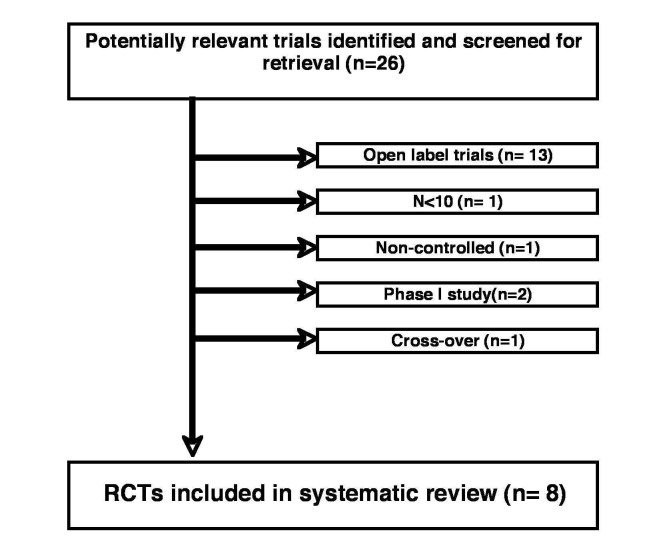
Main results: Eight trials were included involving a total of 1366 HD patients. The duration of the studies ranged between 30 and 144 weeks (median: 52 weeks). The following interventions were selected: vitamin E, Idebenone, Baclofen, Lamotrigine, creatine, coenzyme Q10 + Remacemide, ethyl-eicosapentanoic acid and Riluzole. No trials produced positive results for the selected efficacy outcome measures. A descriptive summary of the trials is provided. The selected interventions were found to be generally safe and well tolerated.
Authors' conclusions: Only pharmacological interventions were included and none proved to be effective as a disease-modifying therapy for HD. Further trials with greater methodological quality should be conducted using more sensitive biological markers. Pre-symptomatic mutation carriers should be included in future studies.
Conflict of interest statement
Mestre T, Ferreira J, Coelho M, Rosa MM were investigators in a clinical trial to investigate the efficacy of ethyl‐eicosapentanoic acid for the treatment of HD.
Update of
References
References to studies included in this review
CARE‐HD {published data only}
-
- The Huntington study group. A randomized, placebo‐controlled trial of coenzyme Q10 and remacemide in Huntington's disease. Neurology 2001;57(3):397‐404. - PubMed
EHDN {published data only}
-
- European Huntington Disease Initiative Study Group. Riluzole in Huntington´s disease: a 3 year, randomised controlled study. Annals of Neurology 2007;62(3):262‐272. - PubMed
Kremer B {published data only}
-
- Kremer B, Clark CM, Almqvist EW, Raymond LA, Graf P, Jacova C, et al. Influence of lamotrigine on progression of early Huntington disease: a randomized clinical trial. Neurology 1999;53(5):1000‐1011. - PubMed
Peyser CE {published data only}
-
- Peyser CE, Folstein M, Chase GA, Starkstein S, Brandt J, Cockrell JR, et al. Trial of d‐alpha‐tocopherol in Huntington's disease. Am J Psychiatry 1995;152(12):1771‐1775. - PubMed
Puri BK {published and unpublished data}
-
- Puri BK, Leavitt BR, Hayden MR, Ross CA, Rosenblatt A, Greenamyre JT, et al. Ethyl‐EPA in Huntington disease: a double‐blind, randomized, placebo‐controlled trial. Neurology 2005;65(2):286‐92. - PubMed
Ranen NG {published data only}
-
- Ranen NG, Peyser CE, Coyle JT, Bylsma FW, Sherr M, Day L, et al. A controlled trial of idebenone in Huntington's disease. Mov Disord 1996;11(5):549‐554. - PubMed
Shoulson I {published data only}
-
- Shoulson I, Odoroff C, Oakes D, Behr J, Goldblatt D, Caine E, et al. A controlled clinical trial of baclofen as protective therapy in early Huntington's disease. Ann Neurol 1989;25(3):252‐259. - PubMed
Verbessem P {published data only}
-
- Verbessem P, Lemiere J, Eijnde BO, Swinnen S, Vanhees L, Leemputte M, et al. Creatine supplementation in Huntington's disease: a placebo‐controlled pilot trial. Neurology 2003;61(7):925‐930. - PubMed
References to studies excluded from this review
Bachoud‐Lévi AC (a) {published data only}
-
- Bachoud‐Lévi A, Bourdet C, Brugières P, Nguyen JP, Grandmougin T, Haddad B, Jény R, Bartolomeo P, Boissé MF, Barba GD, Degos JD, Ergis AM, Lefaucheur JP, Lisovoski F, Pailhous E, Rémy P, Palfi S, Defer GL, Cesaro P, Hantraye P, Peschanski M. Safety and tolerability assessment of intrastriatal neural allografts in five patients with Huntington's disease. Exp Neurol 2000;161(1):194‐202. - PubMed
Bachoud‐Lévi AC (b) {published data only}
-
- Bachoud‐Lévi AC, Rémy P, Nguyen JP, Brugières P, Lefaucheur JP, Bourdet C, Baudic S, Gaura V, Maison P, Haddad B, Boissé MF, Grandmougin T, Jény R, Bartolomeo P, Dalla Barba G, Degos JD, Lisovoski F, Ergis AM, Pailhous E, Cesaro P, Hantraye P, Peschanski M. Motor and cognitive improvements in patients with Huntington's disease after neural transplantation. Lancet 2000;356(9246):1975‐9. - PubMed
Bachoud‐Lévi AC (c) {published data only}
-
- Bachoud‐Lévi AC, Gaura V, Brugières P, Lefaucheur JP, Boissé MF, Maison P, Baudic S, Ribeiro MJ, Bourdet C, Remy P, Cesaro P, Hantraye P, Peschanski M. Effect of fetal neural transplants in patients with Huntington's disease 6 years after surgery: a long‐term follow‐up study. Lancet Neurology 2006;5(4):303‐309. - PubMed
Beister A {published data only}
-
- Beister A, Kraus P, Kuhn W, Dose M, Weindl A, Gerlach M. The N‐methyl‐D‐aspartate antagonist memantine retards progression of Huntington's disease. J Neural Transm Suppl 2004;68:117‐22. - PubMed
Bender A {published data only}
-
- Bender A, Auer DP, Merl T, Reilmann R, Saemann P, Yassouridis A, Bender J, Weindl A, Dose M, Gasser T, Klopstock T. Creatine supplementation lowers brain glutamate levels in Huntington's disease. J Neurol. 2005;252(1):36‐41. - PubMed
Bloch J {published data only}
-
- Bloch J, Bachoud‐Lévi AC, Déglon N, Lefaucheur JP, Winkel L, Palfi S, Nguyen JP, Bourdet C, Gaura V, Remy P, Brugières P, Boisse MF, Baudic S, Cesaro P, Hantraye P, Aebischer P, Peschanski M. Neuroprotective gene therapy for Huntington's disease, using polymer‐encapsulated cells engineered to secrete human ciliary neurotrophic factor: results of a phase I study. Hum Gene Ther 2004;15(10):968‐75. - PubMed
Bonelli RM (a) {published data only}
-
- Bonelli RM, Heuberger C, Reisecker F. Minocycline for Huntington's disease: an open label study. Neurology. 2003;60(5):883‐4. - PubMed
Bonelli RM (b) {published data only}
-
- Bonelli RM, Hödl AK, Hofmann P, Kapfhammer HP. Neuroprotection in Huntington's disease: a 2‐year study on minocycline. Int Clin Psychopharmacol 2004;19(6):337‐42. - PubMed
Caro A {published data only}
Dubinsky R {published data only}
-
- Dubinsky R, Gray C. CTYE‐I‐HD: phase I dose finding and tolerability study of cysteamine (Cystagon) in Huntington's disease. Mov Disord 2006;21(4):530‐533.. - PubMed
Feigin A {published data only}
-
- Feigin A, Kieburtz K, Como P, Hickey C, Claude K, Abwender D, Zimmerman C, Steinberg K, Shoulson I. Assessment of coenzyme Q10 tolerability in Huntington's disease. Mov Disord 1996;11(3):312‐323. - PubMed
Fink JS {published data only}
-
- Fink JS, Schumacher JM, Ellias SL, Palmer EP, Saint‐Hilaire M, Shannon K, Penn R, Starr P, VanHorne C, Kott HS, Dempsey PK, Fischman AJ, Raineri R, Manhart C, Dinsmore J, Isacson O. Porcine xenografts in Parkinson's disease and Huntington's disease patients:preliminary results. Cell Transplant 2000;9(2):273‐8. - PubMed
Hauser RA {published data only}
-
- Hauser RA, Furtado S, Cimino CR, Delgado H, Eichler S, Schwartz S, Scott D, Nauert GM, Soety E, Sossi V, Holt DA, Sanberg PR, Stoessl AJ, Freeman TB. Bilateral human fetal striatal transplantation in Huntington's disease. Neurology 2002;58(5):687‐95. - PubMed
Puri BK (b) {published data only}
-
- Puri BK, Bydder GM, Counsell SJ, Corridan BJ, Richardson AJ, Hajnal JV, Appel C, Mckee HM, Vaddadi KS, Horrobin DF. MRI and neuropsychological improvement in Huntington disease following ethyl‐EPA treatment. Neuroreport. 2002;13(1):123‐6.. - PubMed
Rosas HD {published data only}
-
- Rosas HD, Koroshetz WJ, Jenkins BG, Chen YI, Hayden DL, Beal MF, Cudkowicz ME. Riluzole therapy in Huntington's disease (HD). Mov Disord 1999;14(2):326‐30. - PubMed
Tabrizi SJ (a) {published data only}
-
- Tabrizi SJ, Blamire AM, Manners DN, Rajagopalan B, Styles P, Schapira AH, Warner TT. Creatine therapy for Huntington's disease: clinical and MRS findings in a 1‐year pilot study. Neurology 2003;Jul 8;61(1):141‐2.. - PubMed
Tabrizi SJ (b) {published data only}
-
- Tabrizi SJ, Blamire AM, Manners DN, Rajagopalan B, Styles P, Schapira AH, Warner TT. High‐dose creatine therapy for Huntington disease: a 2‐year clinical and MRS study. Neurology 2005;64(9):1655‐6. - PubMed
Thomas M {published data only}
-
- Thomas M, Ashizawa T, Jankovic J. Minocycline in Huntington´s disease: a pilot study. Movement disorders 2004;20(4):510‐511. - PubMed
References to studies awaiting assessment
References to ongoing studies
2CARE {published data only}
-
- Coenzyme Q10 in Huntington's Disease.. Ongoing study March 2008..
DOMINO {published data only}
-
- A Multi‐Center, Double‐Blind, Pilot Study of Minocycline in Huntington's Disease.. Ongoing study January 2006..
Additional references
Bonelli 2004
-
- Bonelli, RM, Wenning GK, Kapfhammer HP. Huntington's disease: present treatments and future therapeutic modalities. Int Clin Psychopharmacol 2004;19 (2):51‐62. - PubMed
Cochrane 2008
HSG 1996
Jadad 1996
-
- Jadad AR, Moore RA, Carroll D, Jenkinson C, Reynolds DJ, Gavaghan DJ, McQuay HJ. Assessing the quality of reports of randomized clinical trials: is blinding necessary?. Control Clin Trials 1996;17((1)):1‐12. - PubMed
Kieburtz 1994
Lanska 1995
-
- Lanska, DJ. George Huntington and hereditary chorea. J Child Neurol 1995;10 (1):46‐8. - PubMed
Miraxion‐Europe
-
- European Huntingotn Disease Network. World Congress in Huntington's disease. 2007.
Paulsen JS
-
- Paulsen JS, Langbehn DR, Stout JC, Aylward E, Ross CA, Nance M, Guttman M, Johnson S, McDonald M, Beglinger LJ, Duff K, Kayson E, Biglan K, Shoulson I, Oakes D, Hayden M. Detection of Huntington's disease decades before diagnosis: The Predict HD study. J Neurol Neurosurg Psychiatry 2008;79(8):874‐80. - PMC - PubMed
Revman 2008
-
- Review Manager (RevMan) [MacOSX]. Version 5.0. Copenhagen: The Nordic Cochrane Centre, The Cochrane Collaboration, 2008.
Ropper 2005
-
- Ropper AH, Brown RH. Principles of Neurology. 8th Edition. McGraw‐Hill, 2005.
TH s DCR Group 1993
-
- Group, TH.s.DCR. A novel gene containing a trinucleotide repeat that is expanded and unstable on Huntington's disease chromosome. Cell 1993;72:971‐83. - PubMed
TRACK‐HD
-
- http://www.track‐hd.net.
TREND‐HD
-
- The Huntington Study group. TREND‐HD ‐ A Trial of Ethyl‐EPA (Miraxion™) in Treating Mild to Moderate Huntington's Disease. World Congress in Huntington's disease. 2007.
Publication types
MeSH terms
LinkOut - more resources
Full Text Sources
Other Literature Sources
Medical
