


Mild decarboxylative allylation of coumarins
- PMID: 19588967
- PMCID: PMC2878741
- DOI: 10.1021/ol901288r
Mild decarboxylative allylation of coumarins
Abstract
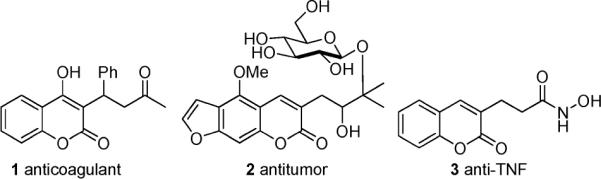
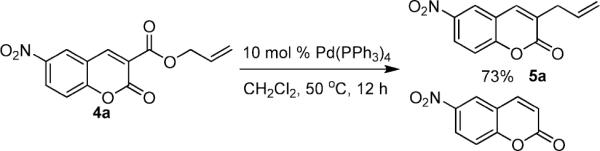
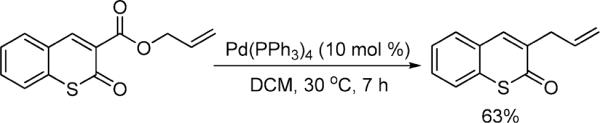
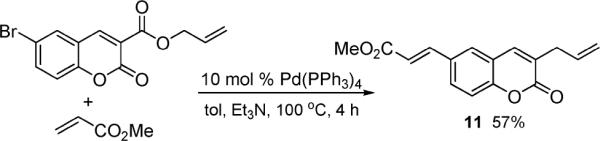
Allyl esters of 3-carboxylcoumarins undergo facile decarboxylative coupling at just 25-50 degrees C. This represents the first extension of decarboxylative C-C bond-forming reactions to the coupling of aromatics with sp(3)-hybridized electrophiles. Finally, the same concept can be applied to the sp(2)-sp(3) couplings of pyrones and flavones. Thus, a variety of biologically important heteroaromatics can be readily functionalized without the need for strong bases or stoichiometric organometallics that are typically required for more standard cross-coupling reactions.
Figures
References
-
- Shimizu I, Yamada T, Tsuji J. Tetrahedron Lett. 1980:3199.
- Tsuda T, Chujo Y, Nishi S.-i., Tawara K, Saegusa T. J. Am. Chem. Soc. 1980;102:6381.
- Rayabarapu DK, Tunge JA. J. Am. Chem. Soc. 2005;127:13510. - PubMed
- Waetzig SR, Rayabarapu DK, Weaver JD, Tunge JA. Angew. Chem., Int. Ed. 2006;45:4977. - PubMed
- Waetzig SR, Tunge JA. J. Am. Chem. Soc. 2007;129:4138. - PubMed
- Weaver JD, Tunge JA. Org. Lett. 2008;10:4657. - PMC - PubMed
- Mohr JT, Behenna DC, Harned AW, Stoltz BM. Angew. Chem., Int. Ed. 2005;44:6924. - PubMed
- Trost BM, Bream RN, Xu J. Angew. Chem., Int. Ed. 2006;45:3109. - PubMed
-
-
The decarboxylative allylation of silylenol ethers has been reported. Tsuji J, Ohashi Y, Minami O. Tetrahedron Lett. 1987;28:2397.. Snider BB, Buckman BO. J. Org. Chem. 1992;57:4883.. Coates RM, Sandefur LO, Smillie RD. J. Am. Chem. Soc. 1975;97:1619..
-
-
- Horton DA, Bourne GT, Smythe ML. Chem. Rev. 2003;103:893. - PubMed
- Estevez-Craun A, Gonzalez AG. Nat. Prod. Rep. 1997:465. - PubMed
- Ngameni B, Touaibia M, Patnam R, Belkaid A, Sonna P, Ngadjui BT, Annabi B, Roy R. Phytochemistry. 2006;67:2573. - PubMed
- Chun K, Park S-K, Kim HM, Choi Y, Kim M-H, Park C-H, Joe B-Y, Chun TG, Choi H-M, Lee H-Y, Hong SH, Kim MS, Nam K-Y, Han G. Biorg. Med. Chem. 2008;16:530. - PubMed
Publication types
MeSH terms
Substances
Grants and funding
LinkOut - more resources
Full Text Sources
