. 2009 Sep 25;284(39):26831-8.
doi: 10.1074/jbc.M109.009498. Epub 2009 Jul 9.

Epidithiodiketopiperazines block the interaction between hypoxia-inducible factor-1alpha (HIF-1alpha) and p300 by a zinc ejection mechanism

Affiliations

Epidithiodiketopiperazines block the interaction between hypoxia-inducible factor-1alpha (HIF-1alpha) and p300 by a zinc ejection mechanism

Kristina M Cook et al. J Biol Chem. .

Abstract

The hypoxic response in humans is regulated by the hypoxia-inducible transcription factor system; inhibition of hypoxia-inducible factor (HIF) activity has potential for the treatment of cancer. Chetomin, a member of the epidithiodiketopiperazine (ETP) family of natural products, inhibits the interaction between HIF-alpha and the transcriptional coactivator p300. Structure-activity studies employing both natural and synthetic ETP derivatives reveal that only the structurally unique ETP core is required and sufficient to block the interaction of HIF-1alpha and p300. In support of both cell-based and animal work showing that the cytotoxic effect of ETPs is reduced by the addition of Zn(2+) through an unknown mechanism, our mechanistic studies reveal that ETPs react with p300, causing zinc ion ejection. Cell studies with both natural and synthetic ETPs demonstrated a decrease in vascular endothelial growth factor and antiproliferative effects that were abrogated by zinc supplementation. The results have implications for the design of selective ETPs and for the interaction of ETPs with other zinc ion-binding protein targets involved in gene expression.


Figures
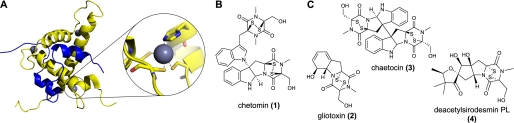
FIGURE 1.
FIGURE 1.
HIF-1α-C-TAD and p300-CH1 interaction and naturally occurring ETPs. A, views from structures of the C-TAD of HIF-1α (amino acids 786–826, in blue) interacting with the CH1 of p300 (amino acids 323–423, in yellow). Protein Data Bank (PDB) ID code 1L3E (2), showing the location of the three zinc-binding sites. A close-up of one of the zinc-coordinating sites of CH1 showing His402, Cys406, Cys411, and Cys414 is shown. B, structure of chetomin. C, structures of the naturally occurring ETPs gliotoxin (2), chaetocin (3), and deacetylsirodesmin PL (4).
FIGURE 2.
FIGURE 2.
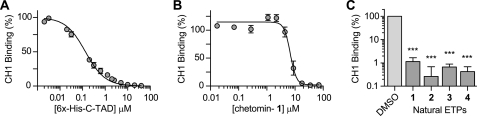
Results from fluorescent binding assay. A, validation of C-TAD-CH1 fluorescent binding assay (6) by competitive inhibition. Biotin-C-TAD786–826 and GST-CH1 binding inhibited by increasing His6His-C-TAD775–826 (mean ± S.E. (error bars), n = 2–4 independent experiments run in duplicate). B, validation of C-TAD-CH1 fluorescent binding assay using chetomin. Chetomin was identified by Kung et al. (6) in a screen for compounds that block the CH1-C-TAD interaction. We also found that chetomin abrogates C-TAD and CH1 binding in a dose-dependent manner as reported (6) (mean ± S.E., n = 2–8 independent experiments run in duplicate) with a mean IC50 = 6.8 μm. C, in vitro inhibition of CH1 and C-TAD binding in the fluorescent binding assay by natural ETPs (mean ± S.E., n = 4–6 independent experiments). All four of the natural ETPs reduced CH1-C-TAD binding by ≥ 98.9% (ETP concentration tested at the approximately highest concentration soluble in 1% DMSO: 1 and 3 = 70 μm; 2 = 61 μm; 4 = 100 μm). Statistical analysis of differences between the means of three or more independent groups was evaluated by one-way ANOVA with Tukey's post hoc test (versus DMSO control). There was no statistical significance between the activity of the different ETPs in the fluorescent binding assay. *, p < 0.05, **, p < 0.01, ***, p < 0.001.
FIGURE 3.
FIGURE 3.
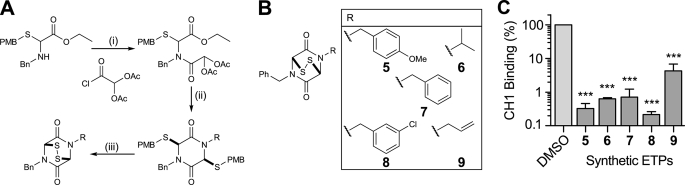
Synthetic ETPs and activity against blocking C-TAD-CH1 interaction. A, outline route used for ETP synthesis. The syntheses of the dibenzyl-substituted ETP (7), the related dithiol (10) and the bis-methylated dithiol (12) were carried out following literature precedent (23, 24, 26, 27). PMB, p-methoxybenzyl. B, synthetic ETPs (racemic). C, in vitro inhibition of CH1 and C-TAD binding in fluorescent assay by synthetic ETPs. Mean ± S.E. (error bars) (n = 3–4, in duplicate) at 62.5 μm. Statistical analysis of synthetic ETPs was evaluated by one-way ANOVA with Tukey's post hoc test. There was no statistical significance between the activity of the different ETPs. *, p < 0.05, **, p < 0.01, ***, p < 0.001.
FIGURE 4.
FIGURE 4.
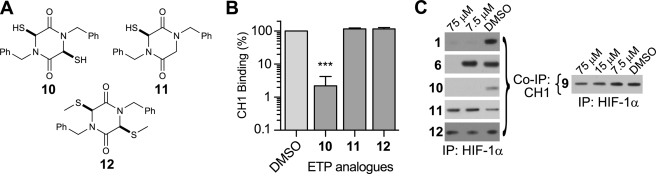
Synthetic ETP analogues and activity against blocking C-TAD-CH1 interaction. A, synthetic ETP analogues (racemic). B, in vitro inhibition of CH1 and C-TAD binding in fluorescence assay by synthetic ETP analogues. Compounds possessing the ETP core in both oxidized (1–9) and reduced (10) form ablate CH1-C-TAD binding. Analogues possessing a single thiol (11) or methylated thiols (12) are inactive. (Mean ± S.E. (error bars), n = 2–3, at 62.5 μm.) Statistical analysis of synthetic ETPs was evaluated by one-way ANOVA with Tukey's post hoc test. There was no statistical significance between the activity of the different ETPs. *, p < 0.05, **, p < 0.01, ***, p < 0.001. C, co-immunoprecipitation (IP) of FLAG-HIF-1α and bound GST-CH1 in the presence of ETPs. Shown is the amount of CH1 pulled down. Compounds with reduced/oxidized ETP core block the CH1-HIF-1α interaction, except for 9, indicating that selectivity of ETPs may be achievable. The single thiol analogue (11) and methylated thiols (12) analogue did not block the interaction. For the entire range of compounds and controls, see supplemental information.
FIGURE 5.
FIGURE 5.
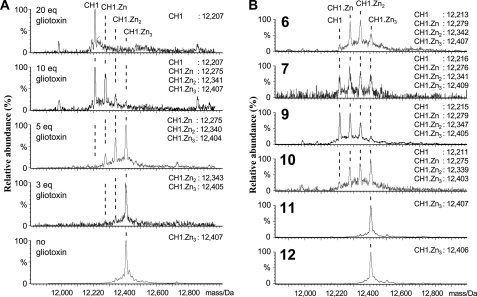
ETPs block the C-TAD-CH1 interaction by zinc ejection from CH1, demonstrated by ESI-MS. A, non-denaturing ESI-MS analyses on the effect of increasing amounts of gliotoxin (2) on zinc ion binding by CH1. B, non-denaturing electrospray ionization mass spectrometric analyses on the effect of various synthetic ETPs and ETP analogues on zinc ion binding by CH1. Note the variations in efficiency and note that the analogues 11 and 12, lacking the ETP core, do not cause zinc ion ejection.
FIGURE 6.
FIGURE 6.
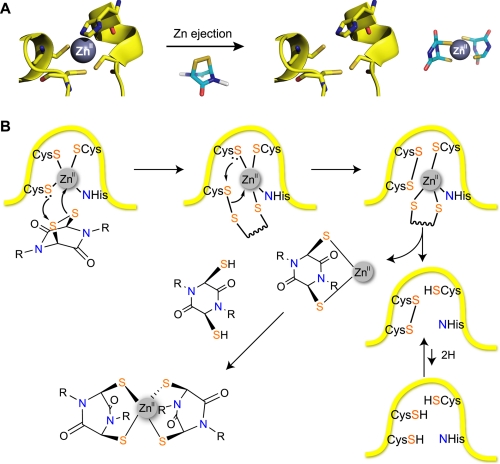
Proposed mechanism of action of ETPs for modification of CH1 (31). A, summary of the mechanism of zinc ejection from p300-CH1. B, a zinc-coordinating cysteine thiol(ate) reacts with the disulfide of the ETP core to generate a transient protein-ETP disulfide. The disulfide then rearranges to form an intramolecular protein disulfide with consequent reduction in zinc ion affinity. The ejected zinc ion (or zinc ETP complex) can then complex with a second (reduced) ETP core to form a stable complex.
FIGURE 7.
FIGURE 7.
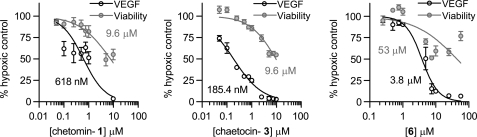
Effect of the three most potent ETPs on VEGF expression and viability of HCT116 cells after 18 h. Chetomin (left), chaetocin (middle), and compound 6 (right) all caused a decrease in secreted VEGF levels. The decrease in secreted VEGF was not directly due to nonspecific cytotoxicity of the ETPs as the percentage of viable cells was considerably higher than the percentage of decrease in VEGF levels at concentrations up to 1 μm chaetocin and chetomin and ∼2.5 μm compound 6 after 18 h. Only at concentrations greater than 10 μm did cell viability decrease to ∼50% in the 18-h time period. Longer incubations with the ETPs did lead to a further decrease in viability, see supplemental Fig. 4B. Data points are presented as mean ± S.E. (error bars) from independent experiments run in duplicate (chetomin: viability n = 2–7, VEGF n = 2–4), (chaetocin: viability n = 6–12, VEGF n = 2–6), and (compound 6: viability n = 3–7, VEGF n = 2–5).
FIGURE 8.
FIGURE 8.
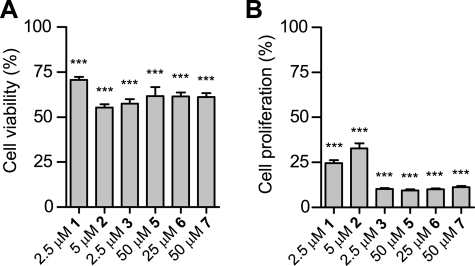
Effect of both natural and synthetic ETPs on HCT116 cell viability (A) and proliferation (B) in normoxia (mean ± S.E. (error bars); viability: n ≥ 4; proliferation: n ≥ 3). Statistical analysis of differences between the means of three or more independent groups was evaluated by one-way ANOVA with Tukey's post hoc test (versus DMSO control). See supplemental information for more supporting data. *, p < 0.05, **, p < 0.01, ***, p < 0.001.
FIGURE 9.
FIGURE 9.
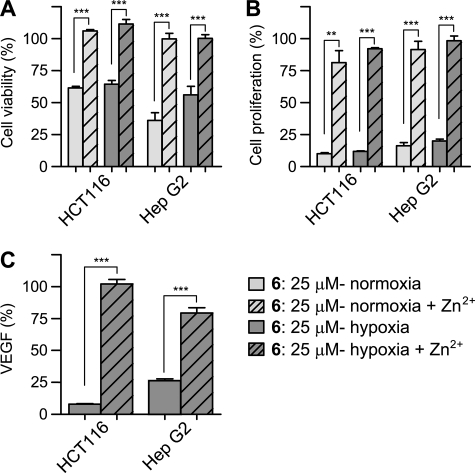
Effect of representative synthetic ETP, compound 6, on HCT116 cell viability, proliferation, and VEGF secretion in the presence or absence of zinc (mean ± S.E. (error bars); viability: n ≥ 4; proliferation: n ≥ 3; VEGF n ≥ 3). HCT116 and Hep G2 cells were treated with 25 μm compound 6, with or without zinc supplementation for 18 h. A, viability of HCT116 and Hep G2 cells under normoxic and hypoxic (1% O2) conditions. The percentage of viable cells was considerably higher in zinc-treated cells versus non-zinc-treated. B, zinc supplementation increases proliferation to levels similar to the control, in both cell lines. C, enzyme-linked immunosorbent assay quantification of secreted VEGF normalized to DMSO control in hypoxic HCT116 and Hep G2 cells. Zinc supplementation restores VEGF production in hypoxic HCT116 and Hep G2 cells. For data on other ETPs, see supplemental information. Statistical significance of differences between the means of ETP-treated samples and ETP-treated samples with zinc supplementation was evaluated by unpaired Student's t test. *, p < 0.05, **, p < 0.01, ***, p < 0.001.

References

    1. Hirota K., Semenza G. L. (2006) Crit. Rev. Oncol. Hematol. 59, 15–26 - PubMed
    1. Freedman S. J., Sun Z. Y., Poy F., Kung A. L., Livingston D. M., Wagner G., Eck M. J. (2002) Proc. Natl. Acad. Sci. U.S.A. 99, 5367–5372 - PMC - PubMed
    1. Kaelin W. G., Jr., Ratcliffe P. J. (2008) Mol. Cell 30, 393–402 - PubMed
    1. Lando D., Peet D. J., Whelan D. A., Gorman J. J., Whitelaw M. L. (2002) Science 295, 858–861 - PubMed
    1. Kung A. L., Wang S., Klco J. M., Kaelin W. G., Livingston D. M. (2000) Nat. Med. 6, 1335–1340 - PubMed

Publication types

MeSH terms

Associated data