


Increased mitogen-activated protein kinase kinase/extracellularly regulated kinase activity in human endometrial stromal fibroblasts of women with endometriosis reduces 3',5'-cyclic adenosine 5'-monophosphate inhibition of cyclin D1
- PMID: 19589865
- PMCID: PMC2754675
- DOI: 10.1210/en.2009-0389
Increased mitogen-activated protein kinase kinase/extracellularly regulated kinase activity in human endometrial stromal fibroblasts of women with endometriosis reduces 3',5'-cyclic adenosine 5'-monophosphate inhibition of cyclin D1
Abstract
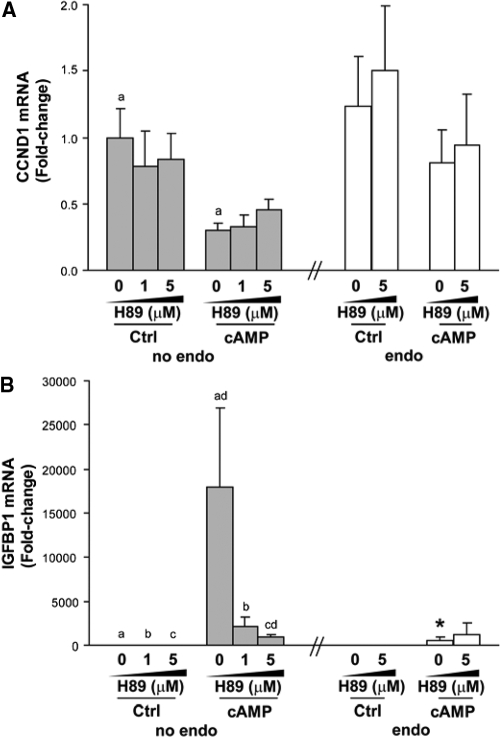
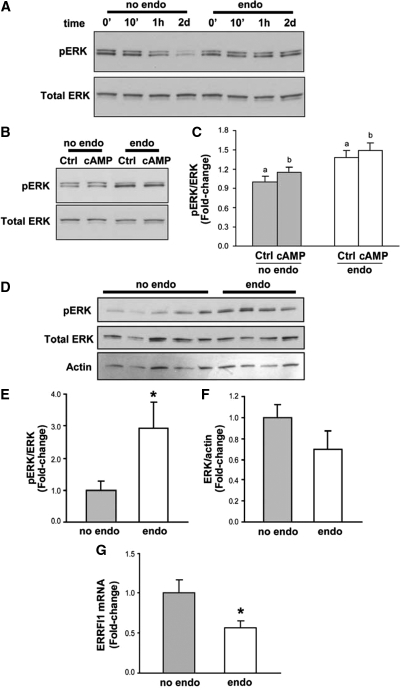
Endometriosis is characterized by endometrial tissue growth outside the uterus, due primarily to survival, proliferation, and neoangiogenesis of eutopic endometrial cells and fragments refluxed into the peritoneal cavity during menses. Although various signaling molecules, including cAMP, regulate endometrial proliferation, survival, and embryonic receptivity in endometrium of women without endometriosis, the exact molecular signaling pathways in endometrium of women with disease remain unclear. Given the persistence of a proliferative profile and differential expression of genes associated with the MAPK signaling cascade in early secretory endometrium of women with endometriosis, we hypothesized that ERK1/2 activity influences cAMP regulation of the cell cycle. Here, we demonstrate that 8-Br-cAMP inhibits bromodeoxyuridine incorporation and cyclin D1 (CCND1) expression in cultured human endometrial stromal fibroblasts (hESF) from women without but not with endometriosis. Incubation with serum-containing or serum-free medium resulted in higher phospho-ERK1/2 levels in hESF of women with vs. without disease, independent of 8-Br-cAMP treatment. The MAPK kinase-1/2 inhibitor, U0126, fully restored cAMP down-regulation of CCND1, but not cAMP up-regulation of IGFBP1, in hESF of women with vs. without endometriosis. Immunohistochemistry demonstrated the highest phospho-ERK1/2 in the late-secretory epithelial and stromal cells in women without disease, in contrast to intense immunostaining in early-secretory epithelial and stromal cells in those with disease. These findings suggest that increased activation of ERK1/2 in endometrial cells from women with endometriosis may be responsible for persistent proliferative changes in secretory-phase endometrium.
Figures



References
-
- Eskenazi B, Warner ML 1997 Epidemiology of endometriosis. Obstet Gynecol Clin North Am 24:235–258 - PubMed
-
- Burney RO, Giudice LC 2008 The pathogenesis of endometriosis. In: Nezhat C, Nezhat C, Nezhat FR, eds. Nezhat’s operative gynecologic laparoscopy and hysteroscopy. 3rd ed. Cambridge, New York: Cambridge University Press; 251–257
-
- Burney RO, Talbi S, Hamilton AE, Vo KC, Nyegaard M, Nezhat CR, Lessey BA, Giudice LC 2007 Gene expression analysis of endometrium reveals progesterone resistance and candidate susceptibility genes in women with endometriosis. Endocrinology 148:3814–3826 - PubMed
-
- Kao LC, Germeyer A, Tulac S, Lobo S, Yang JP, Taylor RN, Osteen K, Lessey BA, Giudice LC 2003 Expression profiling of endometrium from women with endometriosis reveals candidate genes for disease-based implantation failure and infertility. Endocrinology 144:2870–2881 - PubMed
-
- Kamat AA, Younes PS, Sayeeduddin M, Wheeler TM, Simpson JL, Agoulnik AI 2004 Protein expression profiling of endometriosis: validation of 2-mm tissue microarrays. Fertil Steril 82:1681–1683 - PubMed
Publication types
MeSH terms
Substances
Grants and funding
LinkOut - more resources
Full Text Sources
Medical
Research Materials
Miscellaneous
