. 2010 Mar;32(1):15-30.
doi: 10.1007/s11357-009-9106-3. Epub 2009 Jul 10.

Revealing system-level correlations between aging and calorie restriction using a mouse transcriptome

Affiliations

Revealing system-level correlations between aging and calorie restriction using a mouse transcriptome

Seong-Eui Hong et al. Age (Dordr). 2010 Mar.

Abstract

Although systems biology is a perfect framework for investigating system-level declines during aging, only a few reports have focused on a comprehensive understanding of system-level changes in the context of aging systems. The present study aimed to understand the most sensitive biological systems affected during aging and to reveal the systems underlying the crosstalk between aging and the ability of calorie restriction (CR) to effectively slow-down aging. We collected and analyzed 478 aging- and 586 CR-related mouse genes. For the given genes, the biological systems that are significantly related to aging and CR were examined according to three aspects. First, a global characterization by Gene Ontology (GO) was performed, where we found that the transcriptome (a set of genes) for both aging and CR were strongly related in the immune response, lipid metabolism, and cell adhesion functions. Second, the transcriptional modularity found in aging and CR was evaluated by identifying possible functional modules, sets of genes that show consistent expression patterns. Our analyses using the given functional modules, revealed systemic interactions among various biological processes, as exemplified by the negative relation shown between lipid metabolism and the immune response at the system level. Third, transcriptional regulatory systems were predicted for both the aging and CR transcriptomes. Here, we suggest a systems biology framework to further understand the most important systems as they age.


Figures
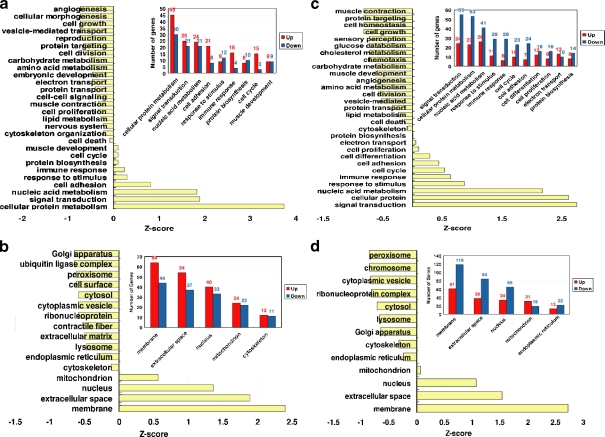
Fig. 1
Fig. 1
a–d Classification of aging and CR transcriptomes in context of Gene Ontology terminologies. a Distribution of the aging transcriptome in respect to biological processes. The major biological processes involved in this study are displayed on the inner bar graph. b Distribution of aging transcriptome in respect to cellular localization. The major compartments are displayed on the inner bar graph. c Distribution of the CR transcriptome in respect to biological processes. The major biological processes involved are displayed on the inner bar graph. d Distribution of the CR transcriptome in respect to cellular localization. The major compartments are displayed on the inner bar graph
Fig. 2
Fig. 2
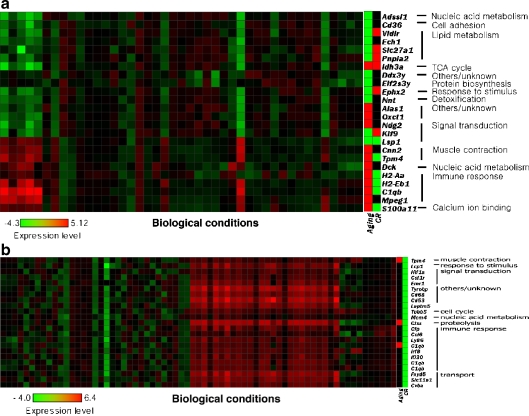
a, b Functional modules. a Module 24 for the aging transcriptome. The genes in this module dramatically divided into two different expression profile patterns, and these opposing activity profiles are evident for both the aging CR transcriptomes. b Module 22 for CR transcriptome. The genes in this module are all down-regulated in the CR transcriptome and mainly are involved in immune response
Fig. 3
Fig. 3
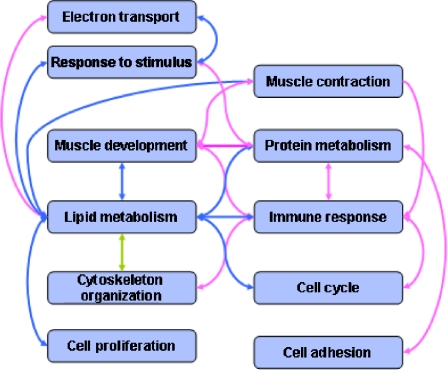
Functional associations at system levels. Systems in the aging and CR transcriptomes are closely correlated in a positive (red line) or negative (blue line) manner. Lipid metabolism, especially, showed an inverse correlation with many other systems, including immune response, cell cycle, cell proliferation, and muscle development. The systems showing the strongest inverse correlation were lipid metabolism and immune response (P = 6.73 × 10-9). The relationship between lipid metabolism and cytoskeleton organization is somewhat ambiguous (green line), showing positive and negative patterns together
Fig. 4
Fig. 4
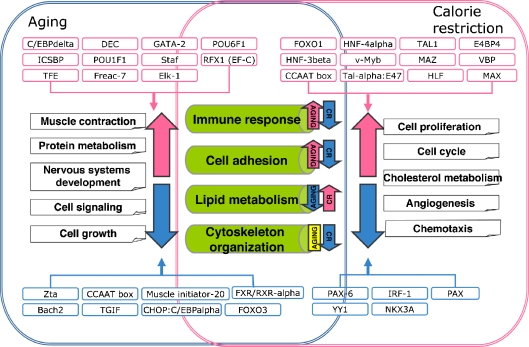
Summary of biological processes and transcription factors involved in aging and CR. The putative transcription factors regulating the mouse aging and CR transcriptomes are described. A total of 11 transcription factors are over-represented in mouse genes that are up-regulated during the aging process. POU6F1 is also over-represented in the common transcriptome, especially those genes that are up-regulated in aging and down-regulated in CR. The putative regulatory elements modulating the genes down-regulated during aging are eight in total. Among these, one regulatory element (i.e., CCAAT box) is a cis-acting regulatory element and the others are trans-acting elements. Interestingly, the CCAAT box is over-represented in the upstream regions of genes that are up-regulated in CR This finding indicates the opposite effect of CCAAT box-related transcription factors on aging and CR. The important regulatory elements involved in the regulation of genes up-regulated in CR are 12 in total. The cis-acting regulatory elements such as CCAAT box and Tal-α:E47 box are also included. It is surprising that two forkhead family transcription factors, FOXO1 and HNF-3β (also known as FOXA2) are involved in the regulation of genes up-regulated in CR. These two transcription factors are also found in some genes in the common transcriptome, especially those down-regulated during the aging process, and contrary to those up-regulated in CR. The transcription factors regulating the genes down-regulated in CR are five. PAX-6 is also an important transcription factor for the regulation of genes up-regulated during aging and down-regulated in CR. There are 14 regulatory elements involved in the regulation of common transcriptome. Among these, six transcription factors are over-represented in genes up-regulated during aging and down-regulated in CR, including POU6F1 and PAX-6, as described above. Eight regulatory elements comprise the various forkhead families involved in the regulation of genes down-regulated during aging and up-regulated in CR, including FOXO1 and HNF-3β described above

References

    1. Barrett T, Suzek TO, Troup DB, Wilhite SE, Ngau WC, Ledoux P, Rudnev D, Lash AE, Fujibuchi W, Edgar R. NCBI GEO: mining millions of expression profiles—database and tools. Nucleic Acids Res. 2005;33:D562–D566. doi: 10.1093/nar/gki022. - DOI - PMC - PubMed
    1. Beggs ML, Nagarajan R, Taylor-Jones JM, Nolen G, Macnicol M, Peterson CA. Alterations in the TGFbeta signaling pathway in myogenic progenitors with age. Aging Cell. 2004;3:353–361. doi: 10.1111/j.1474-9728.2004.00135.x. - DOI - PubMed
    1. Biggs WH, 3rd, Meisenhelder J, Hunter T, Cavenee WK, Arden KC. Protein kinase B/Akt-mediated phosphorylation promotes nuclear exclusion of the winged helix transcription factor FKHR1. Proc Natl Acad Sci USA. 1999;96:7421–7426. doi: 10.1073/pnas.96.13.7421. - DOI - PMC - PubMed
    1. Blake JA, Eppig JT, Bult CJ, Kadin JA, Richardson JE. The Mouse Genome Database (MGD): updates and enhancements. Nucleic Acids Res. 2006;34:D562–D567. doi: 10.1093/nar/gkj085. - DOI - PMC - PubMed
    1. Blalock EM, Chen KC, Stromberg AJ, Norris CM, Kadish I, Kraner SD, Porter NM, Landfield PW. Harnessing the power of gene microarrays for the study of brain aging and Alzheimer′s disease: statistical reliability and functional correlation. Ageing Res Rev. 2005;4:481–512. - PubMed

Publication types