Review
. 2010 Jan;46(1):4-12.
doi: 10.1016/j.bone.2009.06.029. Epub 2009 Jul 8.

The emerging role of serotonin (5-hydroxytryptamine) in the skeleton and its mediation of the skeletal effects of low-density lipoprotein receptor-related protein 5 (LRP5)

Affiliations
Review

The emerging role of serotonin (5-hydroxytryptamine) in the skeleton and its mediation of the skeletal effects of low-density lipoprotein receptor-related protein 5 (LRP5)

Stuart J Warden et al. Bone. 2010 Jan.

Abstract

Novel molecular pathways obligatory for bone health are being rapidly identified. One pathway recently revealed involves gut-derived 5-hydroxytryptamine (5-HT) mediation of the complete skeletal effects of low-density lipoprotein receptor-related protein 5 (LRP5). Mounting evidence supports 5-HT as an important regulatory compound in bone with previous evidence demonstrating that bone cells possess functional pathways for responding to 5-HT. In addition, there is growing evidence that potentiation of 5-HT signaling via inhibition of the 5-HT transporter (5-HTT) has significant skeletal effects. The later is clinically significant as the 5-HTT is a popular target of pharmaceutical agents, such as selective serotonin reuptake inhibitors (SSRIs), used for the management of major depressive disorder and other affective conditions. The observation that 5-HT mediates the complete skeletal effects of LRP5 represents a significant paradigm shift from the traditional view that LRP5 located on the cell surface membrane of osteoblasts exerts direct skeletal effects via Wnt/beta-catenin signaling. This paper discusses the mounting evidence for skeletal effects of 5-HT and the ability of gut-derived 5-HT to satisfactorily explain the skeletal effects of LRP5.


Figures

Figure 1
Figure 1
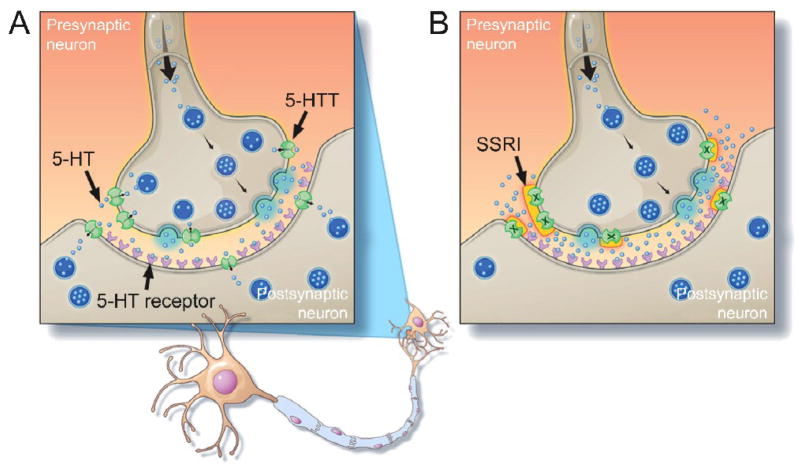
A) 5-hydroxytryptamine (5-HT) signaling within the central nervous system. 5-HT is synthesized by presynaptic neurons and stored in vesicles. Vesicles bind with the cell membrane following a stimulus to release 5-HT into the synaptic cleft via exocytosis. Released 5-HT activates post-synaptic receptors to stimulate the post-synaptic neuron. Membrane-bound 5-HT transporters (5-HTT) uptake released 5-HT to control the duration of 5-HT effects and recycle or degrade 5-HT. B) The effects of 5-HTT inhibition using a selective serotonin reuptake inhibitor (SSRI) on 5-HT signaling. Inhibition of the 5-HTT prevents uptake of 5-HT from resulting in its accumulation within the synaptic cleft and the prolonging receptor activation.
Figure 2
Figure 2
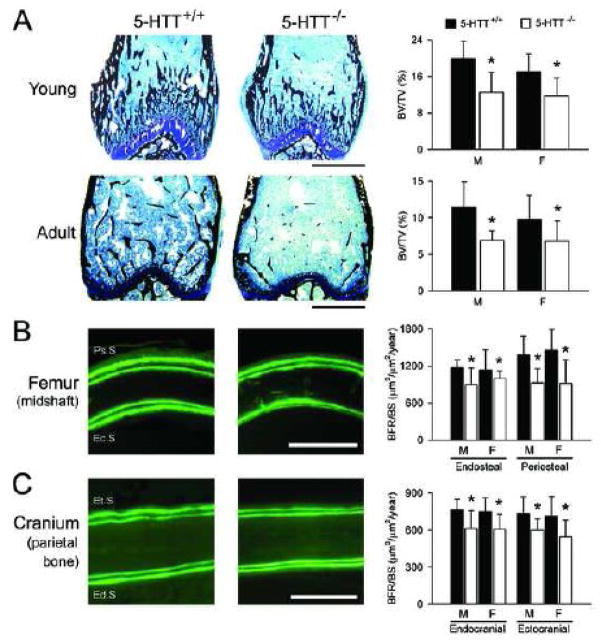
Gene-mediated inhibition of the 5-hydroxytryptamine transporter (5-HTT) reduces: A) trabecular bone volume fraction (bone volume [BV]/total volume [TV]) within the distal femur of young (four-week-old) and adult (19-week-old) mice; B) femoral midshaft periosteal (Ps.S) and endosteal (Ec.S) surface bone formation (bone formation rate normalized for bone surface [BFR/BS]) in young (four-week-old) mice, and; C) cranial ectocranial (Et.S) and endocranial (Ed.S) surface BFR/BS in young (four-week-old) mice. 5-HTT+/+ = wild-type control mice; 5-HTT−/− = mice with null mutation in the 5-htt gene; M = male; F = female. Scale bars = 1 mm, 100 μm and 200 μm in A), B) and C) respectively. Error bars show mean ± SD. *Indicates P < 0.05 for genotype main effect, as determined by 2-way factorial ANOVA (genotype × sex). There were no significant genotype × sex interactions (all P > 0.05). Reproduced with permission of The Endocrine Society (©2005) from Warden et al. [3].
Figure 3
Figure 3
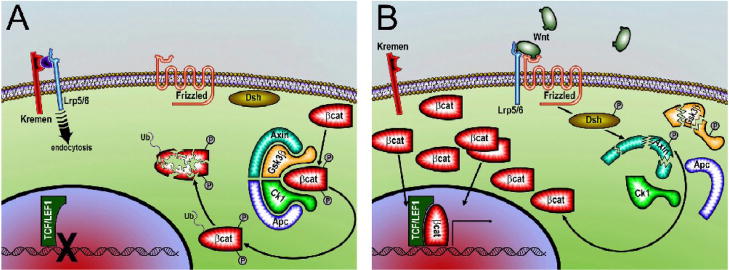
Elements of Wnt/β-catenin signaling. A) Lack of Wnt signaling (i.e. via soluble Frizzled related protein [sFrp] antagonism of Wnt, Dickkopf [Dkk] antagonism of low-density lipoprotein receptor-related protein 5/6 [Lrp5/6], or other means) permits stabilization of the Axin-adenomatosis polyposis coli (Apc) complex, which facilitates phosphorylation of β-catenin by glycogen synthase kinase 3 (Gsk3) and casein kinase 1 (Ck1). Phosphorylated β-catenin is subsequently ubiquitin-tagged (Ub) by β-Trcp for proteosome degradation, and consequently does not accumulate in the cytoplasm in sufficient quantities to allow translocation to the nucleus. The Tcf/Lef 1 transcription factor requires β-catenin binding to initiate gene transcription. B) Activated Wnt signaling occurs through Wnt binding and complexing of Lrp5/6 with Frizzled. Formation of the trimeric receptor–ligand complex induces degradation of the Axin complex through phosphorylated Dishevelled (Dsh) signaling. Loss of the β-catenin phosphorylation machinery allows β-catenin to remain stable (unphosphorylated) and accumulate in the cytoplasm, to the point where translocation to the nucleus occurs and gene transcription is initiated.
Figure 4
Figure 4
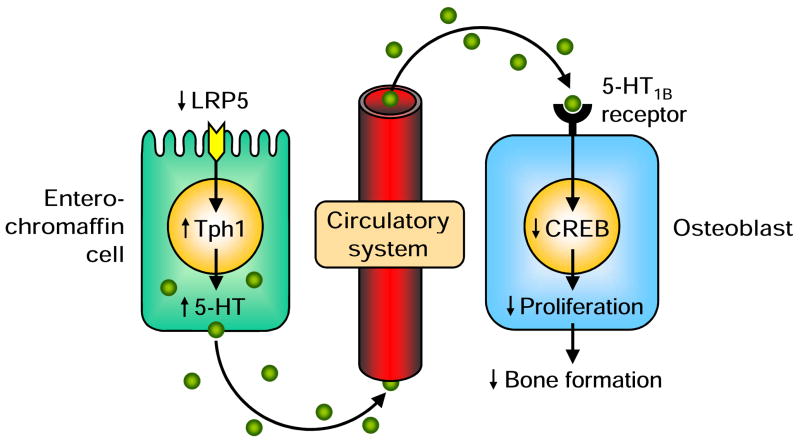
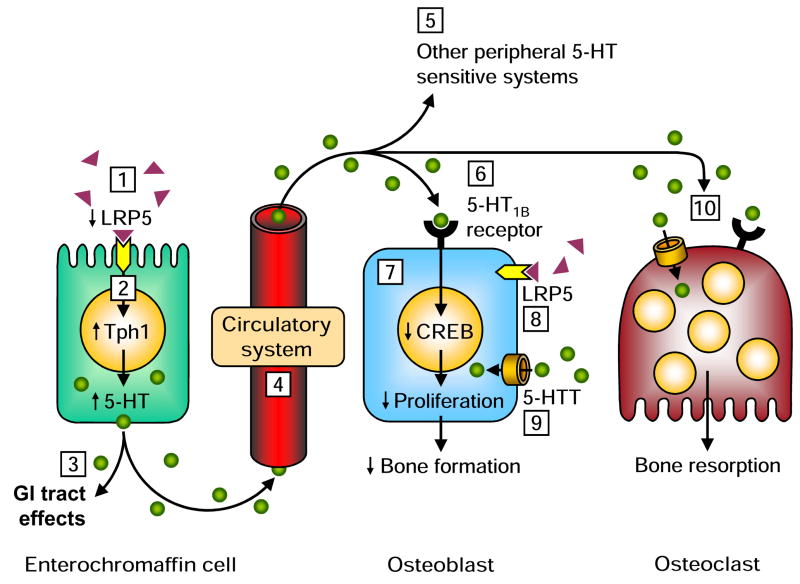
Schematic of the low-density lipoprotein receptor-related protein 5 (LRP5)–5-hydroxytryptamine (5-HT)–osteoblast pathway observed by Yadav et al. [4]. LRP5 was inhibitory of tryptophan hydroxylase 1 (Tph1) expression and resultant 5-HT synthesis in enterochromaffin cells in the gut, but had no direct effect on osteoblasts. A reduction in gut LRP5 increased Tph1 expression and 5-HT synthesis resulting in an increase in circulating 5-HT levels. Binding of 5-HT to osteoblastic 5-HT1B receptors resulted in a reduction in cAMP response element binding (CREB) protein expression contributing to a reduction in osteoblast proliferation and bone formation.
Figure 5
Figure 5
Unanswered questions regarding the low-density lipoprotein receptor-related protein 5 (LRP5)—5-hydroxytryptamine (5-HT)—osteoblast pathway. 1) What is the ligand for LRP5 within enterochromaffin cells? 2) What is the molecular pathway between LRP5 and tryptophan hydroxylase 1 (Tph1) within enterochromaffin cells? 3) Does LRP5-mediated 5-HT synthesis by enterochromaffin cells have any local effects on the gastrointestinal (GI) tract? 4) How are LRP5-mediated changes in circulating 5-HT levels transported to bone cells (i.e. is it sequestered in platelets or free within the plasma)? 5) What effect does LRP5-mediated changes in circulating 5-HT levels have on other peripheral 5-HT sensitive systems, including heart valves and the pulmonary circulation? 6) Does activation of the 5-HT1B receptor completely explain the skeletal effects of 5-HT or are other 5-HT receptors involved depending on the prevailing conditions? 7) Does 5-HT solely influence osteoblast proliferation or does it also influence differentiation depending on the prevailing conditions? 8) Are there direct skeletal effects of LRP5 under alternative conditions (i.e. at different stages within the osteoblastic lineage or during mechanical loading)? 9) What is the role of the osteoblastic 5-HT transporter (5-HTT) in regulating the skeletal effects of gut-derived 5-HT? 10) Does the LRP5-mediated change in circulating 5-HT levels influence the functional 5-HT pathways observed in osteoclasts?

References

    1. Rapport MM, Green AA, Page IH. Serum vasoconstrictor (serotonin). IV. Isolation and characterization. J Biol Chem. 1948;176:1243–51. - PubMed
    1. Bliziotes MM, Eshleman AJ, Zhang X-W, Wiren KM. Neurotransmitter action in osteoblasts: expression of a functional system for serotonin receptor activation and reuptake. Bone. 2001;29:477–86. - PubMed
    1. Warden SJ, Robling AG, Sanders MS, Bliziotes MM, Turner CH. Inhibition of the serotonin (5-hydroxytryptamine) transporter reduces bone accrual during growth. Endocrinology. 2005;146:685–93. - PubMed
    1. Yadav VK, Ryu JH, Suda N, Tanaka KF, Gingrich JA, Schutz G, Glorieux FH, Chiang CY, Zajac JD, Insogna KL, Mann JJ, Hen R, Ducy P, Karsenty G. Lrp5 controls bone formation by inhibiting serotonin synthesis in the duodenum. Cell. 2008;135:825–37. - PMC - PubMed
    1. Walther DJ, Peter JU, Bashammakh S, Hortnagl H, Voits M, Fink H, Bader M. Synthesis of serotonin by a second tryptophan hydroxylase isoform. Science. 2003;299:76. - PubMed

Publication types

MeSH terms

Substances