Comparative Study
. 2009 Sep;191(18):5577-83.
doi: 10.1128/JB.00493-09. Epub 2009 Jul 10.

Comparisons between geographically diverse samples of carried Staphylococcus aureus

Affiliations
Comparative Study

Comparisons between geographically diverse samples of carried Staphylococcus aureus

Raymond Ruimy et al. J Bacteriol. 2009 Sep.

Abstract

Approximately one-third of the human population is asymptomatically colonized by Staphylococcus aureus. However, much of the global diversity within the carriage populations remains uncharacterized, and it is unclear to what degree the variation is geographically partitioned. We isolated 300 carriage isolates from 1,531 adults contemporaneously in four countries: France, Algeria, Moldova, and Cambodia. All strains were characterized by multilocus sequence typing. Six clonal complexes (CCs) were present in all four samples (CC30, -45, -121, -15, -5, and -8). Analyses based on the genotype frequencies revealed the French and Algerian samples to be most similar and the Cambodian sample to be most distinct. While this pattern is consistent with likely rates of human migration and geographic distance, stochastic clonal expansion also contributes to regional differences. Phylogenetic analysis revealed a highly divergent and uncharacterized genotype (ST1223) within Cambodia. This lineage is related to CC75, which has previously been observed only in remote aboriginal populations in northern Australia.


Figures
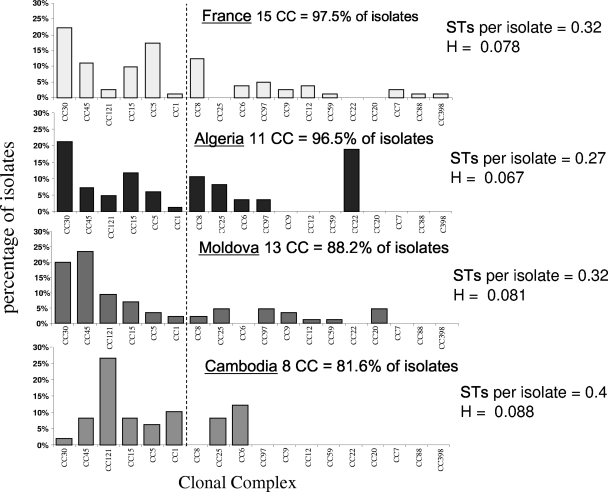
FIG. 1.
FIG. 1.
Proportions all CCs identified within each of the four samples. eBURST analysis was used to subdivide the data into a total of 18 CCs, each named according to the ST of the assigned founder. Frequency profiles of these 18 CCs are given for the four countries. Six widely disseminated CCs (CC30, -45, -121, -15, -5, and -1) were observed in all four samples and are placed to the left of the dashed line. The diversity of each sample (given as STs per isolate and as H) is given.
FIG. 2.
FIG. 2.
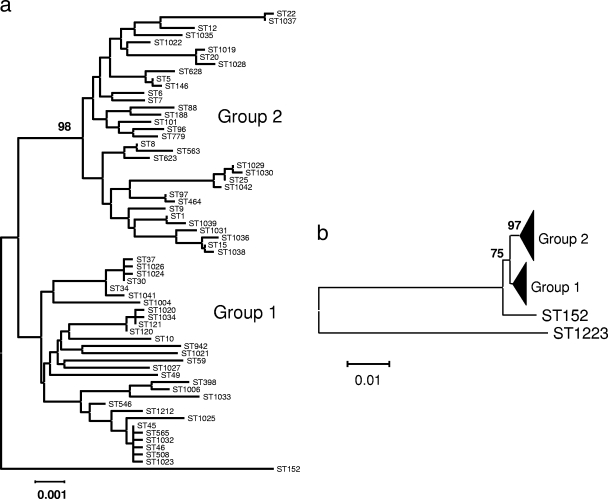
(a) Neighbor-joining tree reconstructed from the concatenated sequences of each unique ST observed in the pooled data set. The Kimura two-parameter distance measure was used as implemented in MEGA 4.0. The analysis resolved the STs in the two main groups identified previously; group 2 is supported by a bootstrap score of 98. Two STs did not cluster within the two major groups. One of these, ST1223, is omitted for the sake of clarity, while ST152 (corresponding to a single French isolate) is approximately equidistant from the two main groups. The use of ST152 as an outgroup confirms that group 1 is basal to group 2. (b) Neighbor-joining tree showing the divergent position of ST1223. Groups 1 and 2 are collapsed for the sake of clarity, and ST1223 is ∼10% diverged from these groups. Bootstrap scores for the group 2 node and the ancestral node of groups 1 and 2 are given.
FIG. 3.
FIG. 3.
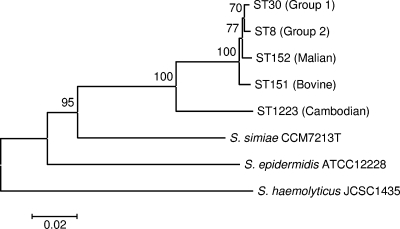
Neighbor-joining tree of selected S. aureus genotypes and closely related coagulase-negative staphylococcal species, based on the concatenated sequences of six MLST genes. arcC is excluded due to difficulties in amplifying this gene in S. simiae. This analysis confirms that ST1223 is more closely related to other S. aureus genotypes than to the nearest coagulase-negative species and clusters with S. aureus with a bootstrap support of 100%. This is consistent with the taxonomic status of ST1223 as S. aureus.

References

    1. Agapow, P.-M., and A. Burt. 2001. Indices of multilocus linkage disequilibrium. Mol. Ecol. Notes 1101-102.
    1. Armand-Lefevre, L., R. Ruimy, and A. Andremont. 2005. Clonal comparison of Staphylococcus aureus isolates from healthy pig farmers, human controls, and pigs. Emerg. Infect. Dis. 11711-714. - PMC - PubMed
    1. Collery, M. M., D. S. Smyth, J. M. Twohig, A. C. Shore, D. C. Coleman, and C. J. Smyth. 2008. Molecular typing of nasal carriage isolates of Staphylococcus aureus from an Irish university student population based on toxin gene PCR, agr locus types and multiple locus, variable number tandem repeat analysis. J. Med. Microbiol. 57348-358. - PubMed
    1. Conceicao, T., M. Aires de Sousa, and H. de Lencastre. 2009. Staphylococcal interspersed repeat unit typing of Staphylococcus aureus: evaluation of a new multilocus variable-number tandem-repeat analysis typing method. J. Clin. Microbiol. 471300-1308. - PMC - PubMed
    1. David, M. Z., K. M. Rudolph, T. W. Hennessy, S. Boyle-Vavra, and R. S. Daum. 2008. Molecular epidemiology of methicillin-resistant Staphylococcus aureus, rural southwestern Alaska. Emerg. Infect. Dis. 141693-1699. - PMC - PubMed

Publication types

MeSH terms