Review
. 2009 Dec;5(12):1405-12.
doi: 10.1039/B903580J.

Signal initiation in biological systems: the properties and detection of transient extracellular protein interactions

Affiliations
Review

Signal initiation in biological systems: the properties and detection of transient extracellular protein interactions

Gavin J Wright. Mol Biosyst. 2009 Dec.

Abstract

Individual cells within biological systems frequently coordinate their functions through signals initiated by specific extracellular protein interactions involving receptors that bridge the cellular membrane. Due to their biochemical nature, these membrane-embedded receptor proteins are difficult to manipulate and their interactions are characterised by very weak binding strengths that cannot be detected using popular high throughput assays. This review will provide a general outline of the biochemical attributes of receptor proteins focussing in particular on the biophysical properties of their transient interactions. Methods that are able to detect these weak extracellular binding events and especially those that can be used for identifying novel interactions will be compared. Finally, I discuss the feasibility of constructing a complete and accurate extracellular protein interaction map, and the methods that are likely to be useful in achieving this goal.


Figures
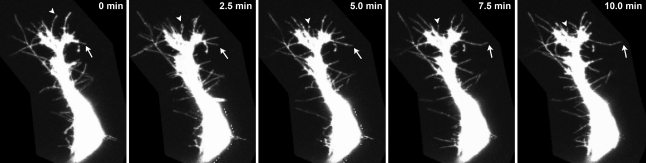
Fig. 1
Fig. 1. Cellular membranes are highly dynamic in vivo. Time-resolved images of a migrating zebrafish intersomitic endothelial cell during vascular embryonic development. Note the rapid extension (arrows) and retraction (arrowheads) of filopodial processes. Images kindly provided by Dr Jon Leslie, Cancer Research UK, London.
Fig. 2
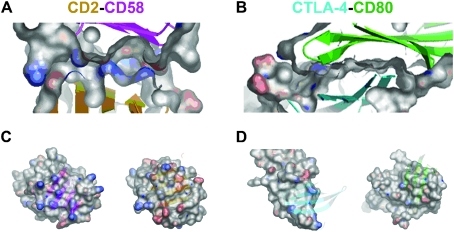
Fig. 2. Contrasting structural properties of low affinity extracellular protein interactions. The interfaces of the human CD2–CD58 and CTLA-4–CD80 co-crystal structures are shown side by side to highlight the differences in their structural properties. (A) The CD2–CD58 interface has a poor surface-shape complementarity—notice the large gaps between the two interacting proteins—whereas that between CTLA-4–CD80, shown in (B) is comparatively good. In (C) and (D), the two proteins in the complex have been separated and rotated to reveal the charge distribution at the interacting surfaces. In each case, the backbone of the binding partner is shadowed as a partly-transparent structure in ribbon format. The CD2–CD58 interaction interface (C) is highly charged whereas the CTLA-4–CD80 interface is composed almost entirely of hydrophobic residues (D). The coordinates for CD2–CD58 and CTLA-4–CD80 co-crystal structures (PDB accession numbers 1qa9 and 1i8l, respectively) were rendered using the program OpenAstexViewer™ 3.0. Key: ribbon backbones: CD2, orange; CD58, magenta; CTLA-4, cyan; CD80, green; charge polarity: blue, positive; red, negative.
Fig. 3
Fig. 3. Schematic representation of fusion proteins containing recombinant multimerising protein tags. The spatial arrangement (N-terminus, dark to C-terminus, light shading) of ectodomains from a typical type I two immunoglobulin superfamily domain-containing cell surface receptor multimerised using different tags are drawn approximately to scale.
Fig. 4
Fig. 4. (A) The relative rates of novel protein interaction discovery according to detection method and protein localisation. All metazoan binary protein interactions were extracted from the IntAct database (a total of 106 415 interactions) and then grouped into three broader categories depending on the method by which they were identified: (1) Y2H methods, (2) biochemical purification strategies and (3) all other methods. The cumulative number of interactions for each method per year is expressed as a percentage of the final number of metazoan interactions in the database. (B) The relative proportions of membrane-associated and secreted proteins according to their functional class. Functional classes were defined according to their Pfam domain annotation. The number of protein-coding genes containing these Pfam domains in the human genome was extracted from the Ensembl database.
None

References

    1. Kornfeld R., Kornfeld S. Annu. Rev. Biochem. 1985;54:631–664. - PubMed
    1. Goshima N., Kawamura Y., Fukumoto A., Miura A., Honma R., Satoh R., Wakamatsu A., Yamamoto J., Kimura K., Nishikawa T., Andoh T., Iida Y., Ishikawa K., Ito E., Kagawa N., Kaminaga C., Kanehori K., Kawakami B., Kenmochi K., Kimura R., Kobayashi M., Kuroita T., Kuwayama H., Maruyama Y., Matsuo K., Minami K., Mitsubori M., Mori M., Morishita R., Murase A., Nishikawa A., Nishikawa S., Okamoto T., Sakagami N., Sakamoto Y., Sasaki Y., Seki T., Sono S., Sugiyama A., Sumiya T., Takayama T., Takayama Y., Takeda H., Togashi T., Yahata K., Yamada H., Yanagisawa Y., Endo Y., Imamoto F., Kisu Y., Tanaka S., Isogai T., Imai J., Watanabe S., Nomura N. Nat. Methods. 2008;5:1011–1017. - PubMed
    1. Josic D., Clifton J. G. Proteomics. 2007;7:3010–3029. - PubMed
    1. Macher B. A., Yen T. Y. Mol. BioSyst. 2007;3:705–713. - PubMed
    1. van der Merwe P. A., Barclay A. N. Trends Biochem. Sci. 1994;19:354–358. - PubMed

MeSH terms

Substances