


doi: 10.1111/j.1474-9726.2009.00503.x.
Epub 2009 Jul 9.
Calorie restriction alters mitochondrial protein acetylation
Affiliations
- PMID: 19594485
- PMCID: PMC2752488
- DOI: 10.1111/j.1474-9726.2009.00503.x
Item in Clipboard
Calorie restriction alters mitochondrial protein acetylation
Aging Cell.
2009 Sep.
Abstract
Calorie restriction (CR) increases lifespan in organisms ranging from budding yeast through mammals. Mitochondrial adaptation represents a key component of the response to CR. Molecular mechanisms underlying this adaptation are largely unknown. Here we show that lysine acetylation of mitochondrial proteins is altered during CR in a tissue-specific fashion. Via large-scale mass spectrometry screening, we identify 72 candidate proteins involved in a variety of metabolic pathways with altered acetylation during CR. Mitochondrial acetylation changes may play an important role in the pro-longevity CR response.
Figures
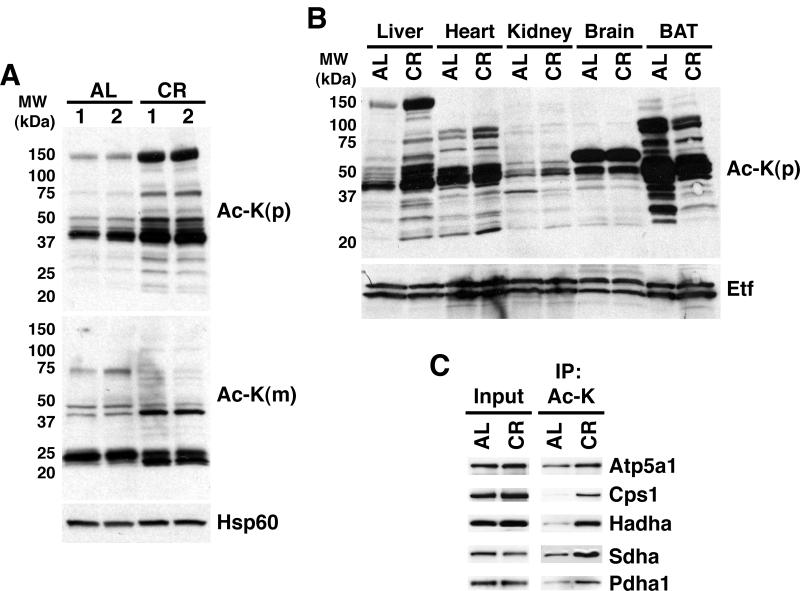
Calorie restriction alters mitochondrial acetylation. (A) Liver mitochondrial acetylation in CR. Mitochondrial extracts were generated from either CR or AL mice, fractionated by SDS-PAGE, and probed with the indicated antibodies. Ac-K, anti-acetyl-lysine. p=polyclonal, m=monoclonal. (B) Tissue-specific changes in mitochondrial acetylation. Mitochondria were prepared from indicated tissues of CR and AL mice and probed as in panel A. (C) Identification of proteins hyperacetylated in CR. Total acetylated proteins were immunopurified from AL and CR mitochondrial extracts and probed for the indicated proteins. Each panel represents mitochondrial extracts derived from a single AL/CR pair and is representative of at least three independent experiments.
References
-
- Dhahbi JM, Mote PL, Wingo J, Rowley BC, Cao SX, Walford RL, Spindler SR. Caloric restriction alters the feeding response of key metabolic enzyme genes. Mech Ageing Dev. 2001;122:1033–1048. - PubMed
-
- Hagopian K, Harper ME, Ram JJ, Humble SJ, Weindruch R, Ramsey JJ. Long-term calorie restriction reduces proton leak and hydrogen peroxide production in liver mitochondria. Am J Physiol Endocrinol Metab. 2005;288:E674–684. - PubMed
-
- Hagopian K, Ramsey JJ, Weindruch R. Caloric restriction increases gluconeogenic and transaminase enzyme activities in mouse liver. Exp Gerontol. 2003;38:267–278. - PubMed
-
- Hagopian K, Ramsey JJ, Weindruch R. Krebs cycle enzymes from livers of old mice are differentially regulated by caloric restriction. Exp Gerontol. 2004;39:1145–1154. - PubMed
Publication types
MeSH terms
Substances
Grants and funding
LinkOut - more resources
Full Text Sources
Other Literature Sources
Molecular Biology Databases
