


Low inhibitory control and restrictive feeding practices predict weight outcomes
- PMID: 19595373
- PMCID: PMC2764786
- DOI: 10.1016/j.jpeds.2009.04.052
Low inhibitory control and restrictive feeding practices predict weight outcomes
Abstract
Objective: A priority for research is to identify individuals early in development who are particularly susceptible to weight gain in the current, obesogenic environment. This longitudinal study investigated whether early individual differences in inhibitory control, an aspect of temperament, predicted weight outcomes and whether parents' restrictive feeding practices moderated this relation.
Study design: Participants included 197 non-Hispanic white girls and their parents; families were assessed when girls were 5, 7, 9, 11, 13, and 15 years old. Measures included mothers' reports of girls' inhibitory control levels, girls' reports of parental restriction in feeding, girls' body mass indexes (BMIs), and parents' BMIs, education, and income.
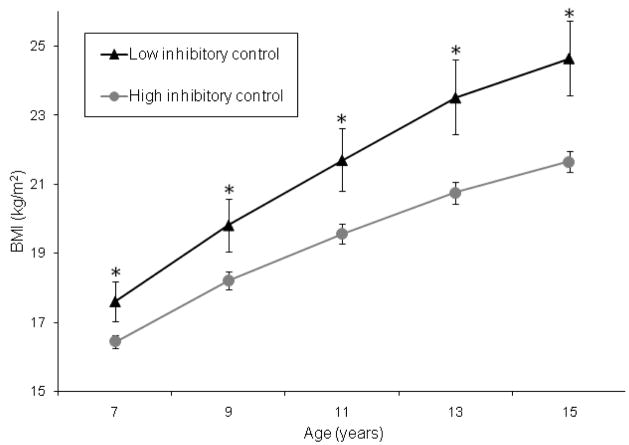
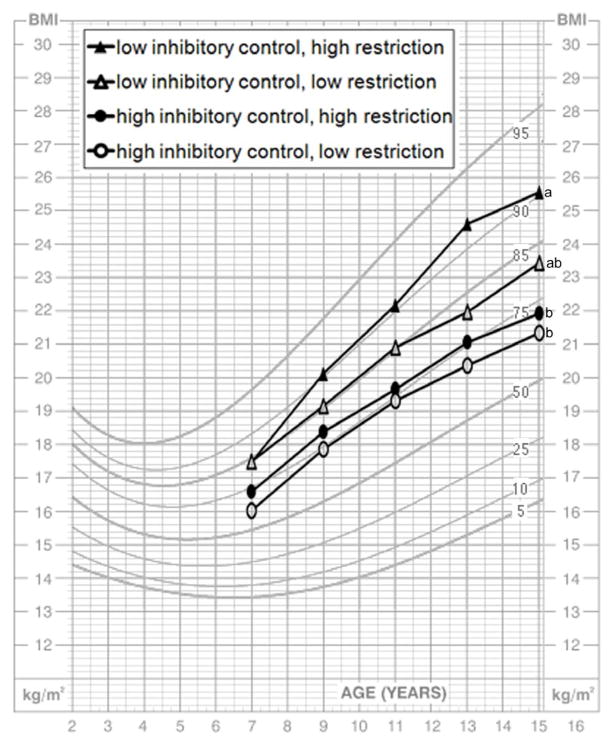
Results: Girls with lower inhibitory control at age 7 had higher concurrent BMIs, greater weight gain, higher BMIs at all subsequent time points, and were 1.95 times more likely to be overweight at age 15. Girls who perceived higher parental restriction exhibited the strongest inverse relation between inhibitory control and weight status.
Conclusion: Variability in inhibitory control could help identify individuals who are predisposed to obesity risk; the current findings also highlight the importance of parenting practices as potentially modifiable factors that exacerbate or attenuate this risk.
Conflict of interest statement
The authors declare no potential conflicts of interest.
Figures
Comment in
-
Internal versus external influences on energy intake: are disinhibited eaters born or created?J Pediatr. 2009 Nov;155(5):608-9. doi: 10.1016/j.jpeds.2009.06.041. Epub 2009 Aug 8. J Pediatr. 2009. PMID: 19665728 No abstract available.
References
-
- Rothbart MK, Ellis L, Posner M. Temperament and self-regulation. In: Baumeister R, Vohs K, editors. The handbook of self-regulation: Research, theory and applications. New York: Guilford Press; 2004. pp. 357–370.
-
- Kochanska G, Murray K, Coy KC. Inhibitory control as a contributor to conscience in childhood: From toddler to early school age. Child Development. 1997;68:263–277. - PubMed
-
- Wang L, Kliegel M, Liu W, Yang Z. Prospective memory performance in preschoolers: Inhibitory control matters. European Journal of Developmental Psychology. 2008;5:289–302.
-
- Schwebel DC. Temperamental risk factors for children’s unintentional injury: The role of impulsivity and inhibitory control. Personality and Individual Differences. 2004;37:567–578.
-
- Ivanov I, Schulz KP, Londo ED, Newcorn JH. Inhibitory control deficits in childhood and risk for substance use disorders: A review. American Journal of Drug and Alcohol Abuse. 2008;34:239–258. - PubMed
