


Perceived job insecurity and worker health in the United States
- PMID: 19596166
- PMCID: PMC2757283
- DOI: 10.1016/j.socscimed.2009.06.029
Perceived job insecurity and worker health in the United States
Abstract
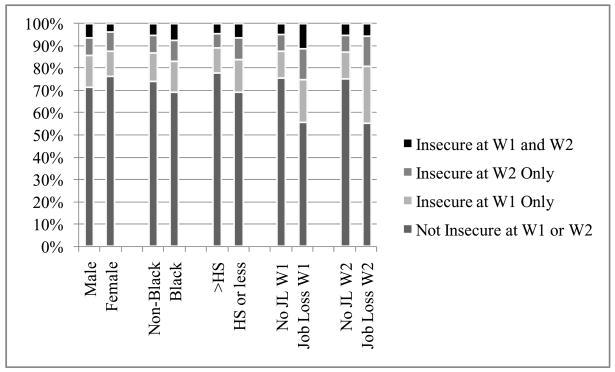
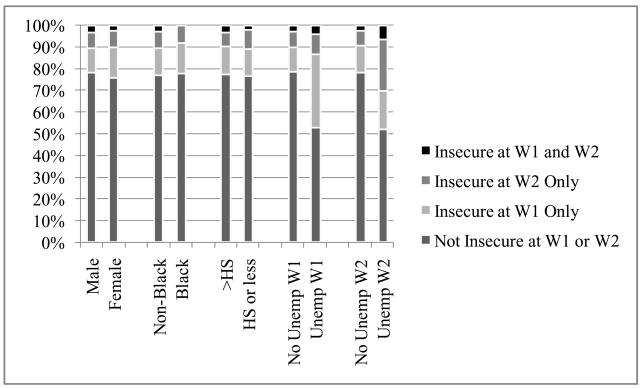
Economic recessions, the industrial shift from manufacturing toward service industries, and rising global competition have contributed to uncertainty about job security, with potential consequences for workers' health. To address limitations of prior research on the health consequences of perceived job insecurity, we use longitudinal data from two nationally-representative samples of the United States population, and examine episodic and persistent perceived job insecurity over periods of about three years to almost a decade. Results show that persistent perceived job insecurity is a significant and substantively important predictor of poorer self-rated health in the American's Changing Lives (ACL) and Midlife in the United States (MIDUS) samples, and of depressive symptoms among ACL respondents. Job losses or unemployment episodes are associated with perceived job insecurity, but do not account for its association with health. Results are robust to controls for sociodemographic and job characteristics, negative reporting style, and earlier health and health behaviors.
Figures
References
-
- Allison Paul. Using Panel Data to Estimate the Effects of Events. Sociological Methods and Research. 1994;23:174–199.
-
- Brief AP, Burke MJ, George JM, Robinson BS, Webster J. Should Negative Affectivity Remain an Unmeasured Variable in the Study of Job Stress? Journal of Applied Psychology. 1988;73:193–198. - PubMed
-
- Burgard Sarah A, Brand Jennie E, House James S. Toward a Better Estimation of the Effect of Job Loss on Health. Journal of Health and Social Behavior. 2007;48:369–384. - PubMed
-
- Cappelli P, Bassi L, Katz H, Knoke D, Osterman P, Useem M. Change at Work. New York: Oxford University Press; 1997.
-
- Catalano Ralph, Rook Karen, Dooley David. Labor Markets and Help-Seeking: A Test of the Employment Security Hypothesis. Journal of Health and Social Behavior. 1986;27:277–287. - PubMed
Publication types
MeSH terms
Grants and funding
LinkOut - more resources
Full Text Sources
Medical
