


A critical assessment of the role of helical intermediates in amyloid formation by natively unfolded proteins and polypeptides
- PMID: 19596696
- PMCID: PMC2719502
- DOI: 10.1093/protein/gzp036
A critical assessment of the role of helical intermediates in amyloid formation by natively unfolded proteins and polypeptides
Abstract
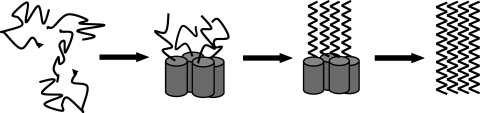
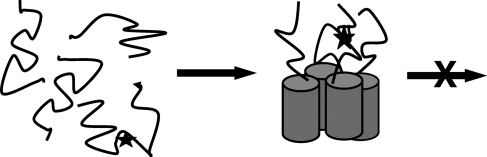
Amyloidogenic proteins and polypeptides can be divided into two structural classes, namely those which are flexible and are intrinsically disordered in their unaggregated state and those which form a compact globular structure with a well-defined tertiary fold in their normally soluble state. This review article is focused on amyloid formation by natively disordered polypeptides. Important examples of this class include islet amyloid polypeptide (IAPP, amylin), pro-IAPP processing intermediates, alpha-synuclein, the Abeta peptide, atrial natriuretic factor, calcitonin, pro-calcitonin, the medin polypeptide, as well as a range of de novo designed peptides. Amyloid formation is a complex process consisting of a lag phase during which no detectable fibril material is formed, followed by a rapid growth phase that leads to amyloid fibrils. A critical analysis of the literature suggests that a subset of intrinsically disordered polypeptides populate a helical intermediate during the lag phase. In this scenario, early formation of multimeric species is promoted by helix-helix association involving one region of the polypeptide chain which leads to a high effective concentration of an amyloidogenic sequence located in a different region of the chain. Helical intermediates appear to be particularly important in membrane-catalyzed amyloid formation and have been implicated in glycosaminoglycan mediated amyloid formation as well. There is suggestive evidence that targeting helix-helix interactions can be a viable strategy to inhibit amyloid formation. The characterization of transient helical intermediates is challenging, but new methods are being developed that offer the prospect of providing residue-specific information in real time.
Figures
References
-
- Abedini A., Raleigh D. Biochemistry. 2005;44:16284–16291. - PubMed
-
- Abedini A., Tracz S.M., Cho J., Raleigh D. Biochemistry. 2006;45:9228–9237. - PubMed
-
- Abedini A., Meng F., Raleigh D. J. Am. Chem. Soc. 2007;129:11300–11301. - PubMed
-
- Ancsin J.B. Amyloid: J. Protein Folding Disord. 2003;10:67–79. - PubMed
Publication types
MeSH terms
Substances
Grants and funding
LinkOut - more resources
Full Text Sources
