


Relationship between quality of care and functional decline in hospitalized vulnerable elders
- PMID: 19597372
- PMCID: PMC2751845
- DOI: 10.1097/MLR.0b013e3181a7e3ec
Relationship between quality of care and functional decline in hospitalized vulnerable elders
Abstract
Background: Although process of care is a valuable dimension of quality, process-of-care-based quality indicators (POC-QIs) are ideally associated with meaningful patient outcomes. The relationship between POC-QIs for hospitalized older patients and functional decline, a relevant outcome for older patients, is unknown.
Objective: To assess the relationship between POC-QIs for hospitalized elders and functional decline.
Research design: Observational cohort study.
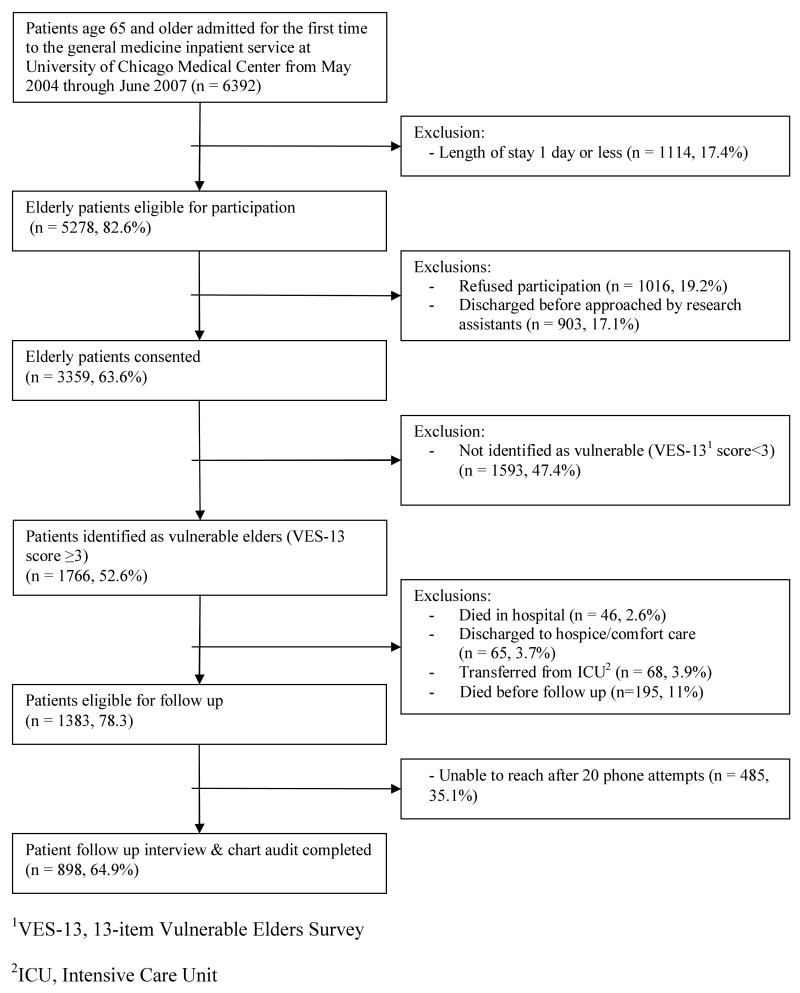
Subjects: Hospitalized vulnerable elder patients age 65 or older admitted to a general medicine inpatient service from June 1, 2004 to June 1, 2007.
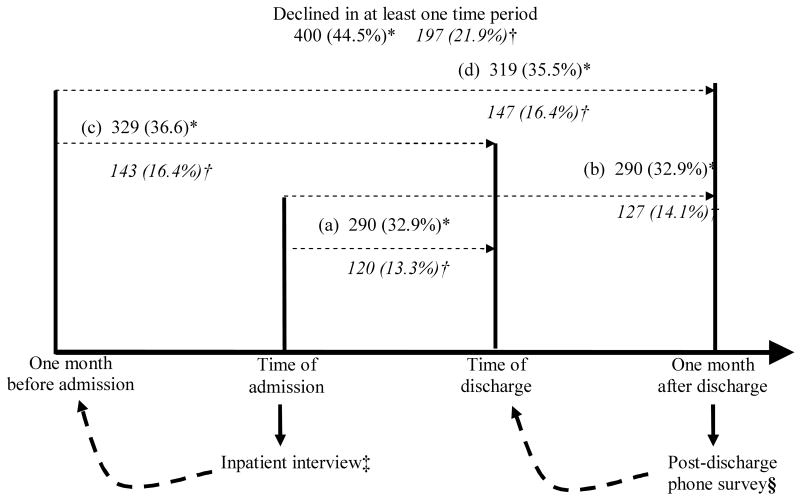
Measures: POC-QIs received by hospitalized patients (measured by Assessing Care of Vulnerable Elders QIs) and functional decline (increased activities of daily living impairments postdischarge).
Results: For 898 vulnerable elder patients, mean adherence to 6 universally applied quality indicators was 57.8%. After adjustment for factors likely associated with functional decline (comorbidity, vulnerability, baseline functional limitation, number of POC-QIs triggered, length of stay, code status, and interaction between frailty and QI adherence), there was no association higher quality of care (using the composite score) and increased risk of functional decline. Patients who received a mobility plan were 1.48 (95% CI: 1.07-2.05; P = 0.017) times more likely to suffer functional decline after discharge. Patients who received an assessment of nutritional status had a lower odds of suffering functional decline after discharge (OR: 0.37, [95% CI: 0.21-0.64; P < 0.001]).
Conclusions: Hospitalized vulnerable elders who receive higher quality of care, as measured by Assessing Care of Vulnerable Elders QIs, are not less likely to suffer decline after discharge.
Figures
References
-
- Bradley EH, Herrin J, Elbel B, et al. Hospital quality for acute myocardial infarction: correlation among process measures and relationship with short-term mortality. JAMA. 2006;296(1):72–8. - PubMed
-
- Rowe JW. Pay-for-performance and accountability: related themes in improving health care. Ann Intern Med. 2006;145(9):695–9. - PubMed
-
- Higashi T, Wenger NS, Adams JL, et al. Relationship between number of medical conditions and quality of care. N Engl J Med. 2007;356(24):2496–504. - PubMed
-
- Wenger NS, Shekelle PG. Assessing care of vulnerable elders: ACOVE project overview. Ann Intern Med. 2001;135(8 Pt 2):642–6. - PubMed
-
- Shekelle PG, MacLean CH, Morton SC, et al. Acove quality indicators. Ann Intern Med. 2001;135(8 Pt 2):653–67. - PubMed
Publication types
MeSH terms
Grants and funding
LinkOut - more resources
Full Text Sources
