


Interoceptive awareness declines with age
- PMID: 19602175
- PMCID: PMC2865139
- DOI: 10.1111/j.1469-8986.2009.00859.x
Interoceptive awareness declines with age
Abstract
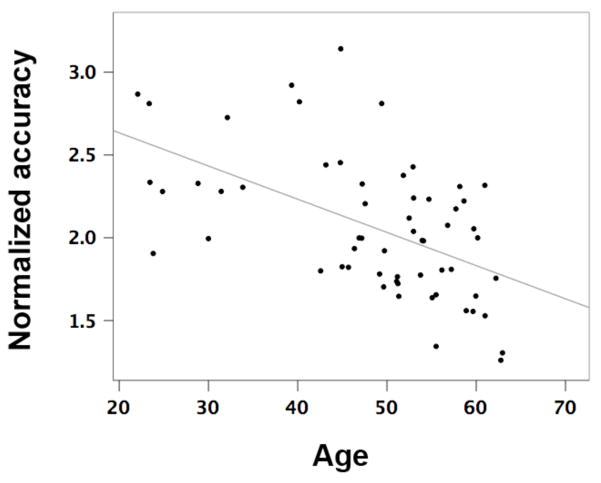
Aging has been shown to increase sensory thresholds for a variety of exteroceptive and proprioceptive stimuli. However, the influence of aging on interoceptive awareness has received relatively little empirical attention. Here we report an inverse association between aging and interoception, as indexed by the ability to sense the heartbeat at rest. In a group of 59 participants ranging in age from 22 to 63 years, age inversely predicted heartbeat detection ability, both within and across several measurement sessions. On average, age accounted for 30% of the variance in heartbeat detection accuracy. Other attribute variables including body mass index and sex were not related to heartbeat detection ability. These findings provide clear empirical evidence that interoception, much like exteroception and proprioception, declines with age.
Figures
References
-
- Andres P, Parmentier FB, Escera C. The effect of age on involuntary capture of attention by irrelevant sounds: a test of the frontal hypothesis of aging. Neuropsychologia. 2006;44(12):2564–8. - PubMed
-
- Barsky AJ, Ahern DK, Brener J, Surman OS, Ring C, Dec GW. Palpitations and cardiac awareness after heart transplantation. Psychosom Med. 1998;60(5):557–62. - PubMed
-
- Beck AT, Steer RA. Manual for the Beck depression inventory. San Antonio: The Psychological Corporation; 1993.
-
- Brener J, Kluvitse C. Heartbeat detection: judgments of the simultaneity of external stimuli and heartbeats. Psychophysiology. 1988;25(5):554–61. - PubMed
Publication types
MeSH terms
Grants and funding
LinkOut - more resources
Full Text Sources
Medical
