


Alcohol abuse and pulmonary disease
- PMID: 19602670
- PMCID: PMC4057657
- DOI: 10.1189/jlb.0209087
Alcohol abuse and pulmonary disease
Abstract
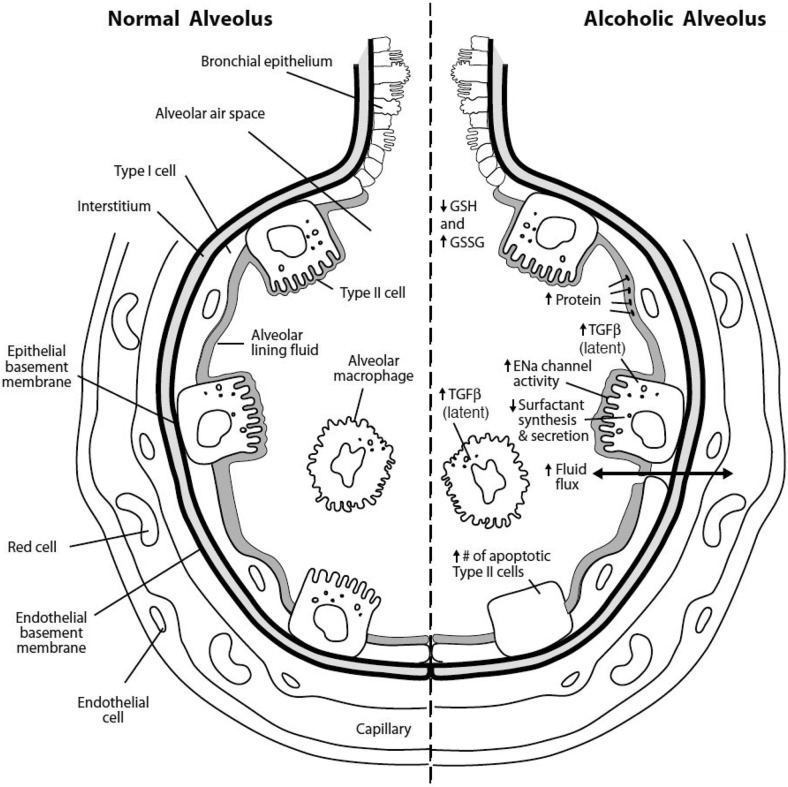
ARDS is a severe form of lung injury characterized by increased permeability of the alveolar capillary membrane, diffuse alveolar damage, the accumulation of proteinaceous interstitial and intra-alveolar edema, and the presence of hyaline membranes. These pathological changes are accompanied by physiological alterations, including severe hypoxemia, an increase in pulmonary dead space, and decreased pulmonary compliance. Approximately 200,000 individuals develop ARDS in the United States each year, and nearly 50% of these patients have a history of alcohol abuse. We have identified alcohol abuse as an independent risk factor for the development of ARDS, and more recent studies have validated these findings in patients following lung resection and blood transfusion. In ARDS survivors, alcohol abuse is also associated with an increased duration of mechanical ventilation and prolonged ICU length of stay. Despite studies aimed at improving outcomes in patients with ARDS, the mortality remains high at > 40%]. For those who abuse alcohol, the mortality is even higher, at 65%. In this review, we will discuss the relationship between alcohol abuse and ARDS, the effects of alcohol abuse on pulmonary function, and future directions and potential therapeutic targets for patients at risk for ARDS as a result of alcohol abuse, which impairs immune function, decreases pulmonary antioxidant capacity, decreases alveolar epithelial cell function, alters activation of the renin angiotensin system, and impairs GM-CSF signaling. These pathways represent potential therapeutic targets for patients at risk for ARDS as a result of alcohol abuse.
Figures
References
-
- Goss C. H., Brower R. G., Hudson L. D., Rubenfeld G. D. Incidence of acute lung injury in the United States. Crit Care Med. 2003;31:1607–1611. - PubMed
-
- Gajic O., Rana R., Winters J. L., Yilmaz M., Mendez J. L., Rickman O. B., O'Byrne M. M., Evenson L. K., Malinchoc M., DeGoey S. R., Afessa B., Hubmayr R. D., Moore S. B. Transfusion-related acute lung injury in the critically ill: prospective nested case-control study. Am J Respir Crit Care Med. 2007;176:886–891. - PMC - PubMed
-
- Licker M., de Perrot M., Spiliopoulos A., Robert J., Diaper J., Chevalley C., Tschopp J. M. Risk factors for acute lung injury after thoracic surgery for lung cancer. Anesth Analg. 2003;97:1558–1565. - PubMed
-
- Moss M., Bucher B., Moore F. A., Moore E. E., Parsons P. E. The role of chronic alcohol abuse in the development of acute respiratory distress syndrome in adults. JAMA. 1996;275:50–54. - PubMed
-
- Moss M., Parsons P. E., Steinberg K. P., Hudson L. D., Guidot D. M., Burnham E. L., Eaton S., Cotsonis G. A. Chronic alcohol abuse is associated with an increased incidence of acute respiratory distress syndrome and severity of multiple organ dysfunction in patients with septic shock. Crit Care Med. 2003;31:869–877. - PubMed
Publication types
MeSH terms
LinkOut - more resources
Full Text Sources
Medical
