


Monosomy of chromosome 10 associated with dysregulation of epidermal growth factor signaling in glioblastomas
- PMID: 19602687
- PMCID: PMC3089898
- DOI: 10.1001/jama.2009.1022
Monosomy of chromosome 10 associated with dysregulation of epidermal growth factor signaling in glioblastomas
Abstract
Context: Glioblastomas--uniformly fatal brain tumors--often have both monosomy of chromosome 10 and gains of the epidermal growth factor receptor (EGFR) gene locus on chromosome 7, an association for which the mechanism is poorly understood.
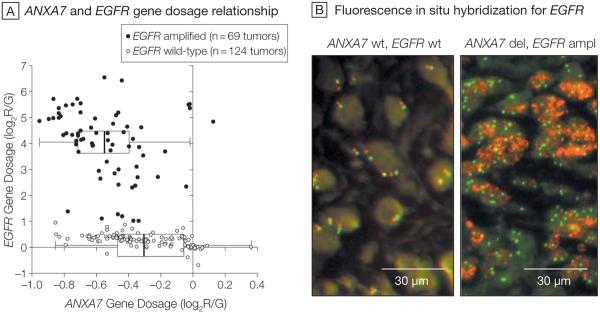
Objectives: To assess whether coselection of EGFR gains on 7p12 and monosomy 10 in glioblastomas promotes tumorigenic epidermal growth factor (EGF) signaling through loss of the annexin A7 (ANXA7) gene on 10q21.1-q21.2 and whether ANXA7 acts as a tumor suppressor gene by regulating EGFR in glioblastomas.
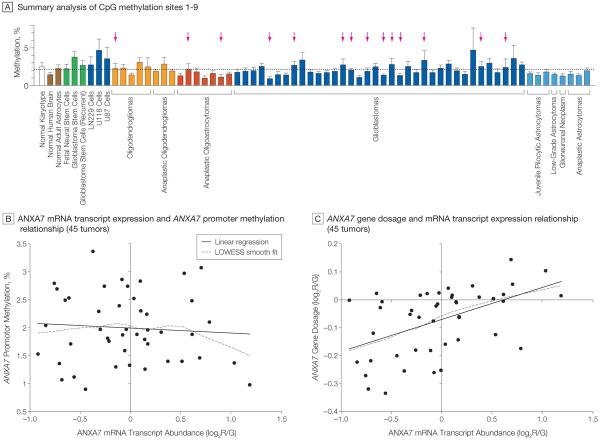
Design, setting, and patients: Multidimensional analysis of gene, coding sequence, promoter methylation, messenger RNA (mRNA) transcript, protein data for ANXA7 (and EGFR), and clinical patient data profiles of 543 high-grade gliomas from US medical centers and The Cancer Genome Atlas pilot project (made public 2006-2008; and unpublished, tumors collected 2001-2008). Functional analyses using LN229 and U87 glioblastoma cells.
Main outcome measures: Associations among ANXA7 gene dosage, coding sequence, promoter methylation, mRNA transcript, and protein expression. Effect of ANXA7 haploinsufficiency on EGFR signaling and patient survival. Joint effects of loss of ANXA7 and gain of EGFR expression on tumorigenesis.
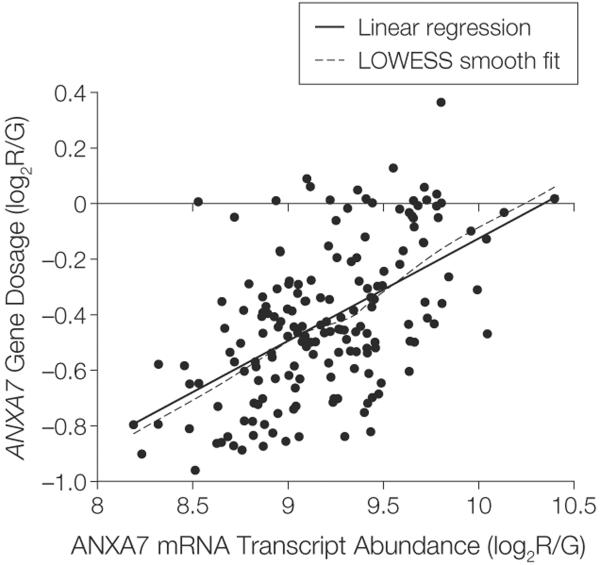
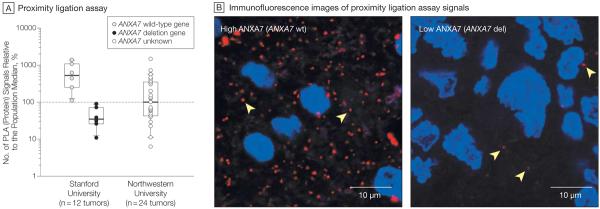
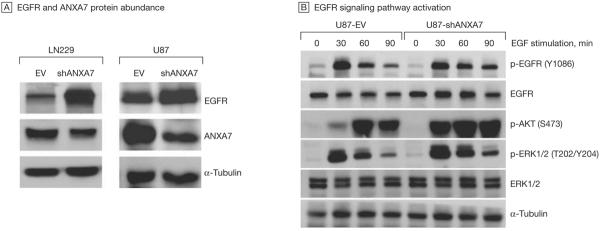
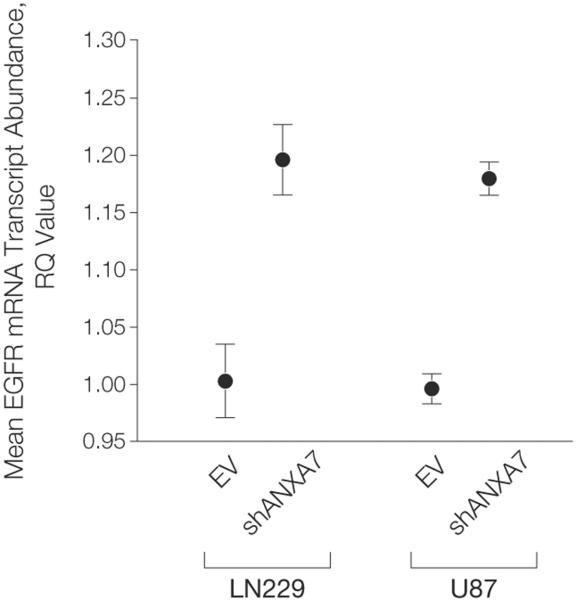
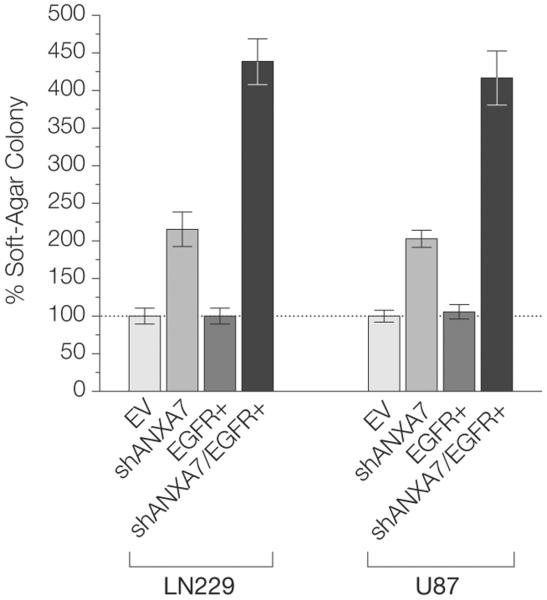
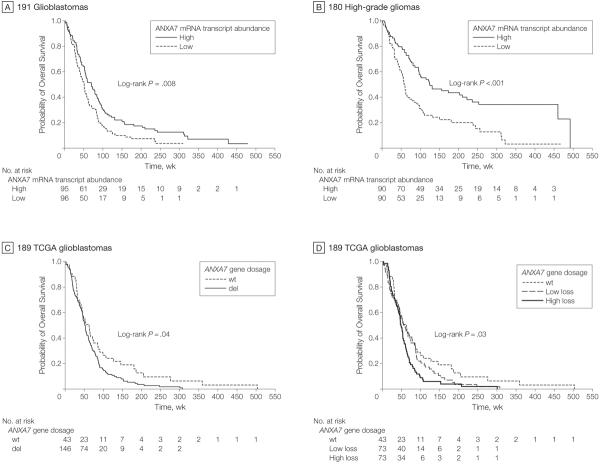
Results: Heterozygous ANXA7 gene deletion is associated with significant loss of ANXA7 mRNA transcript expression (P = 1 x 10(-15); linear regression) and a reduction (mean [SEM]) of 91.5% (2.3%) of ANXA7 protein expression compared with ANXA7 wild-type glioblastomas (P = .004; unpaired t test). ANXA7 loss of function stabilizes the EGFR protein (72%-744% increase in EGFR protein abundance) and augments EGFR transforming signaling in glioblastoma cells. ANXA7 haploinsufficiency doubles tumorigenic potential of glioblastoma cells, and combined ANXA7 knockdown and EGFR overexpression promotes tumorigenicity synergistically. The heterozygous loss of ANXA7 in approximately 75% of glioblastomas in the The Cancer Genome Atlas plus infrequency of ANXA7 mutation (approximately 6% of tumors) indicates its role as a haploinsufficiency gene. ANXA7 mRNA transcript expression, dichotomized at the median, associates with patient survival in 191 glioblastomas (log-rank P = .008; hazard ratio [HR], 0.667; 95% confidence interval [CI], 0.493-0.902; 46.9 vs 74.8 deaths/100 person-years for high vs low ANXA7 mRNA expression) and with a separate group of 180 high-grade gliomas (log-rank P = .00003; HR, 0.476; 95% CI, 0.333-0.680; 21.8 vs 50.0 deaths/100 person-years for high vs low ANXA7 mRNA expression). Deletion of the ANXA7 gene associates with poor patient survival in 189 glioblastomas (log-rank P = .042; HR, 0.686; 95% CI, 0.476-0.989; 54.0 vs 80.1 deaths/100 person-years for wild-type ANXA7 vs ANXA7 deletion).
Conclusion: Haploinsufficiency of the tumor suppressor ANXA7 due to monosomy of chromosome 10 provides a clinically relevant mechanism to augment EGFR signaling in glioblastomas beyond that resulting from amplification of the EGFR gene.
Figures
Comment in
-
One step forward toward identification of the genetic signature of glioblastomas.JAMA. 2009 Jul 15;302(3):325-6. doi: 10.1001/jama.2009.1023. JAMA. 2009. PMID: 19602695 No abstract available.
-
Malignant astrocytomas: a system disease.Arch Neurol. 2010 Mar;67(3):353-5. doi: 10.1001/archneurol.2010.19. Arch Neurol. 2010. PMID: 20212234 No abstract available.
References
-
- Duesberg P, Li R. Multistep carcinogenesis: a chain reaction of aneuploidizations. Cell Cycle. 2003;2(3):202–210. - PubMed
-
- Furge LL, Chen K, Cohen S. Annexin VII and annexin XI are tyrosine phosphorylated in peroxovana-date-treated dogs and in platelet-derived growth factor-treated rat vascular smooth muscle cells. J Biol Chem. 1999;274(47):33504–33509. - PubMed
-
- Gerke V, Creutz CE, Moss SE. Annexins: linking Ca2+ signalling to membrane dynamics. Nat Rev Mol Cell Biol. 2005;6(6):449–461. - PubMed
-
- Shirvan A, Srivastava M, Wang MG, et al. Divergent structure of the human synexin (annexin VII) gene and assignment to chromosome 10. Biochemistry. 1994;33(22):6888–6901. - PubMed
Publication types
MeSH terms
Substances
Grants and funding
LinkOut - more resources
Full Text Sources
Medical
Research Materials
Miscellaneous
