


Lumbar sympathetic blockade in children with complex regional pain syndromes: a double blind placebo-controlled crossover trial
- PMID: 19602962
- PMCID: PMC2724014
- DOI: 10.1097/ALN.0b013e3181aaea90
Lumbar sympathetic blockade in children with complex regional pain syndromes: a double blind placebo-controlled crossover trial
Abstract
Background: Sympathetic blockade is used in the management of complex regional pain syndromes in children, but there are no data on the efficacy or mechanism(s) by which it produces pain relief. The purpose of this study is to compare the efficacy of lidocaine administered by lumbar sympathetic to IV route.
Methods: Under general anesthesia, children with unilateral lower limb complex regional pain syndromes received catheters along the lumbar sympathetic chain. In a double-blind placebo-controlled crossover design, patients received IV lidocaine and lumbar sympathetic saline or lumbar sympathetic lidocaine and IV saline. Spontaneous and evoked pain ratings and sensory thresholds were assessed before and after these two lidocaine/saline doses and between routes of lumbar sympathetic blockade and IV.
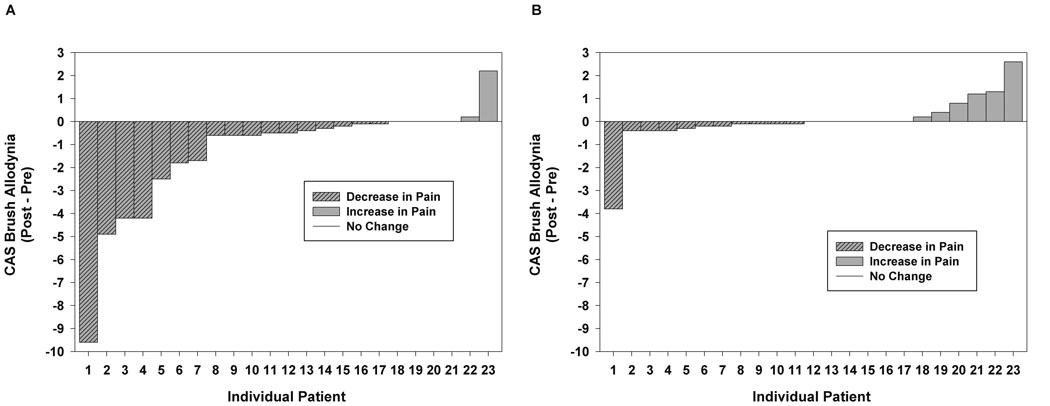
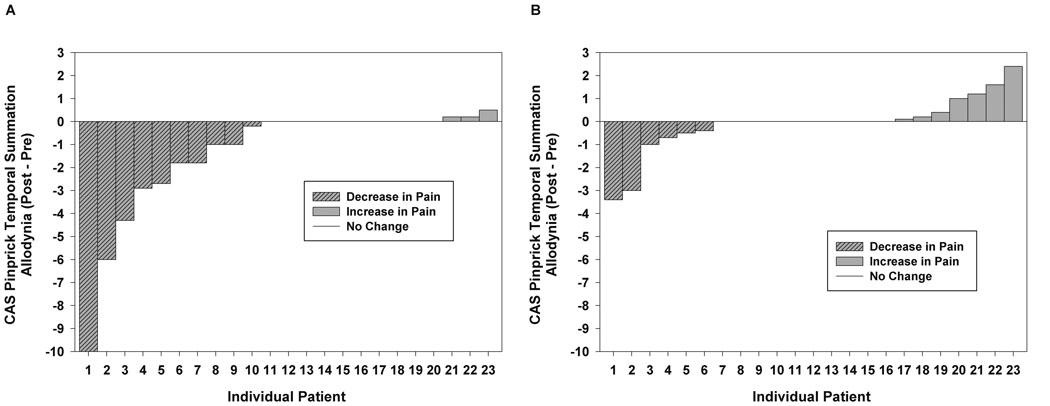
Results: Twenty-three patients, ages 10-18 yr, were enrolled. There was evidence for reduction of mean pain intensity of allodynia to brush (mean -1.4, 95% confidence interval [CI] -2.5 to -0.3) and to pinprick temporal summation (mean -1.3, 95% CI -2.5 to -0.2) with lidocaine treatment via the lumbar sympathetic blockade compared to IV route. Lumbar sympathetic blockade also produced significant reduction in pain intensity compared to pretreatment values of allodynia to brush, pinprick and pinprick temporal summation and verbal pain scores. IV lidocaine did not produce significant changes in spontaneous and evoked pain intensity measurements compared to pretreatment values. There were no carryover effects as assessed by route-by-period interaction.
Conclusions: Under the conditions of this study, the results provide some direct evidence that a component of pain may be mediated by abnormal sympathetic efferent activity.
Figures
References
-
- Lee BH, Scharff L, Sethna NF, McCarthy CF, Scott-Sutherland J, Shea AM, Sullivan P, Meier P, Zurakowski D, Masek BJ, Berde CB. Physical therapy and cognitive-behavioral treatment for complex regional pain syndromes. J Pediatr. 2002;141:135–140. - PubMed
-
- Cepeda MS, Lau J, Carr DB. Defining the therapeutic role of local anesthetic sympathetic blockade in complex regional pain syndrome: A narrative and systematic review. Clin J Pain. 2002;18:216–233. - PubMed
-
- Nelson DV, Stacey BR. Interventional therapies in the management of complex regional pain syndrome. Clin J Pain. 2006;22:438–442. - PubMed
-
- Sethna NF, Wilder RT. Regional anesthetic techniques for chronic pain. Pain in infants, children, and adolescents. In: Schechter NL, Berde CB, Yaster M, editors. Baltimore: Williams & Wilkins; 1993. pp. 281–293.
-
- Price DD, Long S, Wilsey B, Rafii A. Analysis of peak magnitude and duration of analgesia produced by local anesthetics injected into sympathetic ganglia of complex regional pain syndrome patients. Clin J Pain. 1998;14:216–226. - PubMed
Publication types
MeSH terms
Substances
Grants and funding
LinkOut - more resources
Full Text Sources
Medical
