Valsartan improves endothelial dysfunction in hypertension: a randomized, double-blind study
- PMID: 19604249
- PMCID: PMC2948429
- DOI: 10.1111/j.1755-5922.2009.00085.x
Valsartan improves endothelial dysfunction in hypertension: a randomized, double-blind study
Abstract
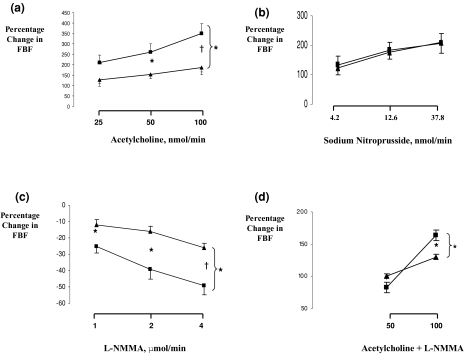
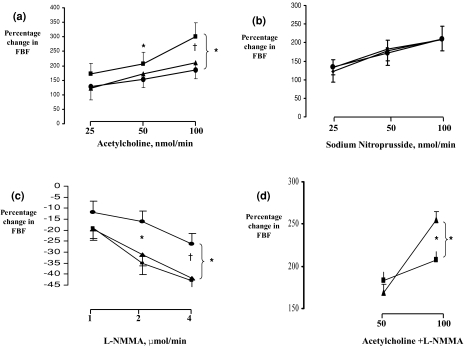
Endothelial dysfunction can predict cardiac outcomes in hypertension and reversing this abnormality has become an attractive therapeutic objective. We tested the hypothesis that blocking the angiotensin type 1 (AT(1)) receptor with valsartan in comparison with amlodipine would lead to an improvement in forearm resistance artery endothelial dysfunction. In total, 25 hypertensive subjects (mean age 60 years, SD 8) with a mean daytime ambulatory blood pressure (BP) of 154 (10)/97 (6) mmHg were randomized following a 3-week placebo run-in period to a double-blind, crossover trial of 16-week treatment periods with either valsartan or amlodipine, separated by a 3-week washout period. Intra-arterial infusions of acetylcholine (ACh) and N(G)-monomethyl-L-arginine (L-NMMA) were used to assess stimulated and basal endothelium-dependent nitric oxide (NO) release, respectively. Coinfusion of ACh and L-NMMA was employed to investigate the existence of an NO-independent vasodilatory pathway. Valsartan and amlodipine each lowered the clinical BP to the same extent (139 [7]/87 [6] and 139 [11]/89 [4] mmHg, respectively). The vasodilatory response to ACh was significantly increased with valsartan (maximal percentage change in forearm blood flow (max. DeltaFBF%) 301 [47] vs. 185 [34], mean [SEM]; P < 0.05) as compared with placebo, but remained unchanged with amlodipine. Both valsartan and amlodipine similarly increased the vasoconstrictive response to L-NMMA (max. DeltaFBF%-43 [5], -42 [5], respectively, vs. -26 [3] baseline; P < 0.001). The vasodilatory response after coinfusion of ACh and L-NMMA was significantly (P < 0.05) enhanced only with valsartan. Valsartan reserved peripheral endothelial dysfunction through both NO-dependent and -independent pathways, while for the same degree of BP control, amlodipine had only a partial effect on NO bioactivity.
Figures
References
-
- Calver A, Collier J, Moncada S, Vallance P. Effect of local intra-arterial NG-monomethyl-L-arginine in patients with hypertension: The nitric oxide dilator mechanism appears abnormal. J Hypertens. 1992;10:1025–1031. - PubMed
-
- Panza JA, Quyyumi AA, Brush JE, Jr, Epstein SE. Abnormal endothelium-dependent vascular relaxation in patients with essential hypertension. N Engl J Med. 1990;323:22–27. - PubMed
-
- Taddei S, Virdis A, Mattei P, Salvetti A. Vasodilation to acetylcholine in primary and secondary forms of human hypertension. Hypertension. 1993;21:929–933. - PubMed
-
- Modena MG, Bonetti L, Coppi F, Bursi F, Rossi R. Prognostic role of reversible endothelial dysfunction in hypertensive postmenopausal women. J Am Coll Cardiol. 2002;40:505–510. - PubMed
-
- Perticone F, Ceravolo R, Pujia A, et al. Prognostic significance of endothelial dysfunction in hypertensive patients. Circulation. 2001;104:191–196. - PubMed
Publication types
MeSH terms
Substances
LinkOut - more resources
Full Text Sources
Medical
Research Materials