


Review
doi: 10.1111/j.1365-2249.2009.03956.x.
Immunomodulation of innate immune responses by vasoactive intestinal peptide (VIP): its therapeutic potential in inflammatory disease
Affiliations
- PMID: 19604262
- PMCID: PMC2730848
- DOI: 10.1111/j.1365-2249.2009.03956.x
Item in Clipboard
Review
Immunomodulation of innate immune responses by vasoactive intestinal peptide (VIP): its therapeutic potential in inflammatory disease
Clin Exp Immunol.
2009 Aug.
Abstract
Since the late 1970s a number of laboratories have studied the role of vasoactive intestinal peptide (VIP) in inflammation and immunity. These studies have highlighted the dramatic effect of VIP on immune cell activation and function, and studies using animal models of disease have indicated that VIP has significant therapeutic and prophylactic potential. This review will focus on the effects of VIP on innate immune cell function and discuss the therapeutic potential for VIP in inflammatory diseases of humans.
Figures
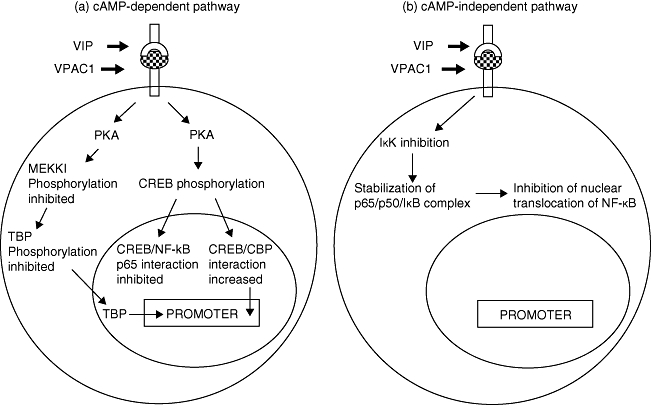
Vasoactive intestinal peptide (VIP) ligation of VPAC1 induces both (a) cyclic adenosine 5′-phosphate (cAMP)-dependent and (b) cAMP-independent signalling cascades.

Vasoactive intestinal peptide (VIP) inhibits production of reactive oxygen species (ROS) and promotes survival of wild-type Salmonella and avirulent Salmonella PhoP mutants in macrophages co-cultured with interferon (IFN)-γ. (a) Optical density measured following nitroblue tetrazolium (NBT) reduction assay in murine macrophages infected with S. typhimurium 14 028; S. typhimurium 4/74 or S. typhimurium 14028 PhoP mutants over 2–24 h post-infection (multiplicity of infection = 10) and co-cultured with IFN-γ (100 U/ml) with or without VIP (10−10 M);  = 2 h;
  = 7 h; □ = 24 h post-infection. Each bar represents the mean of five replicate experiments performed on three separate occasions. *Significant decrease (P < 0·05) in ROS production by VIP cultured cells compared to relevant corresponding treatment without VIP. (b) The number of salmonella colony-forming units recovered from murine macrophages co-cultured with IFN-γ (100 U/ml) with or without VIP (10−10 M) 2–24 h post-infection;
  = 2 h;
  = 7 h; □ = 24 h post-infection. Each bar represents the mean of five replicate experiments performed on three separate occasions.
= 2 h; = 7 h; □ = 24 h post-infection. Each bar represents the mean of five replicate experiments performed on three separate occasions. *Significant decrease (P < 0·05) in ROS production by VIP cultured cells compared to relevant corresponding treatment without VIP. (b) The number of salmonella colony-forming units recovered from murine macrophages co-cultured with IFN-γ (100 U/ml) with or without VIP (10−10 M) 2–24 h post-infection; = 2 h; = 7 h; □ = 24 h post-infection. Each bar represents the mean of five replicate experiments performed on three separate occasions.
Enzyme-linked immunosorbent assay (ELISA) analysis showing that vasoactive intestinal peptide (VIP) inhibits production of both interleukin (IL)-18 and IL-18Bpa in human THP1 monocytes stimulated with Escherichia coli lipopolysaccharide (LPS). Data shows the effect of VIP (10−8 M) on IL-18 and IL-18BPa production by human monocytic THP1 cells stimulated with E. coli LPS (100 ng/ml). Each bar represents the mean of five replicate experiments performed on three separate occasions. *Significant decrease (P < 0·05) in cytokine production when VIP is added to culture compared to corresponding response without VIP.

Fluorescence activated cell sorter (FACS) dot plots showing that vasoactive intestinal peptide (VIP) inhibits expression of Toll-like receptor (TLR)-2 and TLR-4 on the cell membrane of human monocytic (vit D3 differentiated) THP1 cells stimulated with bacterial lipopolysaccharide (LPS). (a) TLR-4 expression by unstimulated THP1 cells cultured for 48 h represents only 2·65% of the THP1 population. (b) Increased expression of TLR-4 in 38% of cell population (arrow) following culture with Escherichia coli LPS (100 ng/ml) for 48 h. (c) TLR-4 expressing THP1 population is reduced to 10·9% (arrow) when cultured with both E. coli LPS and VIP (10−8 M). (d) TLR-2 expression by unstimulated THP1 cells cultured for 48 h represents only 2·5% of the THP1 population. (e) Increased expression of TLR-2 in 27·83% of cell population (arrow) following culture with Porphyromonas gingivalis LPS (100 ng/ml) for 48 h. (f) TLR-2 expressing THP1 population is reduced to 13·24% (arrow) when cultured with both P. gingivalis LPS and VIP (10−8 M). (g) Isotype control, immunoglobulin (Ig)G2a, phycoerythrin (PE) (CD14) and IgG2a, fluorescein isothiocyanate (FITC) (TLR-2/TLR-4). Dot plots are representative of data obtained on at least 10 separate occasions.
References
-
- Said SI, Mutt V. A peptide fraction from lung tissue with prolonged vasodilatory activity. Scand J Clin Lab Invest. 107(Suppl 1969):51–6. - PubMed
-
- Said SI, Mutt V. Isolation from porcine intestinal wall of a vasoactive octacosapeptide related to secretin and to glucagon. Eur J Biochem. 1972;28:199–204. - PubMed
-
- Said SI, Rosenberg RN. Vasoactive intestinal polypeptide: abundant immunoreactivity in neuronal cell lines and normal nervous tissues. Science. 1976;192:907–8. - PubMed
-
- Henning RJ, Sawmiller DR. Vasoactive intestinal peptide: cardiovascular effects. Cardiovasc Res. 2001;49:27–37. - PubMed
-
- D'Amato M, De Beurme FA, Lefebvre RA. Comparison of the effect of vasoactive intestinal polypeptide and non-adrenergic non-cholinergic neurone stimulation in the cat gastric fundus. Eur J Pharmacol. 1988;152:71–82. - PubMed
Publication types
MeSH terms
Substances
LinkOut - more resources
Full Text Sources
Other Literature Sources
Medical
