


Identification of ongoing human immunodeficiency virus type 1 (HIV-1) replication in residual viremia during recombinant HIV-1 poxvirus immunizations in patients with clinically undetectable viral loads on durable suppressive highly active antiretroviral therapy
- PMID: 19605490
- PMCID: PMC2748010
- DOI: 10.1128/JVI.00570-09
Identification of ongoing human immunodeficiency virus type 1 (HIV-1) replication in residual viremia during recombinant HIV-1 poxvirus immunizations in patients with clinically undetectable viral loads on durable suppressive highly active antiretroviral therapy
Abstract
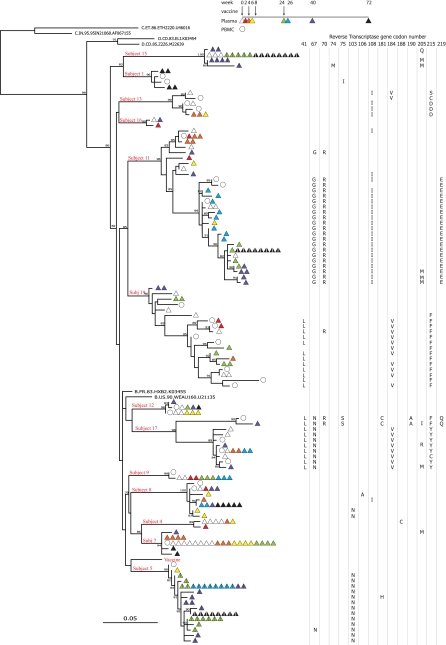
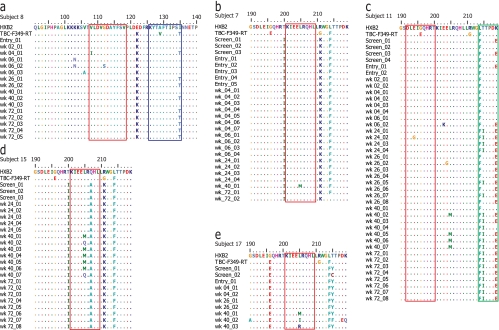
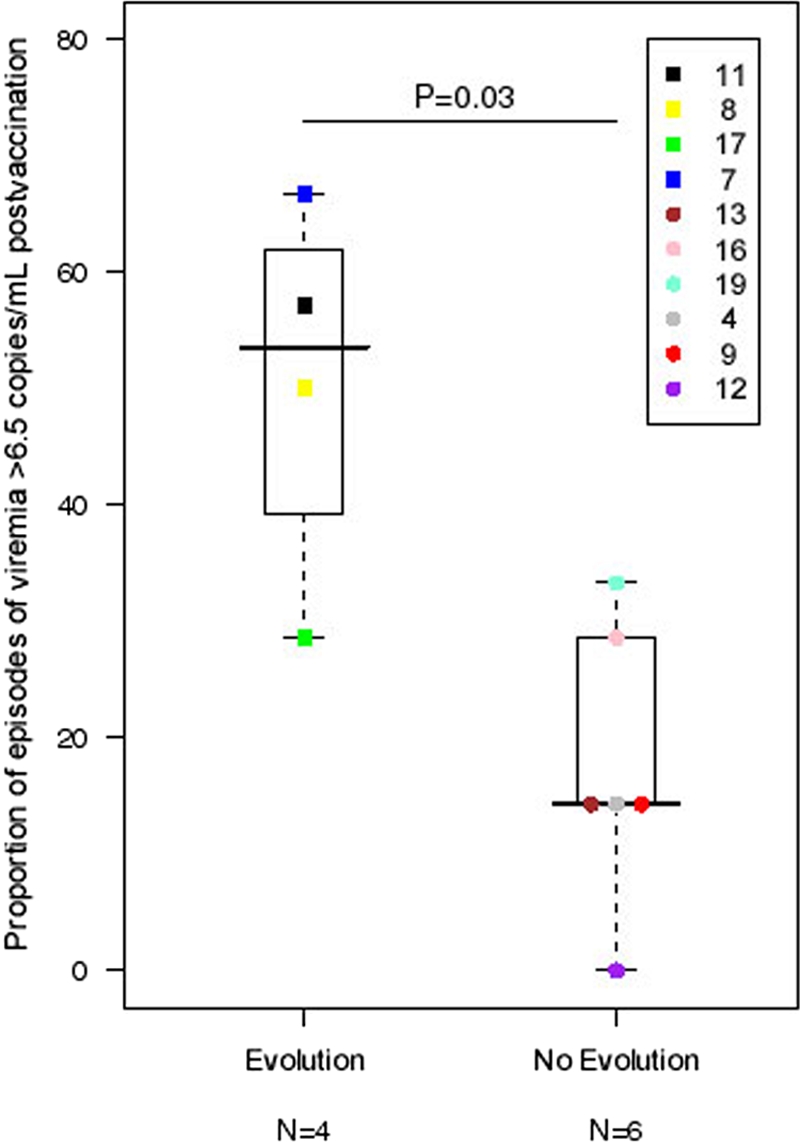
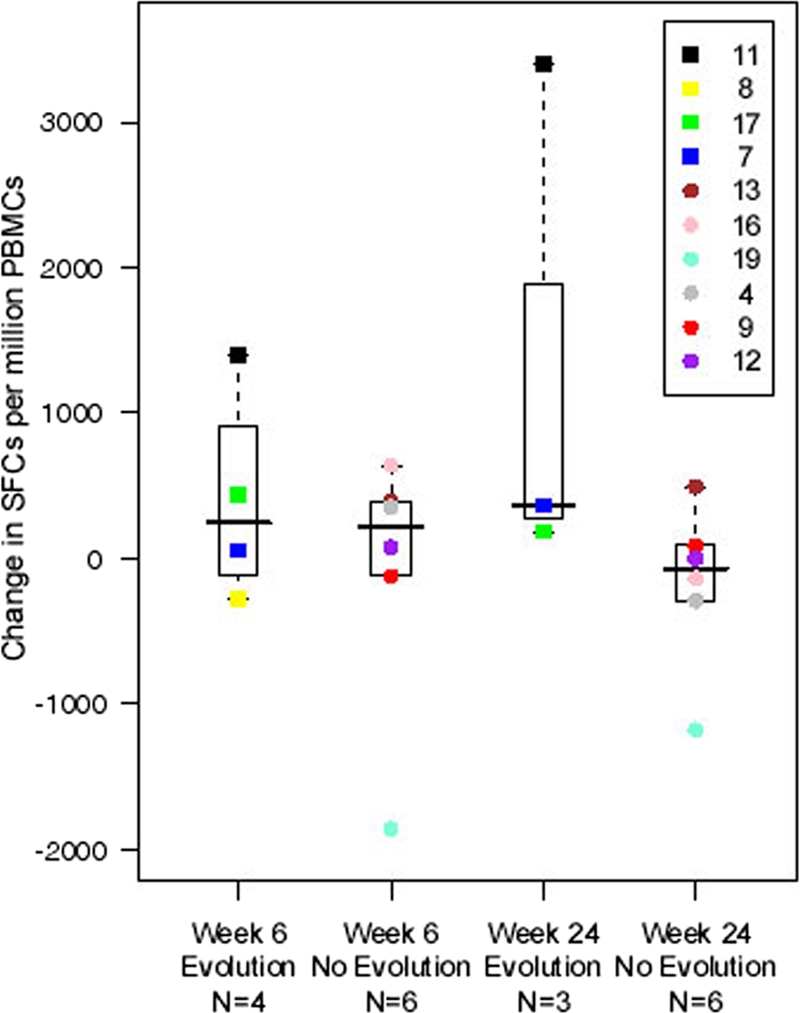
In most human immunodeficiency virus type 1 (HIV-1)-infected individuals who achieve viral loads of <50 copies/ml during highly active antiretroviral therapy (HAART), low levels of plasma virus remain detectable for years by ultrasensitive methods. The relative contributions of ongoing virus replication and virus production from HIV-1 reservoirs to persistent low-level viremia during HAART remain controversial. HIV-1 vaccination of HAART-treated individuals provides a model for examining low-level viremia, as immunizations may facilitate virus replication and sequence evolution. In a phase 1 trial of modified vaccinia virus Ankara/fowlpox virus-based HIV-1 vaccines in 20 HIV-infected young adults receiving HAART, we assessed the prevalence of low-level viremia and sequence evolution, using ultrasensitive viral load (<6.5 copies/ml) and genotyping (five-copy sensitivity) assays. Viral evolution, consisting of new drug resistance mutations and novel amino acid changes within a relevant HLA-restricted allele (e.g., methionine, isoleucine, glutamine, or arginine for leucine at position 205 of RT), was found in 1 and 3 of 20 subjects, respectively. Sequence evolution was significantly correlated with levels of viremia of between 6.5 and <50 copies/ml (P = 0.03) and was more likely to occur within epitopes presented by relevant HLA alleles (P < 0.001). These findings suggest that ongoing virus replication contributes to low-level viremia in patients on HAART and that this ongoing replication is subject to CD8(+) T-cell selective pressures.
Trial registration: ClinicalTrials.gov NCT00107549.
Figures
References
-
- Ananworanich, J., A. Gayet-Ageron, M. Le Braz, W. Prasithsirikul, P. Chetchotisakd, S. Kiertiburanakul, W. Munsakul, P. Raksakulkarn, S. Tansuphasawasdikul, S. Sirivichayakul, M. Cavassini, U. Karrer, D. Genne, R. Nuesch, P. Vernazza, E. Bernasconi, D. Leduc, C. Satchell, S. Yerly, L. Perrin, A. Hill, T. Perneger, P. Phanuphak, H. Furrer, D. Cooper, K. Ruxrungtham, and B. Hirschel. 2006. CD4-guided scheduled treatment interruptions compared with continuous therapy for patients infected with HIV-1: results of the Staccato randomised trial. Lancet 368:459-465. - PubMed
-
- Bailey, J. R., A. R. Sedaghat, T. Kieffer, T. Brennan, P. K. Lee, M. Wind-Rotolo, C. M. Haggerty, A. R. Kamireddi, Y. Liu, J. Lee, D. Persaud, J. E. Gallant, J. Cofrancesco, Jr., T. C. Quinn, C. O. Wilke, S. C. Ray, J. D. Siliciano, R. E. Nettles, and R. F. Siliciano. 2006. Residual human immunodeficiency virus type 1 viremia in some patients on antiretroviral therapy is dominated by a small number of invariant clones rarely found in circulating CD4+ T cells. J. Virol. 80:6441-6457. - PMC - PubMed
-
- Bailey, J. R., H. Zhang, B. W. Wegweiser, H. C. Yang, L. Herrera, A. Ahonkhai, T. M. Williams, R. F. Siliciano, and J. N. Blankson. 2007. Evolution of HIV-1 in an HLA-B*57-positive patient during virologic escape. J. Infect. Dis. 196:50-55. - PubMed
-
- Brown, A. J., H. M. Precious, J. M. Whitcomb, J. K. Wong, M. Quigg, W. Huang, E. S. Daar, R. T. D'Aquila, P. H. Keiser, E. Connick, N. S. Hellmann, C. J. Petropoulos, D. D. Richman, and S. J. Little. 2000. Reduced susceptibility of human immunodeficiency virus type 1 (HIV-1) from patients with primary HIV infection to nonnucleoside reverse transcriptase inhibitors is associated with variation at novel amino acid sites. J. Virol. 74:10269-10273. - PMC - PubMed
Publication types
MeSH terms
Substances
Associated data
Grants and funding
LinkOut - more resources
Full Text Sources
Other Literature Sources
Medical
Molecular Biology Databases
Research Materials
