. 2009 Sep;102(3):1868-79.
doi: 10.1152/jn.00063.2009. Epub 2009 Jul 15.

Changes in performance monitoring during sensorimotor adaptation

Affiliations

Changes in performance monitoring during sensorimotor adaptation

Joaquin A Anguera et al. J Neurophysiol. 2009 Sep.

Abstract

Error detection and correction are essential components of motor skill learning. These processes have been well characterized in cognitive psychology using electroencephalography (EEG) to record an event-related potential (ERP) called error-related negativity (ERN). However, it is unclear whether this ERP component is sensitive to the magnitude of the error made in a sensorimotor adaptation task. In the present study, we tested the function of error-related activity in a visuomotor adaptation task. To examine whether error size is reflected in the ERP, two groups of participants adapted manual aiming movements to either a small (30 degrees) or large (45 degrees) rotation of the visual feedback display. Each participant's trials were sorted into large and small error trials using a median split to examine potential error magnitude waveform differences. We also examined these trial types at the early and late stages of adaptation. There were no group differences for the behavioral or neural measures; however, waveforms from large error trials were significantly different from small error trials. The waveforms also changed as a function of practice as early adaptation waveforms were larger than late adaptation waveforms. The observed ERP component reflected differences in error magnitude with the amount of activity corresponding to the size of the error. Movement monitoring potentials likely affected the frequency and time course of the waveform so that it did not resemble the typical ERN; however, error-related activity was still distinguishable. The present findings are discussed in terms of current theories of the ERN as well as skill acquisition.


Figures
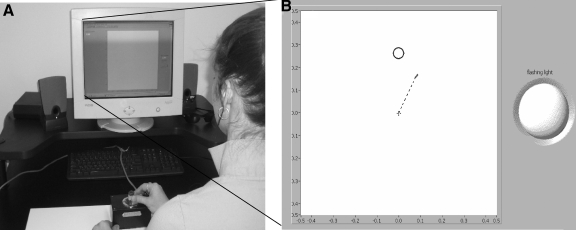
FIG. 1.
FIG. 1.
Experimental setup and initial endpoint error calculation. Participants viewed a computer screen from a distance of 60 cm with the joystick mounted via Velcro on the table in front of them (A). B: a screen shot of the computer screen during the task (including the flashing light for the photoreceptor). The dashed line drawn from the starting center point to the cursor illustrates a 30° perturbed trajectory during the early learning period when participants would aim the joystick directly toward the target.
FIG. 2.
FIG. 2.
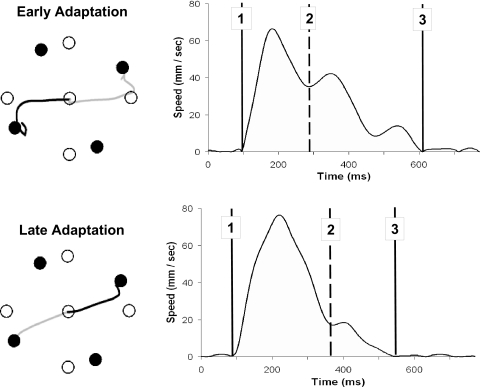
Spatial trajectories and corresponding velocity profiles (for each dark trajectory) during early and late adaptation. Top: a velocity profile from early adaptation under the 30° feedback rotation; bottom: a trial from the same subject during the late adaptation period. Point 1 is the movement onset, point 2 represents the initiation of the corrective phase [initial endpoint error (IEE)], and point 3 is the cursor's final endpoint position. ○, target location in visual space (including the center start position); •, the target locations in joystick space. The spatial trajectory is presented in joystick coordinates. Adaptation is evidenced by the straighter trajectories in the bottom comparison to the top.
FIG. 3.
FIG. 3.
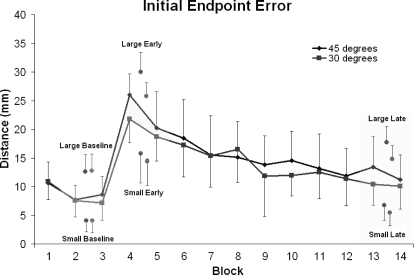
Group means and SDs for IEE are presented for each block of the experiment with the group pooled large/small error trial block pair indicated by a separate point within each respective stage (baseline, early, late). Blocks 1–3 were performed under nonperturbed conditions, whereas blocks 4–14 involved visual feedback of the cursor movement being rotated by 30°/ 45°. Adaptation is evidenced across blocks 4–14 as performance improved (e.g., mean block scores were closer to 0) with practice. There was no difference between perturbation groups at any stage.
FIG. 4.
FIG. 4.
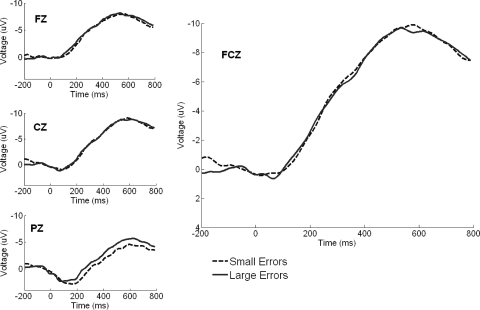
Large and small error trial waveforms time-locked to reaction time at selected central electrodes pooled across each stage, with activity at FCz highlighted. There was no difference between large and small error trial waveforms.
FIG. 5.
FIG. 5.
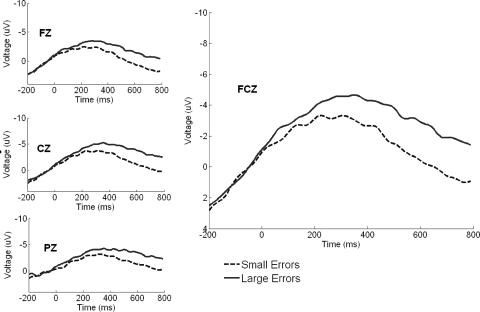
Large and small error trial waveforms time-locked to the initiation of the corrective submovement at selected central electrodes pooled across each stage with activity at FCz highlighted. Large error trials elicited significantly more activity vs. small error waveforms, reflecting a sensitivity to the size of the error experienced.
FIG. 6.
FIG. 6.
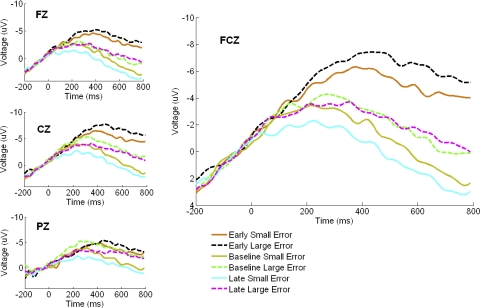
Large and small error trial waveforms time-locked to the initiation of the corrective submovement at selected central electrodes at each stage, with activity at FCz highlighted. Pooled early adaptation waveforms showed greater activity vs. pooled baseline or late adaptation waveforms, and early high and low error waveforms were distinct from one another.
FIG. 7.
FIG. 7.
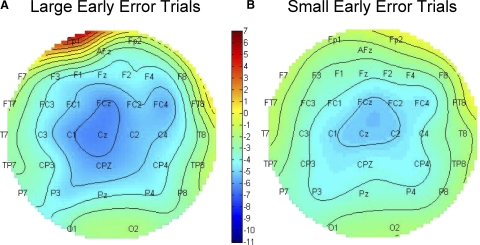
Scalp plots for early adaptation. Mean scalp plot of all subjects between 100 and 600 ms after onset of the movement correction at the early stage. A: mean activity of large error trials; B: small error trials.

References

    1. Adams J. A closed-loop theory of motor learning. J Mot Behav 3: 111–149, 1971. - PubMed
    1. Anguera J, Russell C, Noll D, Seidler R. Neural correlates associated with intermanual transfer of sensorimotor adaptation. Brain Res 1185: 136–151, 2007. - PubMed
    1. Badgaiyan R, Posner M. Mapping the cingulate cortex in response selection and monitoring. Neuroimage 7: 255–260, 1998. - PubMed
    1. Barto A. Reinforcement learning in motor control. Curr Opin Neurobiol 4: 888–893, 1994. - PubMed
    1. Barto A. Reinforcement learning In: Handbook of Brain Theory and Neural Networks (2nd ed.), edited by Arbib MA.Cambridge: MIT Press, 2003a, p. 963–968.

Publication types

MeSH terms

LinkOut - more resources