


A toolbox for the fast information analysis of multiple-site LFP, EEG and spike train recordings
- PMID: 19607698
- PMCID: PMC2723115
- DOI: 10.1186/1471-2202-10-81
A toolbox for the fast information analysis of multiple-site LFP, EEG and spike train recordings
Abstract
Background: Information theory is an increasingly popular framework for studying how the brain encodes sensory information. Despite its widespread use for the analysis of spike trains of single neurons and of small neural populations, its application to the analysis of other types of neurophysiological signals (EEGs, LFPs, BOLD) has remained relatively limited so far. This is due to the limited-sampling bias which affects calculation of information, to the complexity of the techniques to eliminate the bias, and to the lack of publicly available fast routines for the information analysis of multi-dimensional responses.
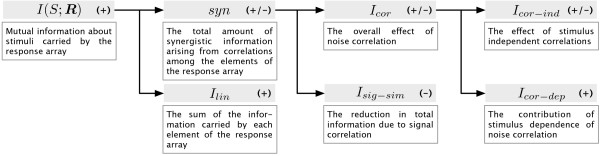
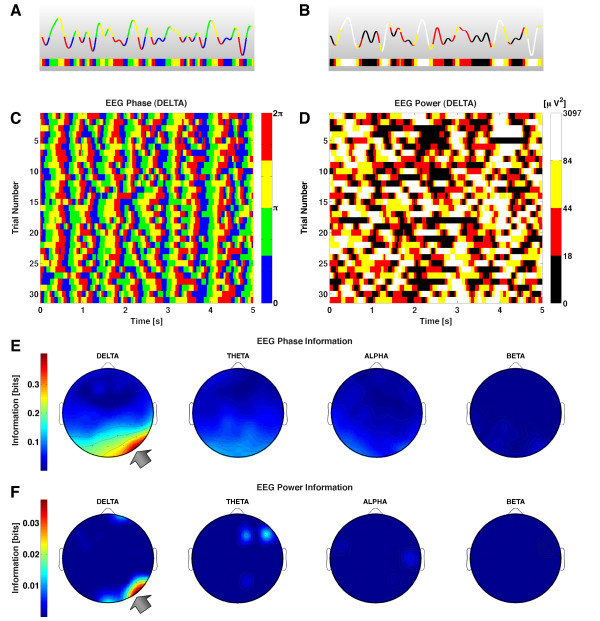
Results: Here we introduce a new C- and Matlab-based information theoretic toolbox, specifically developed for neuroscience data. This toolbox implements a novel computationally-optimized algorithm for estimating many of the main information theoretic quantities and bias correction techniques used in neuroscience applications. We illustrate and test the toolbox in several ways. First, we verify that these algorithms provide accurate and unbiased estimates of the information carried by analog brain signals (i.e. LFPs, EEGs, or BOLD) even when using limited amounts of experimental data. This test is important since existing algorithms were so far tested primarily on spike trains. Second, we apply the toolbox to the analysis of EEGs recorded from a subject watching natural movies, and we characterize the electrodes locations, frequencies and signal features carrying the most visual information. Third, we explain how the toolbox can be used to break down the information carried by different features of the neural signal into distinct components reflecting different ways in which correlations between parts of the neural signal contribute to coding. We illustrate this breakdown by analyzing LFPs recorded from primary visual cortex during presentation of naturalistic movies.
Conclusion: The new toolbox presented here implements fast and data-robust computations of the most relevant quantities used in information theoretic analysis of neural data. The toolbox can be easily used within Matlab, the environment used by most neuroscience laboratories for the acquisition, preprocessing and plotting of neural data. It can therefore significantly enlarge the domain of application of information theory to neuroscience, and lead to new discoveries about the neural code.
Figures
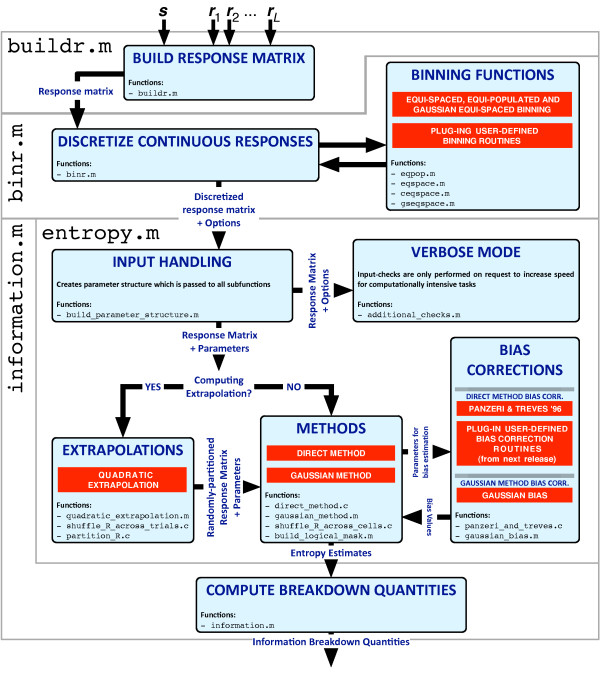
 -long arrays: the first array stores a list specifying, for each trial, which stimulus was presented to the subject while the L remaining arrays specify the L corresponding recorded responses.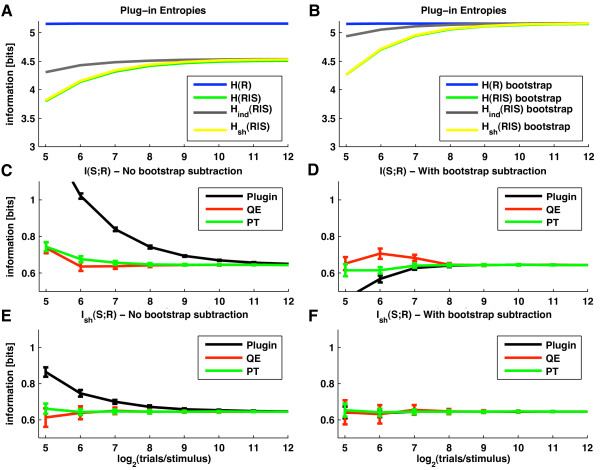
 ,
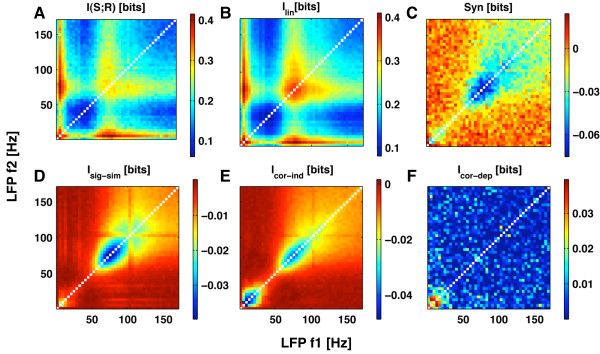
,  ), conveyed jointly about the stimulus by pairs of LFP power responses B: The linear sum, Ilin(S; , ), of the information conveyed independently by each response. C: The synergy syn(, ), between the responses at the two frequencies. D: The signal-similarity term Isig-sim E: The stimulus-independent noise correlation component Icor-ind F: the stimulus-dependent correlational component Icor-dep.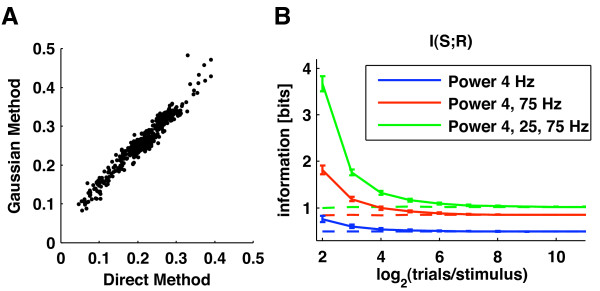
References
-
- Shannon C. A mathematical theory of communcation. Bell Systems Technical Journal. 1948;27:379–423.
-
- Cover TM, Thomas JA. Elements of information theory. New York: John Wiley; 2006.
-
- Rieke F, Warland D, van Steveninck R, Bialek W. Spikes: exploring the neural code. Cambridge: MIT Press; 1997.
Publication types
MeSH terms
LinkOut - more resources
Full Text Sources
