. 2009 Jul 16:10:321.
doi: 10.1186/1471-2164-10-321.

Exaptation of an ancient Alu short interspersed element provides a highly conserved vitamin D-mediated innate immune response in humans and primates

Affiliations

Exaptation of an ancient Alu short interspersed element provides a highly conserved vitamin D-mediated innate immune response in humans and primates

Adrian F Gombart et al. BMC Genomics. .

Abstract

Background: About 45% of the human genome is comprised of mobile transposable elements or "junk DNA". The exaptation or co-option of these elements to provide important cellular functions is hypothesized to have played a powerful force in evolution; however, proven examples are rare. An ancient primate-specific Alu short interspersed element (SINE) put the human CAMP gene under the regulation of the vitamin D pathway by providing a perfect vitamin D receptor binding element (VDRE) in its promoter. Subsequent studies demonstrated that the vitamin D-cathelicidin pathway may be a key component of a novel innate immune response of human to infection. The lack of evolutionary conservation in non-primate mammals suggested that this is a primate-specific adaptation. Evidence for evolutionary conservation of this regulation in additional primate lineages would provide strong evidence that the TLR2/1-vitamin D-cathelicidin pathway evolved as a biologically important immune response mechanism protecting human and non-human primates against infection.

Results: PCR-based amplification of the Alu SINE from human and non-human primate genomic DNA and subsequent sequence analysis, revealed perfect structural conservation of the VDRE in all primates examined. Reporter gene studies and induction of the endogenous CAMP gene in Rhesus macaque peripheral blood mononuclear cells demonstrated that the VDREs were conserved functionally. In addition, New World monkeys (NWMs) have maintained additional, functional steroid-hormone receptor binding sites in the AluSx SINE that confer retinoic acid responsiveness and provide potential thyroid hormone receptor binding sites. These sites were less well-conserved during human, ape and Old World monkey (OWM) evolution and the human CAMP gene does not respond to either retinoic acid or thyroid hormone.

Conclusion: We demonstrated that the VDRE in the CAMP gene originated from the exaptation of an AluSx SINE in the lineage leading to humans, apes, OWMs and NWMs and remained under purifying selection for the last 55-60 million years. We present convincing evidence of an evolutionarily fixed, Alu-mediated divergence in steroid hormone nuclear receptor gene regulation between humans/primates and other mammals. Evolutionary selection to place the primate CAMP gene under regulation of the vitamin D pathway potentiates the innate immune response and may counter the anti-inflammatory properties of vitamin D.


Figures

Figure 1
Figure 1
Conservation of the VDRE-containing AluSx SINEs in humans, apes, OWMs and NWMs. A) Amplification of the AluSx SINEs from a panel of non-human primates and humans. Products of the expected size were found in all but three primates. The increase in fragment sizes for M. mulatta, S. labiatus and C. jacchus was due to an additional Alu insertion. B) Schematic indicating the position and type of Alu insertion that was identified from sequencing the PCR products amplified in panel A. The location of the VDRE is indicated by the arrow. C) The nucleotide sequences of each AluSx SINE amplified in panel A were aligned with the AluSx consensus sequence [74]. The positions of the A- and B-boxes are indicated by an underline and the position of the VDRE is outlined by a box.
Figure 2
Figure 2
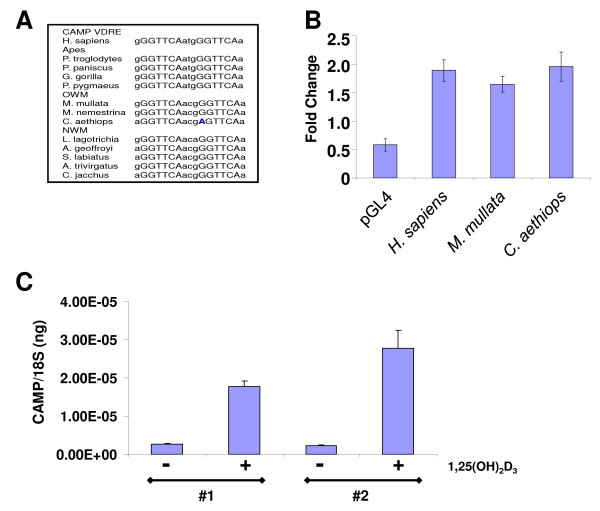
Structural and functional conservation of the VDREs in primate promoters. A) The nucleotide sequence of each primate VDRE is aligned to demonstrate the high degree of conservation of the direct repeats (upper case) and 3-bp spacer (lower case). C. aethiops contained a G-to-A change in the second direct repeat otherwise all the direct repeats were identical. B) To determine if primate VDREs were activated by 1,25(OH)2D3, the amplified Alus for H. sapiens, M. mulatta and C. aethiops were subcloned into the pGL4 luciferase reporter vector. The constructs were co-transfected into U937 cells with phTKRL (Promega) to control for efficiency. The change in expression is represented as fold-change comparing vehicle treated to 1,25(OH)2D3 treated cells. C) Mononuclear cells were isolated from the peripheral blood of two individual M. mullata and treated with either vehicle or 100 nM 1,25(OH)2D3 for 48 h. The expression level of CAMP mRNA was determined by QRT-PCR and normalized to 18S levels. The data are represented as ng of CAMP per ng of 18S.
Figure 3
Figure 3
Potential retinoic acid and thyroid hormone receptor binding sites conserved in AluSx of NWMs. The nucleotide sequence (1–89) of the AluSx of each primate was aligned with the consensus AluSx sequence. The location of four direct repeats is indicated within each box with the consensus sequence indicated below each. The potential retinoic acid receptor binding sites (DR2) and the thyroid hormone binding site (DR4) are indicated above the boxes. The locations of the A- and B-boxes of the Alu are indicated below the sequences. The G-to-A and C-to-A change in positions three and five in the third direct repeat occurs in the human, all apes and OWMs, but not NWMs. These changes would likely abrogate binding of TR and RAR to the DR4 and the second DR2, respectively. All NWMs acquired a G-to-A change in the sixth position of the fourth direct repeat thus creating a potentially better DR2 for retinoic acid receptor binding. The third direct repeat in NWMs was unchanged from the consensus Alu sequence and would provide an ideal direct repeat providing a potentially functional DR4 and DR2.
Figure 4
Figure 4
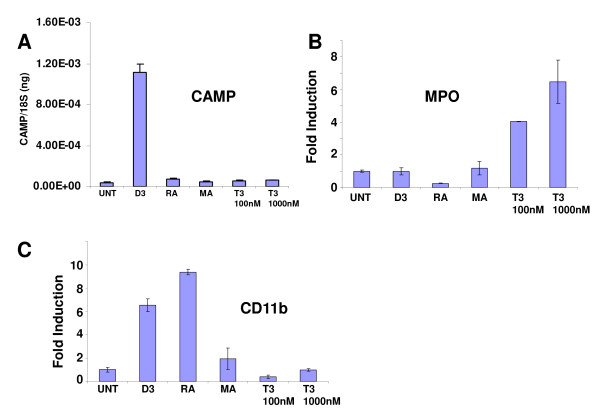
The human CAMP gene does not respond to retinoic acid or thyroid hormone treatment. The human myeloid cell line NB4 was treated with either vehicle (UNT), 1,25(OH)2D3 (D3), retinoic acid (RA), methoprene acid (MA) or thyroid hormone (T3). Expression of either A) CAMP, B) MPO or C) CDllb was determined by QRT-PCR and normalized to 18S rRNA.
Figure 5
Figure 5
The NWM CAMP gene responds to retinoic acid. The marmoset (C. jacchus) B-cell line B95-8 was treated with increasing doses of either ATRA (0.5 to 500 nM) or T3 (0.1 to 100 nM) for 24 h. Relative fold-change compared with untreated cells was determined for CAMP gene expression (normalized to 18S rRNA) using QRT-PCR. CAMP gene expression decreased for ATRA treatment in a dose-dependent fashion. CAMP gene expression was unaffected by T3 treatment.

References

    1. Waring M, Britten RJ. Nucleotide sequence repetition: a rapidly reassociating fraction of mouse DNA. Science. 1966;154:791–794. doi: 10.1126/science.154.3750.791. - DOI - PubMed
    1. Britten RJ, Kohne DE. Repeated sequences in DNA. Hundreds of thousands of copies of DNA sequences have been incorporated into the genomes of higher organisms. Science. 1968;161:529–540. doi: 10.1126/science.161.3841.529. - DOI - PubMed
    1. Britten RJ, Davidson EH. Gene regulation for higher cells: a theory. Science. 1969;165:349–357. doi: 10.1126/science.165.3891.349. - DOI - PubMed
    1. Britten RJ, Davidson EH. Repetitive and non-repetitive DNA sequences and a speculation on the origins of evolutionary novelty. Q Rev Biol. 1971;46:111–138. doi: 10.1086/406830. - DOI - PubMed
    1. Lander ES, Linton LM, Birren B, Nusbaum C, Zody MC, Baldwin J, Devon K, Dewar K, Doyle M, FitzHugh W, et al. Initial sequencing and analysis of the human genome. Nature. 2001;409:860–921. doi: 10.1038/35057062. - DOI - PubMed

Publication types

Substances