


Organotypic culture model of pancreatic cancer demonstrates that stromal cells modulate E-cadherin, beta-catenin, and Ezrin expression in tumor cells
- PMID: 19608876
- PMCID: PMC2716963
- DOI: 10.2353/ajpath.2009.090131
Organotypic culture model of pancreatic cancer demonstrates that stromal cells modulate E-cadherin, beta-catenin, and Ezrin expression in tumor cells
Abstract
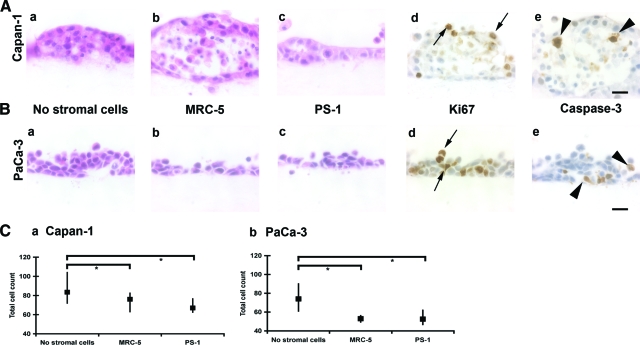
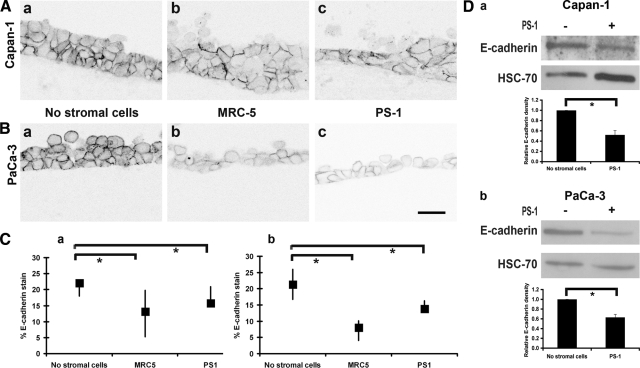
Pancreatic cancer is characterized by an intense stromal reaction. Reproducible three-dimensional in vitro systems for exploring interactions of the stroma with pancreatic cancer cells have not previously been available, prompting us to develop such a model. Cancer cells were grown on collagen/Matrigel and embedded with or without stromal cells (hTERT-immortalized human PS-1 stellate cells or MRC-5 fibroblasts) for 7 days. Proliferation and apoptosis, as well as important cell-cell adhesion and cytoskeleton-regulating proteins, were studied. PS-1 cells were confirmed as stellate based on the expression of key cytoskeletal proteins and lipid vesicles. Capan-1, and to a lesser extent PaCa-3, cells differentiated into luminal structures, exhibiting a central apoptotic core with a proliferating peripheral rim and an apico-basal polarity. Presence of either stromal cell type translocated Ezrin from apical (when stromal cells were absent) to basal aspects of cancer cells, where it was associated with invasive activity. Interestingly, the presence of 'normal' (not tumor-derived) stromal cells induced total tumor cell number reduction (P < 0.005) associated with a significant decrease in E-cadherin expression (P < 0.005). Conversely, beta-catenin expression was up-regulated (P < 0.01) in the presence of stromal cells with predominant cytoplasmic expression. Moreover, patient samples confirmed that these data recapitulated the clinical situation. In conclusion, pancreatic organotypic culture offers a reproducible, bio-mimetic, three-dimensional in vitro model that allows examination of the interactions between stromal elements and pancreatic cancer cells.
Figures




References
-
- O'Sullivan A, Kocher HM: Pancreatic cancer. BMJ Clin Evid 2007, 11:409–436. Available online at http://clinicalevidence.bmj.com (accessed Oct 2008). Subscription only. - PubMed
-
- Jones S, Zhang X, Parsons DW, Lin JC, Leary RJ, Angenendt P, Mankoo P, Carter H, Kamiyama H, Jimeno A, Hong SM, Fu B, Lin MT, Calhoun ES, Kamiyama M, Walter K, Nikolskaya T, Nikolsky Y, Hartigan J, Smith DR, Hidalgo M, Leach SD, Klein AP, Jaffee EM, Goggins M, Maitra A, Iacobuzio-Donahue C, Eshleman JR, Kern SE, Hruban RH, Karchin R, Papadopoulos N, Parmigiani G, Vogelstein B, Velculescu VE, Kinzler KW. Core signaling pathways in human pancreatic cancers revealed by global genomic analyses. Science. 2008;321:1801–1806. - PMC - PubMed
-
- Gaggioli C, Hooper S, Hidalgo-Carcedo C, Grosse R, Marshall JF, Harrington K, Sahai E. Fibroblast-led collective invasion of carcinoma cells with differing roles for RhoGTPases in leading and following cells. Nat Cell Biol. 2007;9:1392–1400. - PubMed
-
- Beacham DA, Cukierman E. Stromagenesis: the changing face of fibroblastic microenvironments during tumor progression. Semin Cancer Biol. 2005;15:329–341. - PubMed
Publication types
MeSH terms
Substances
Grants and funding
LinkOut - more resources
Full Text Sources
Other Literature Sources
Medical
