Review
. 2009 Jul 17;325(5938):284-8.
doi: 10.1126/science.1175626.

Foundations for a new science of learning

Affiliations
Review

Foundations for a new science of learning

Andrew N Meltzoff et al. Science. .

Abstract

Human learning is distinguished by the range and complexity of skills that can be learned and the degree of abstraction that can be achieved compared with those of other species. Homo sapiens is also the only species that has developed formal ways to enhance learning: teachers, schools, and curricula. Human infants have an intense interest in people and their behavior and possess powerful implicit learning mechanisms that are affected by social interaction. Neuroscientists are beginning to understand the brain mechanisms underlying learning and how shared brain systems for perception and action support social learning. Machine learning algorithms are being developed that allow robots and computers to learn autonomously. New insights from many different fields are converging to create a new science of learning that may transform educational practices.


Figures
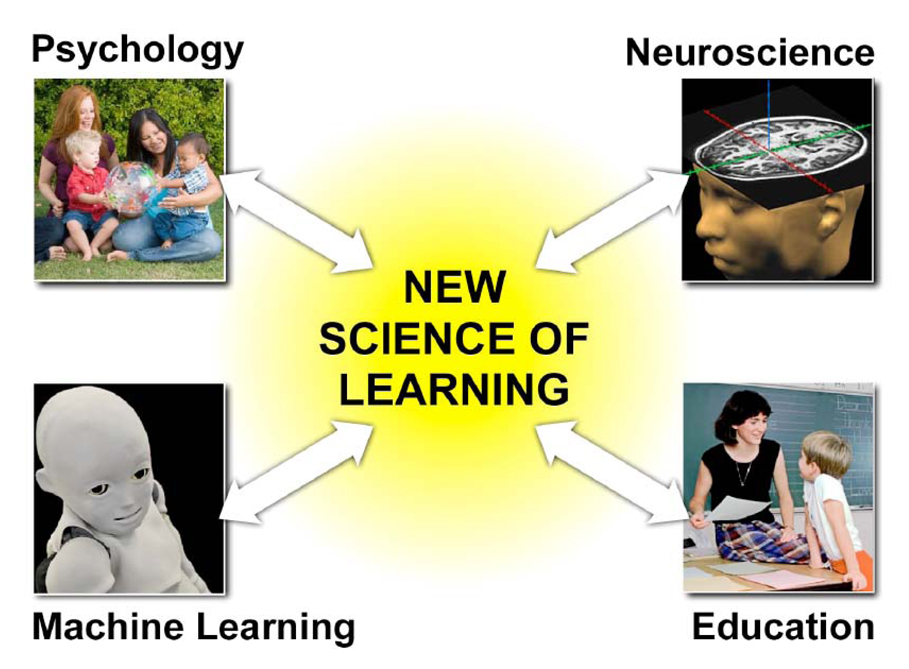
Figure 1
Figure 1
The new science of learning has arisen from several disciplines. Researchers in developmental psychology have identified social factors that are essential for learning. Powerful learning algorithms from machine learning have demonstrated that contingencies in the environment are a rich source of information about social cues. Neuroscientists have found brain systems involved in social interactions and mechanisms for synaptic plasticity that contribute to learning. Classrooms are laboratories for discovering effective teaching practices.
Figure 2
Figure 2
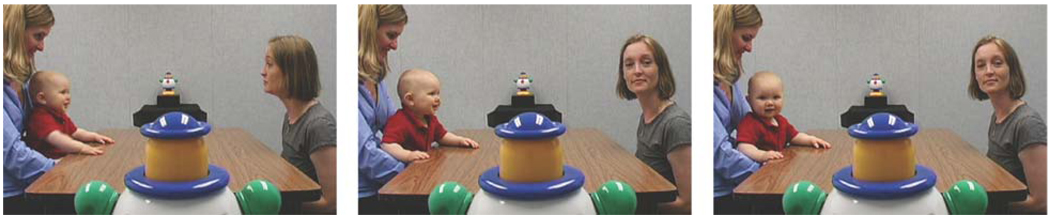
Gaze following is a mechanism that brings adults and infants into perceptual contact with the same objects and events in the world, facilitating word learning and social communication. After interacting with an adult (left panel), 12-month-old infants see an adult look at one of two identical objects (middle panel), and immediately follow her gaze (right panel).
Figure 3
Figure 3
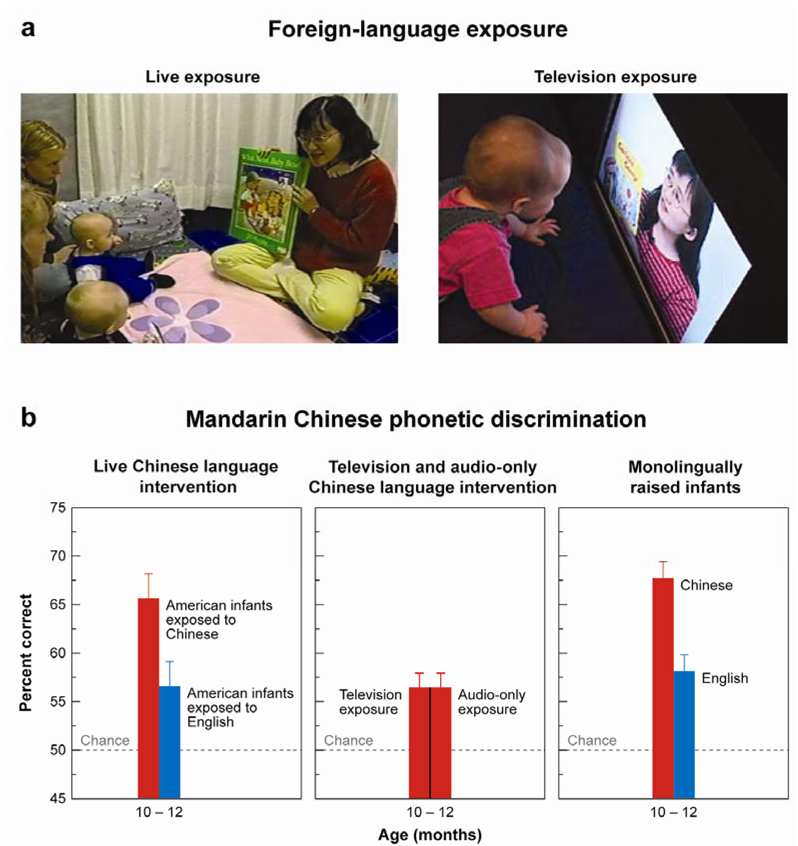
The need for social interaction in language learning is shown by foreign-language learning experiments. 9-month-old infants experienced 12 sessions of Mandarin Chinese through (a) natural interaction with a Chinese speaker (left) or the identical linguistic information delivered via television (right) or audiotape (not shown). (b) Natural interaction resulted in significant learning of Mandarin phonemes when compared to a Control group who participated in interaction using English (left panel). No learning occurred from television or audiotaped presentations (middle panel). Data for age-matched Chinese and American infants learning their native languages are shown for comparison (right panel). [Adapted from (48) and reprinted with permission.]
Figure 4
Figure 4
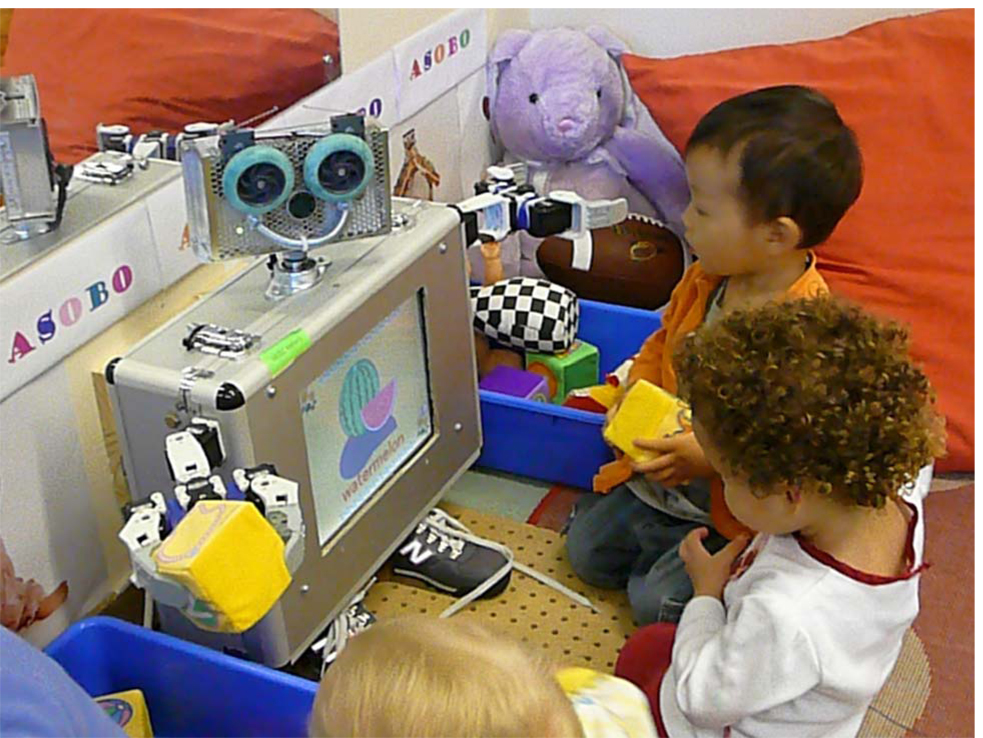
A social robot can operate autonomously with children in a preschool setting. Here toddlers play a game with the robot. One long-term goal is to engineer systems testing whether young children can learn a foreign language through interactions with a talking robot.

Comment in

References

    1. Allman JM. Evolving brains. New York: W. H. Freeman; 1999.
    1. Quartz SR, Sejnowski TJ. Behav. Brain Sci. 1997;20:537. - PubMed
    1. Jacobs RA, Dominguez M. Neural Comput. 2003;15:761–781. - PubMed
    1. Kuhl PK, Williams KA, Lacerda F, Stevens KN, Lindblom B. Science. 1992;255:606. - PubMed
    1. Maye J, Werker JF, Gerken L. Cognition. 2002;82:B101. - PubMed

Publication types