Smoking as a risk factor for prostate cancer: a meta-analysis of 24 prospective cohort studies
- PMID: 19608952
- PMCID: PMC2836346
- DOI: 10.2105/AJPH.2008.150508
Smoking as a risk factor for prostate cancer: a meta-analysis of 24 prospective cohort studies
Abstract
Objectives: We evaluated the relationship between smoking and adenocarcinoma of the prostate.
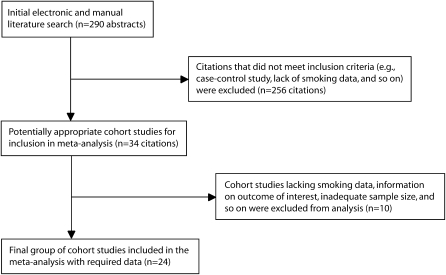
Methods: We pooled data from 24 cohort studies enrolling 21 579 prostate cancer case participants for a general variance-based meta-analysis. Summary relative risks (RRs) and 95% confidence intervals (CIs) were calculated separately for mortality and incidence studies. We tested the robustness of effect measures and evaluated statistical heterogeneity with sensitivity analyses.
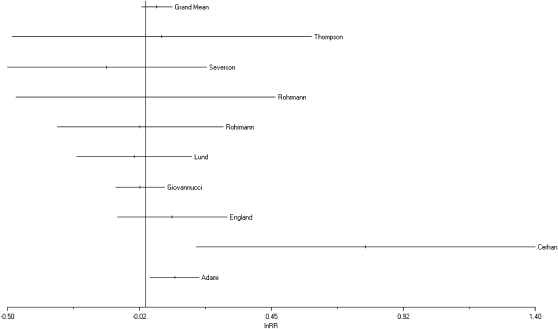
Results: In the pooled data, current smokers had no increased risk of incident prostate cancer (RR = 1.04; 95% CI = 0.87, 1.24), but in data stratified by amount smoked they had statistically significant elevated risk (cigarettes per day or years: RR = 1.22; 95% CI = 1.01, 1.46; pack years of smoking: RR = 1.11; 95% CI = 1.01, 1.22). Former smokers had an increased risk (RR = 1.09; 95% CI = 1.02, 1.16). Current smokers had an increased risk of fatal prostate cancer (RR = 1.14; 95% CI = 1.06, 1.19). The heaviest smokers had a 24% to 30% greater risk of death from prostate cancer than did nonsmokers.
Conclusions: Observational cohort studies show an association of smoking with prostate cancer incidence and mortality. Ill-defined exposure categories in many cohort studies suggest that pooled data underestimate risk.
Figures
References
-
- American Cancer Society Cancer Facts and Figures. Available at: http://www.cancer.org/docroot/CRI/content/CRI_2_2_1X_How_many_men_get_pr.... Accessed April 6, 2008
-
- Chan JM, Jou RM, Carroll PR. The relative impact and future burden of prostate cancer in the United States. J Urol 2004;172:S13–S16 - PubMed
-
- Haenszel W, Kurihara M. Studies of Japanese migrants. I. Mortality from cancer and other diseases among Japanese in the United States. J Natl Cancer Inst 1968;40:43–68 - PubMed
-
- Pienta KJ, Esper PS. Risk factors for prostate cancer. Ann Intern Med 1993;118:793–803 - PubMed
-
- Colditz G. Consensus conference: smoking and prostate cancer. Cancer Causes Control 1996;7:560–562 - PubMed
Publication types
MeSH terms
LinkOut - more resources
Full Text Sources
Medical