


Merkel cell polyomavirus expression in merkel cell carcinomas and its absence in combined tumors and pulmonary neuroendocrine carcinomas
- PMID: 19609205
- PMCID: PMC2932664
- DOI: 10.1097/PAS.0b013e3181aa30a5
Merkel cell polyomavirus expression in merkel cell carcinomas and its absence in combined tumors and pulmonary neuroendocrine carcinomas
Abstract
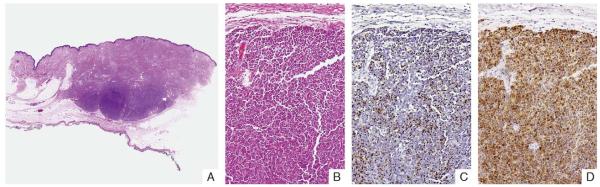
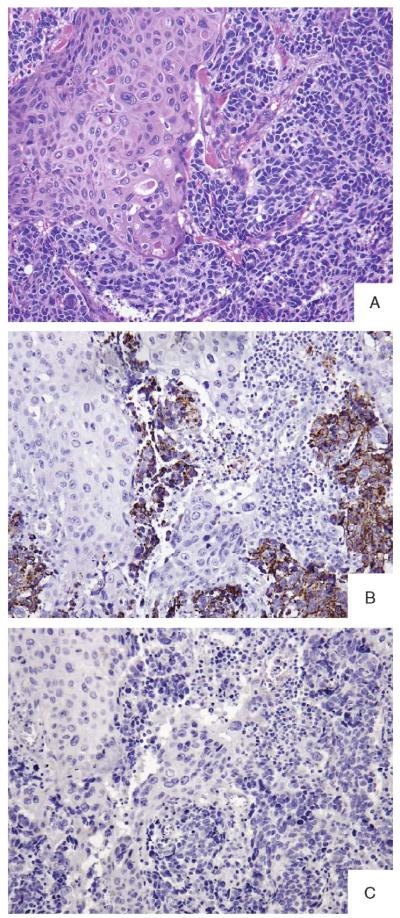
Merkel cell carcinoma (MCC) is the eponym for primary cutaneous neuroendocrine carcinoma. Recently, a new polyoma virus has been identified that is clonally integrated in the genome of the majority of MCCs, with truncating mutations in the viral large T antigen gene. We examined the presence of Merkel cell polyomavirus (MCV) in a set of 17 frozen tumor samples by quantitative polymerase chain reaction; 15 of them (88%) were positive. Sections from corresponding archival material were analyzed by immunohistochemistry (IHC) with the novel monoclonal antibody CM2B4, generated against a predicted antigenic epitope on the MCV T antigen, and tested for the expression of cytokeratin 20 (CK20). Sufficient archival material for IHC was available in only 15 of the 17 cases whose frozen tissue samples had been studied by polymerase chain reaction. Of the 15 tumors analyzed immunohistochemically, 10 (67%) showed positive labeling with CM2B4, 14 (93%) expressed CK20. A tissue microarray of 36 MCCs, 7 combined squamous and neuroendocrine carcinomas of the skin, and 26 pulmonary neuroendocrine carcinomas were also examined by IHC. Of the 36 MCCs assembled on a microarray, 32 (89%) tumors expressed CK20, and 27 (75%) were immunoreactive with CM2B4. The skin tumors with a combined squamous and neuroendocrine phenotype and all pulmonary neuroendocrine carcinomas failed to react with CM2B4. Our study shows that CM2B4 is a useful reagent for the diagnosis of MCC. It labels the majority of MCCs, but fails to react with pulmonary neuroendocrine carcinomas. We also found that neuroendocrine carcinomas of the skin arising in association with a squamous cell carcinoma seem to be independent of MCV.
Figures

References
-
- Agelli M, Clegg LX. Epidemiology of primary Merkel cell carcinoma in the United States. J Am Acad Dermatol. 2003;49:832–841. - PubMed
-
- Allen PJ, Bowne WB, Jaques DP, et al. Merkel cell carcinoma: prognosis and treatment of patients from a single institution. J Clin Oncol. 2005;23:2300–2309. - PubMed
-
- Andea AA, Coit DG, Amin B, et al. Merkel cell carcinoma: histologic features and prognosis. Cancer. 2008;113:2549–2558. - PubMed
-
- Aydin A, Koçer NE, Bekerecioglu M, et al. Cutaneous undifferentiated small (Merkel) cell carcinoma, that developed synchronously with multiple actinic keratoses, squamous cell carcinomas and basal cell carcinoma. J Dermatol. 2003;30:241–244. - PubMed
-
- Battifora H, Silva EG. The use of antikeratin antibodies in the immunohistochemical distinction between neuroendocrine (Merkel cell) carcinoma of the skin, lymphoma, and oat cell carcinoma. Cancer. 1986;58:1040–1046. - PubMed
MeSH terms
Substances
Grants and funding
LinkOut - more resources
Full Text Sources
Other Literature Sources
Medical
