. 2009 Jul;5(7):e1000567.
doi: 10.1371/journal.pgen.1000567. Epub 2009 Jul 17.

Two chromatin remodeling activities cooperate during activation of hormone responsive promoters

Affiliations

Two chromatin remodeling activities cooperate during activation of hormone responsive promoters

Guillermo Pablo Vicent et al. PLoS Genet. 2009 Jul.

Abstract

Steroid hormones regulate gene expression by interaction of their receptors with hormone responsive elements (HREs) and recruitment of kinases, chromatin remodeling complexes, and coregulators to their target promoters. Here we show that in breast cancer cells the BAF, but not the closely related PBAF complex, is required for progesterone induction of several target genes including MMTV, where it catalyzes localized displacement of histones H2A and H2B and subsequent NF1 binding. PCAF is also needed for induction of progesterone target genes and acetylates histone H3 at K14, an epigenetic mark that interacts with the BAF subunits by anchoring the complex to chromatin. In the absence of PCAF, full loading of target promoters with hormone receptors and BAF is precluded, and induction is compromised. Thus, activation of hormone-responsive promoters requires cooperation of at least two chromatin remodeling activities, BAF and PCAF.


Conflict of interest statement

The authors have declared that no competing interests exist.

Figures

Figure 1
Figure 1. BAF is essential for MMTV promoter activity in T47D-MTVL cells.
(A) Cells were transfected either with siRNA against Brg1, Brm , or both siRNAs combined as indicated. After 48 h the medium was replaced by fresh medium without serum. After one day in serum-free conditions, cells were lysed and the levels of Brm, Brg1, PR and tubulin were determined by Western blotting. C, control siRNA. (B) Cells were transfected with Control, Brg1 and Brm siRNAs as described in (A). After one day in serum-free conditions, cells were incubated with 10 nM R5020 for 8 hs and total RNA was prepared, cDNA was generated and used as template for real time PCR with luciferase oligonucleotides. The values represent the mean and standard deviation from 3 experiments performed in duplicate. (C) Cells were transfected with Control, Brg1 and Brm siRNAs as described in (A) and treated with 10 nM R5020. cDNA was generated and used as template for real-time PCR using specific c-Fos, c-Myc, Cyclin D1 and GAPDH primers. The values represent the mean±SD of 3 experiments performed in duplicate. (D) Cells were transfected with Control and BAF57 siRNAs as described in (A) and treated with 10 nM R5020. Left: BAF57 levels were analyzed by Western blotting. Right: RNA was extracted, cDNA was generated and used as template for real time PCR with luciferase oligonucleotides. The values represent the mean±SD of 2 experiments performed in duplicate. (E) Experiments similar to those shown in (D), but cells were transfected with Control and BAF250 siRNAs as described in (A) and (D). The values represent the mean±SD of 2 experiments performed in duplicate. (F) Cells were lysed and immunoprecipitated either with α-BAF57 antibody or with normal rabbit IgG as a negative control (IgG). The immunoprecipitates (IP) were analyzed by western blotting with non-discriminating Brg1/Brm antibody, α-BAF155 or α-BAF170 specific antibodies. (G) Cells were untreated (0) or treated for 5, 30 or 60 min with 10 nM R-5020 and subjected to ChIP assays with α-PR, α-Brg1, α-Brm, α-BAF57, α-BAF250, α-BAF180 and α-BAF200 specific antibodies. The precipitated DNA fragments were subjected to PCR analysis to test for the presence of sequences corresponding to the MMTV nucleosome B. Input material (1%) is shown for comparison. A representative of three independent experiments is shown.
Figure 2
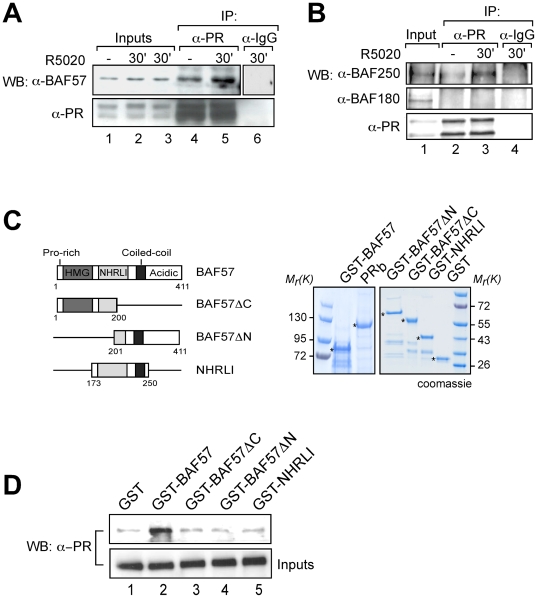
Figure 2. PR forms a complex with BAF in T47D-MTVL cells and binds BAF57 in vitro.
(A) Cells were untreated (−) or treated for 30 min with R5020, lysed and immunoprecipitated either with α-PR antibody or with normal rabbit IgG as a negative control (IgG). Inputs and IPs were analyzed by western blot using α-BAF57 and α-PR, as indicated. (B) Cells were treated as in (A). Inputs and IPs were analyzed by western blot using α-BAF180, α-BAF250 and α-PR, as indicated. (C) Left: Scheme of wild type GST-BAF57 or GST-BAF57 deletion mutants used for pulldown assays. Right: Coomassie-stained gel with the level of expression of the BAF57-GST fusion proteins. (D) Recombinant PR and either wild type GST-BAF57 or GST-BAF57 deletion mutants were used for pulldown assays. Binding reactions were incubated with glutathione sepharose beads and eluted by boiling in SDS sample buffer. Input and bound material were analyzed by western blot with α-PR.
Figure 3
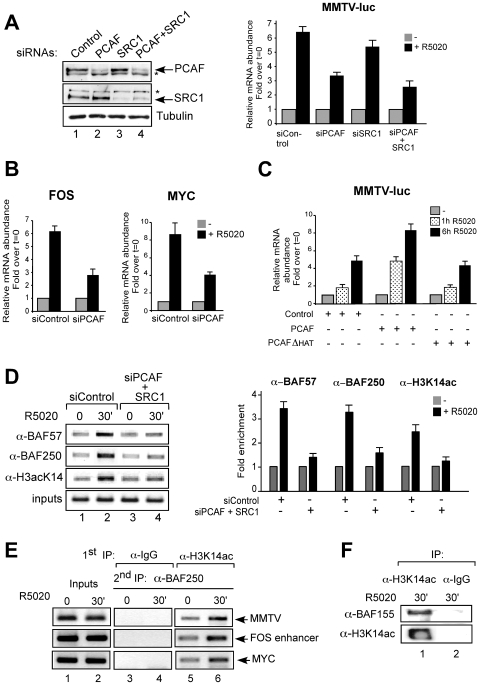
Figure 3. Acetylation on histone H3K14 by PCAF is essential for hormonal transactivation in T47D-MTVL cells.
(A) Left: Cells were transfected with the indicated siRNAs and the levels of PCAF, SRC1, and tubulin were determined by Western blotting. The asterisks indicate inespecific bands. Right: Cells were transfected with the indicated siRNAs and treated with 10 nM R5020 for 6 h. RNA was extracted, cDNA was generated and used as template for real time PCR with luciferase oligonucleotides. The values represent the mean and standard deviation from 3 experiments performed in duplicate. (B) Cells were transfected with siRNAs, treated with 10 nM R5020 as indicated and the levels of c-Fos and c-Myc mRNAs were analyzed by RT–PCR. The values represent the mean and standard deviation from 2 experiments performed in duplicate. (C) Cells were transfected with PCAF or PCAF HAT mutant (PCAFΔHAT), treated with hormone as indicated and transcription from the MMTV promoter was determined as in (B). An empty vector was used as control. The values represent the mean and standard deviation from 2 experiments performed in duplicate. (D) Left: Cells transfected with the siRNAs and treated with hormone as indicated were subjected to ChIP assays with α-BAF57, α-BAF250 and α-K14acH3. The precipitated DNA fragments were subjected to PCR analysis to test for the presence of sequences corresponding to the MMTV nucleosome B. A representative of three independent experiments is shown. Right: quantification of the results by real time PCR from two experiments performed induplicate. (E) Cells were treated with R5020 as indicated and subjected to re-ChIP assays with α-H3K14ac and IgG (first IP) followed by α-BAF250 for the second IP. Precipiated DNA was analysed by PCR for the presence of sequences corresponding to the MMTV, c-Fos and c-Myc PR binding regions. (F) Cells were treated for 30 min with R5020, lysed and chromatin was immunoprecipitated either with α-H3K14ac or with normal rabbit IgG as a negative control (IgG). IPs were analyzed by western blot using α-BAF155 and α-H3K14ac.
Figure 4
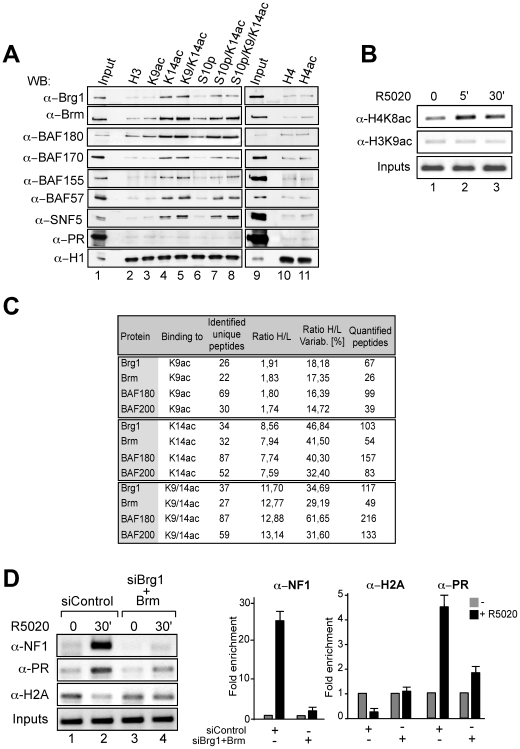
Figure 4. The BAF complex binds preferentially to histone H3K14ac and promotes H2A displacement.
(A) Nuclear extracts derived from T47D-MTVL cells were used for pulldown experiments with the indicated H3 and H4 tail peptides coupled to beads. Immunoblotting was performed for the presence of components of the BAF and PBAF complex, histone H1 and PR. (B) Cells were untreated (0) or treated for 5 and 30 min with 10 nM R-5020 and subjected to ChIP assays with α-H4K8ac and α-H3K9ac specific antibodies. The precipitated DNA fragments were subjected to PCR analysis to test for the presence of sequences corresponding to the MMTV nucleosome B. Input material (1%) is shown for comparison. A representative of three independent experiments is shown. (C) Quantification of the interaction of selected human SWI/SNF subunits with the indicated H3 tail acetylated peptides. SILAC ratios represent the relative abundance of the ‘heavy’ (modified) to the ‘light’ (unmodified) peptide. The variation (in %) and the number of quantified peptides are indicated. (D) Left: T47D-MTVL cells were transfected with siRNAs and treated with hormone as indicated, subjected to ChIP assays using α-NF1, α-PR and α-H2A and primers for MMTV nucleosome B. Right: quantification of the results by real time PCR. A representative of three independent experiments is shown.
Figure 5
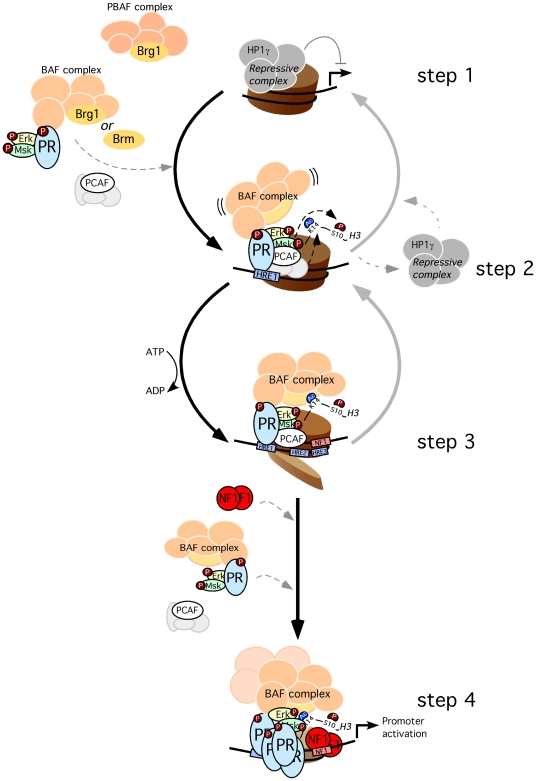
Figure 5. Model for the initial steps of MMTV promoter activation.
Before hormone addition the MMTV promoter is silent and associated with a repressive complex that includes HP1γ (step 1). After hormone addition the activated complex of pPR-pErk-pMsk, as well as PCAF and BAF, are recruited to the MMTV promoter. For simplicity PR is shown as a monomer, though the active form is a homodimer. Msk and PCAF phosphoacetylates H3 leading to H3S10phK14ac (step 2). This modification displaces the repressive complex and anchors the BAF complex, enabling ATP-dependent H2A/H2B displacement (step 3). The nucleosome opening facilitates NF1 binding generating a stable platform that exposes previously hidden HREs for the recruitment of additional PR and BAF complexes, coactivator and eventually promoter activation (step 4). Depletion of BAF prevents progression of the activation process to step 2: no histone displacement is observed, NF1 cannot bind and consequently less PR/BAF complexes are bound to the promoter. Depletion of PCAF has a similar effect, most likely by labilization of BAF binding, blocking the activation process at step 2.

References

    1. Luger K, Mader AW, Richmond RK, Sargent DF, Richmond TJ. Crystal structure of the nucleosome core particle at 2.8 A resolution. Nature. 1997;389:251–260. - PubMed
    1. Aalfs JD, Kingston RE. What does ‘chromatin remodeling’ mean? Trends Biochem Sci. 2000;25:548–555. - PubMed
    1. Whitehouse I, Rando OJ, Delrow J, Tsukiyama T. Chromatin remodelling at promoters suppresses antisense transcription. Nature. 2007;450:1031–1035. - PubMed
    1. Mohrmann L, Verrijzer CP. Composition and functional specificity of SWI2/SNF2 class chromatin remodeling complexes. Biochim Biophys Acta. 2005;1681:59–73. - PubMed
    1. Bruno M, Flaus A, Stockdale C, Rencurel C, Ferreira H, et al. Histone H2A/H2B dimer exchange by ATP-dependent chromatin remodeling activities. Mol Cell. 2003;12:1599–1606. - PMC - PubMed

Publication types