Overexpression of 5-HT2C receptors in forebrain leads to elevated anxiety and hypoactivity
- PMID: 19614978
- PMCID: PMC2777260
- DOI: 10.1111/j.1460-9568.2009.06831.x
Overexpression of 5-HT2C receptors in forebrain leads to elevated anxiety and hypoactivity
Abstract
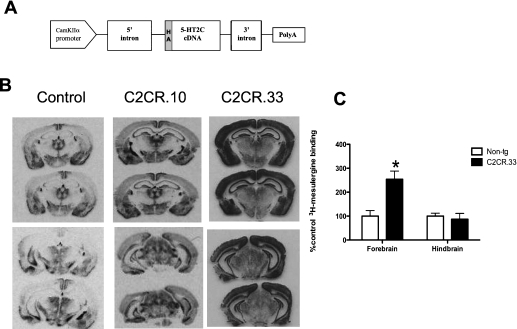
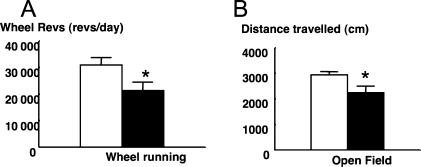
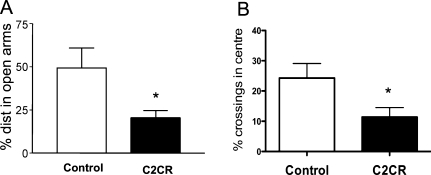
The 5-HT(2C) receptor has been implicated in mood and eating disorders. In general, it is accepted that 5-HT(2C) receptor agonists increase anxiety behaviours and induce hypophagia. However, pharmacological analysis of the roles of these receptors is hampered by the lack of selective ligands and the complex regulation of receptor isoforms and expression levels. Therefore, the exact role of 5-HT(2C) receptors in mood disorders remain controversial, some suggesting agonists and others suggesting antagonists may be efficacious antidepressants, while there is general agreement that antagonists are beneficial anxiolytics. In order to test the hypothesis that increased 5-HT(2C) receptor expression, and thus increased 5-HT(2C) receptor signalling, is causative in mood disorders, we have undertaken a transgenic approach, directly altering the 5-HT(2C) receptor number in the forebrain and evaluating the consequences on behaviour. Transgenic mice overexpressing 5-HT(2C) receptors under the control of the CaMKIIalpha promoter (C2CR mice) have elevated 5-HT(2C) receptor mRNA levels in cerebral cortex and limbic areas (including the hippocampus and amygdala), but normal levels in the hypothalamus, resulting in > 100% increase in the number of 5-HT(2C) ligand binding sites in the forebrain. The C2CR mice show increased anxiety-like behaviour in the elevated plus-maze, decreased wheel-running behaviour and reduced activity in a novel environment. These behaviours were observed in the C2CR mice without stimulation by exogenous ligands. Our findings support a role for 5-HT(2C) receptor signalling in anxiety disorders. The C2CR mouse model offers a novel and effective approach for studying disorders associated with 5-HT(2C) receptors.
Figures
References
-
- Alves SH, Pinheiro G, Motta V, Landeira-Fernandez J, Cruz AP. Anxiogenic effects in the rat elevated plus-maze of 5-HT(2C) agonists into ventral but not dorsal hippocampus. Behav. Pharmacol. 2004;15:37–43. - PubMed
-
- Barnes NM, Sharp T. A review of central 5-HT receptors and their function. Neuropharmacology. 1999;38:1083–1152. - PubMed
-
- Berg KA, Navailles S, Sanchez TA, Silva YM, Wood MD, Spampinato U, Clarke WP. Differential effects of 5-methyl-1-[[2-[(2-methyl-3-pyridyl)oxyl]-5-pyridyl]carbamoyl]-6-trifluoro methylindone (SB 243213) on 5-hydroxytryptamine(2C) receptor-mediated responses. J. Pharmacol. Exp. Ther. 2006;319:260–268. - PubMed
-
- Burns CM, Chu H, Rueter SM, Hutchinson LK, Canton H, Sanders-Bush E, Emeson RB. Regulation of serotonin-2C receptor G-protein coupling by RNA editing. Nature. 1997;387:303–308. - PubMed
Publication types
MeSH terms
Substances
Grants and funding
LinkOut - more resources
Full Text Sources
Medical
Molecular Biology Databases