Review
. 2009 Sep;41(3):251-60.
doi: 10.1165/rcmb.2009-0170TR. Epub 2009 Jul 17.

Heme oxygenase-1/carbon monoxide: from metabolism to molecular therapy

Affiliations
Review

Heme oxygenase-1/carbon monoxide: from metabolism to molecular therapy

Stefan W Ryter et al. Am J Respir Cell Mol Biol. 2009 Sep.

Abstract

Heme oxygenase-1 (HO-1), a ubiquitous inducible stress-response protein, serves a major metabolic function in heme turnover. HO activity cleaves heme to form biliverdin-IXalpha, carbon monoxide (CO), and iron. Genetic experiments have revealed a central role for HO-1 in tissue homeostasis, protection against oxidative stress, and in the pathogenesis of disease. Four decades of research have witnessed not only progress in elucidating the molecular mechanisms underlying the regulation and function of this illustrious enzyme, but also have opened remarkable translational applications for HO-1 and its reaction products. CO, once regarded as a metabolic waste, can act as an endogenous mediator of cellular signaling and vascular function. Exogenous application of CO by inhalation or pharmacologic delivery can confer cytoprotection in preclinical models of lung/vascular injury and disease, based on anti-apoptotic, anti-inflammatory, and anti-proliferative properties. The bile pigments, biliverdin and bilirubin, end products of heme degradation, have also shown potential as therapeutics in vascular disease based on anti-inflammatory and anti-proliferative activities. Further translational and clinical trials research will unveil whether the HO-1 system or any of its reaction products can be successfully applied as molecular medicine in human disease.


Figures
<b>Figure 1.</b>
Figure 1.
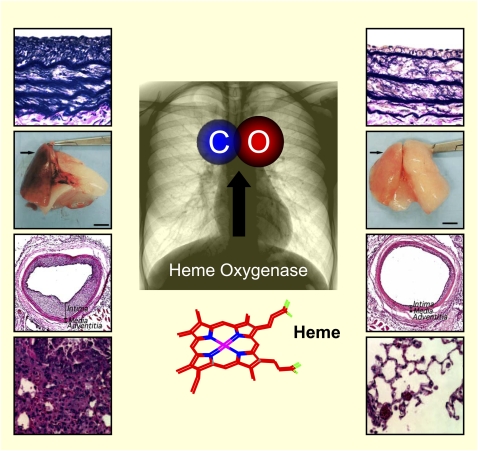
Carbon monoxide (CO) is produced endogenously in the body as a by-product of heme degradation catalyzed by the action of heme oxygenase (HO) enzymes. Induction of HO-1 occurs as a general cellular and tissue response to stress, and can confer cytoprotection in animal models of tissue injury. Recent studies have described that application of CO at low concentration in tissue injury models can also confer protection. This review highlights the evolution of the HO-1/CO field from basic biochemistry to translational applications. (Images adapted from Refs. , , , and .)
<b>Scheme 1.</b>
Scheme 1.
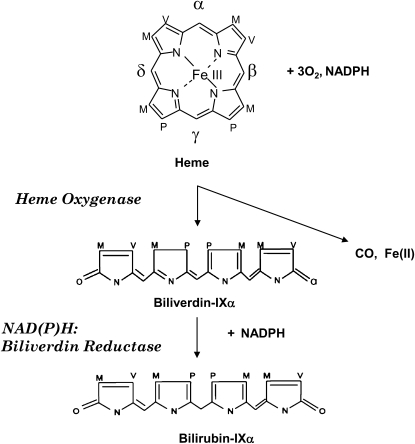
Heme oxygenase (HO) reaction. The HO reaction catalyzes the oxidative degradation of the heme molecule, to generate biliverdin, CO, and ferrous iron. The HO reaction proceeds through three serial monooxygenation cycles in which three molecules of O2 are consumed per heme molecule oxidized. NADPH cytochrome p450 reductase provides electrons for the reduction of the heme iron. The biliverdin released from the HO reaction, which is specific for the α isomer, is enzymatically reduced by NAD(P)H:biliverdin reductase, to form bilirubin.
<b>Scheme 2.</b>
Scheme 2.
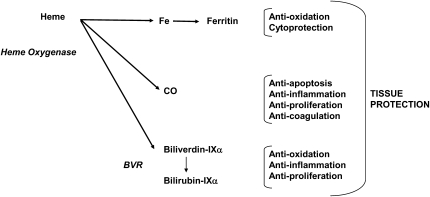
Multimodal effects of HO end-products on tissue protection. The three end-products of HO activity can contribute to cytoprotective mechanisms. CO has been implicated in anti-inflammatory, anti-apoptotic, and anti-proliferative pathways. Biliverdin-IXα and bilirubin-IXα, potent antioxidants, can exert anti-inflammatory and anti-proliferative effects. Iron released from HO activity stimulates a cytoprotective pathway involving the synthesis of ferritin.
<b>Scheme 3.</b>
Scheme 3.
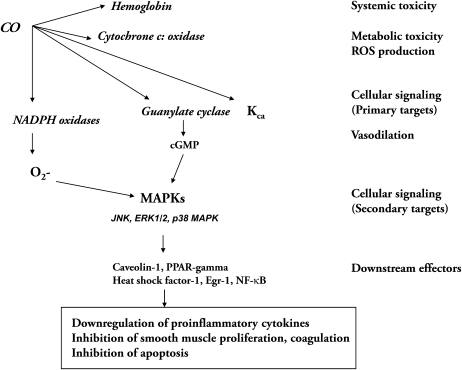
Molecular targets of CO, and proposed signaling pathways. CO modulates intracellular signaling pathways involving hemoproteins, as well as downstream effectors. The primary targets include guanylate cyclase and calcium-dependent potassium channels (KCa) involved in vasoregulation. NADPH oxidase, a putative target of CO, regulates intracellular ROS production. Downstream pathways include mitogen-activated protein kinases (MAPK), caveolin-1, and transcription factors such as heat shock factor-1 (HSF-1), NF-κB, and Egr-1.

References

    1. Tenhunen R, Marver HS, Schmid R. Microsomal heme oxygenase: characterization of the enzyme. J Biol Chem 1969;244:6388–6394. - PubMed
    1. Tenhunen R, Marver HS, Schmid R. The enzymatic conversion of heme to bilirubin by microsomal heme oxygenase. Proc Natl Acad Sci USA 1968;61:748–755. - PMC - PubMed
    1. Mumby S, Upton RL, Chen Y, Stanford SJ, Quinlan GJ, Nicholson AG, Gutteridge JM, Lamb NJ, Evans TW. Lung heme oxygenase-1 is elevated in acute respiratory distress syndrome. Crit Care Med 2004;32:1130–1135. - PubMed
    1. Hoetzel A, Dolinay T, Vallbracht S, Zhang Y, Kim HP, Ifedigbo E, Alber S, Kaynar AM, Schmidt R, Ryter SW, et al. Carbon monoxide protects against ventilator-induced lung injury via PPAR-gamma and inhibition of Egr-1. Am J Respir Crit Care Med 2008;177:1223–1232. - PMC - PubMed
    1. Hoetzel A, Leitz D, Schmidt R, Tritschler E, Bauer I, Loop T, Humar M, Geiger KK, Pannen BH. Mechanism of hepatic heme oxygenase-1 induction by isoflurane. Anesthesiology 2006;104:101–109. - PubMed

Publication types