


Aging impairs flow-induced dilation in coronary arterioles: role of NO and H(2)O(2)
- PMID: 19617414
- PMCID: PMC2755981
- DOI: 10.1152/ajpheart.00356.2009
Aging impairs flow-induced dilation in coronary arterioles: role of NO and H(2)O(2)
Abstract
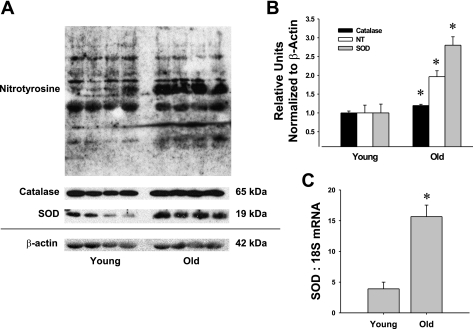
Aging contributes significantly to the development of cardiovascular disease and is associated with elevated production of reactive oxygen species (ROS). The beneficial effects of nitric oxide (NO)-mediated vasodilation are quickly abolished in the presence of ROS, and this effect may be augmented with aging. We previously demonstrated an age-induced impairment of flow-induced dilation in rat coronary arterioles. Therefore, the purpose of this study was to determine the effects of O(2)(-) scavenging, as well as removal of H(2)O(2), the byproduct of O(2)(-) scavenging, on flow-mediated dilation in coronary resistance arterioles of young (4 mo) and old (24 mo) male Fischer 344 rats. Flow increased NO and H(2)O(2) production as evidenced by enhanced diaminofluorescein and dichlorodihydrofluorescein fluorescence, respectively, whereas aging reduced flow-induced NO and H(2)O(2) production. Endothelium-dependent vasodilation was evaluated by increasing intraluminal flow (5-60 nl/s) before and after treatment with the superoxide dismutase mimetic Tempol (100 muM), the H(2)O(2) scavenger catalase (100 U/ml), or Tempol plus catalase. Catalase reduced flow-induced dilation in both groups, whereas Tempol and Tempol plus catalase diminished vasodilation in young but not old rats. Tempol plus deferoxamine (100 muM), an inhibitor of hydroxyl radical formation, reversed Tempol-mediated impairment of flow-induced vasodilation in young rats and improved flow-induced vasodilation in old rats compared with control. Immunoblot analysis revealed increases in endogenous superoxide dismutase, catalase, and nitrotyrosine protein levels with aging. Collectively, these data indicate that NO- and H(2)O(2)-mediated flow-induced signaling decline with age in coronary arterioles and that elevated hydroxyl radical formation contributes to the age-related impairment of flow-induced vasodilation.
Figures



References
-
- Blackwell KA, Sorenson JP, Richardson DM, Smith LA, Suda O, Nath K, Katusic ZS. Mechanisms of aging-induced impairment of endothelium-dependent relaxation: role of tetrahydrobiopterin. Am J Physiol Heart Circ Physiol 287: H2448–H2453, 2004. - PubMed
-
- Bulvik B, Grinberg L, Eliashar R, Berenshtein E, Chevion MM. Iron, ferritin and proteins of the methionine-centered redox cycle in young and old rat hearts. Mech Ageing Dev 130: 139–144, 2009. - PubMed
-
- Carroll RT, Galatsis P, Borosky S, Kopec KK, Kumar V, Althaus JS, Hall ED. 4-Hydroxy-2,2,6,6-tetramethylpiperidine-1-oxyl (Tempol) inhibits peroxynitrite-mediated phenol nitration. Chem Res Toxicol 13: 294–300, 2000. - PubMed
-
- Celermajer DS, Sorensen KE, Spiegelhalter DJ, Georgakopoulos D, Robinson J, Deanfield JE. Aging is associated with endothelial dysfunction in healthy men years before the age-related decline in women. J Am Coll Cardiol 24: 471–476, 1994. - PubMed
-
- Chilian WM, Eastham CL, Marcus ML. Microvascular distribution of coronary vascular resistance in beating left ventricle. Am J Physiol Heart Circ Physiol 251: H779–H788, 1986. - PubMed
Publication types
MeSH terms
Substances
Grants and funding
LinkOut - more resources
Full Text Sources
Medical
