


Comment
doi: 10.1073/pnas.0906430106.
Epub 2009 Jul 15.
The Krebs cycle meets the cell cycle: mitochondria and the G1-S transition
Affiliations
- PMID: 19617546
- PMCID: PMC2715508
- DOI: 10.1073/pnas.0906430106
Item in Clipboard
Comment
The Krebs cycle meets the cell cycle: mitochondria and the G1-S transition
Proc Natl Acad Sci U S A.
.
No abstract available
Conflict of interest statement
The authors declare no conflict of interest.
Figures
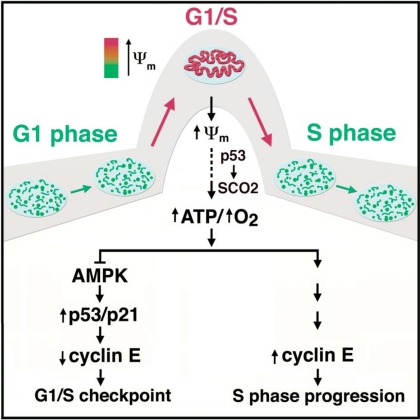
A putative model for the role of mitochondria in the G1–S transition. Throughout most of the cell cycle, mitochondria appear as a combination of either tubular or fragmented morphologies. Surprisingly, at the G1–S transition, the mitochondria coalesce into a giant, single tubular network. This network is electrically coupled and exhibits a hyperpolarized mitochondrial membrane potential (ψm). Because ψm is the ionic gradient used to generate ATP, it is not surprising that this unique morphological and bioenergetic mitochondrial network appears to allow for increased ATP generation. Based on ref. , and previous studies in mammalian cells and lower organisms, the absence of this energetic boost may trigger a G1–S checkpoint that involves the sequential activation of AMPK and p53 and ultimately the down-regulation of cyclin E levels. In addition, ref. suggests that increased mitochondrial activity can positively regulate cyclin E levels and trigger S-phase progression. Note, in this putative model, p53 regulates events in several different contexts, including the transcriptional induction of p21, the cell cycle regulator, and SCO2, a factor that has been demonstrated to regulate mitochondrial oxygen consumption.
Comment on
-
A hyperfused mitochondrial state achieved at G1-S regulates cyclin E buildup and entry into S phase.Proc Natl Acad Sci U S A. 2009 Jul 21;106(29):11960-5. doi: 10.1073/pnas.0904875106. Epub 2009 Jul 15. Proc Natl Acad Sci U S A. 2009. PMID: 19617534 Free PMC article.
References
-
- Detmer SA, Chan DC. Functions and dysfunctions of mitochondrial dynamics. Nat Rev Mol Cell Biol. 2007;8:870–879. - PubMed
-
- Mandal S, Guptan P, Owusu-Ansah E, Banerjee U. Mitochondrial regulation of cell cycle progression during development as revealed by the tenured mutation in Drosophila. Dev Cell. 2005;9:843–854. - PubMed
-
- Jones RG, et al. AMP-activated protein kinase induces a p53-dependent metabolic checkpoint. Mol Cell. 2005;18:283–293. - PubMed
Publication types
MeSH terms
Substances
LinkOut - more resources
Full Text Sources
