


Large D/H variations in bacterial lipids reflect central metabolic pathways
- PMID: 19617564
- PMCID: PMC2722351
- DOI: 10.1073/pnas.0903030106
Large D/H variations in bacterial lipids reflect central metabolic pathways
Abstract
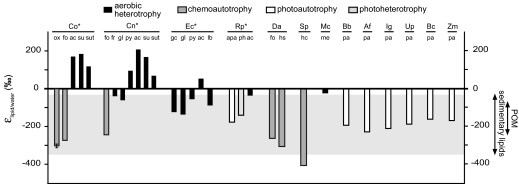
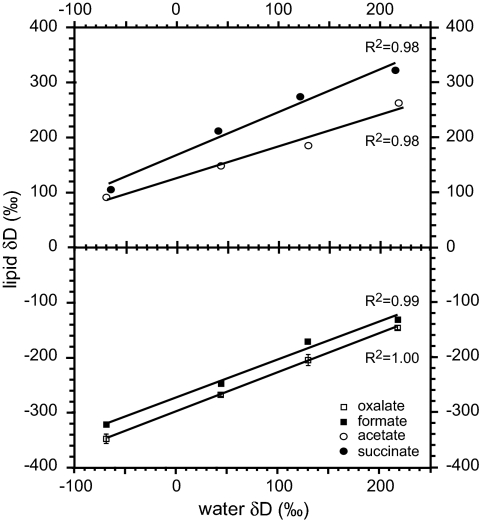
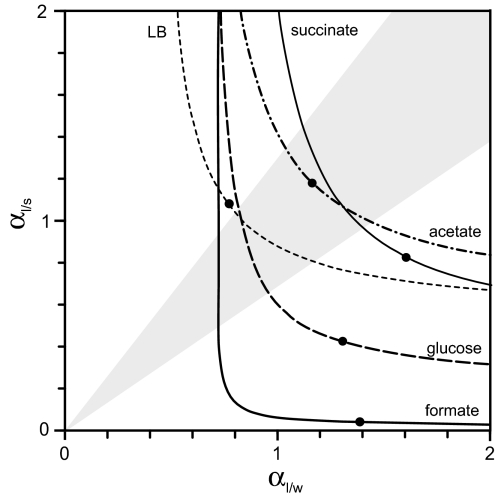
Large hydrogen-isotopic (D/H) fractionations between lipids and growth water have been observed in most organisms studied to date. These fractionations are generally attributed to isotope effects in the biosynthesis of lipids, and are frequently assumed to be approximately constant for the purpose of reconstructing climatic variables. Here, we report D/H fractionations between lipids and water in 4 cultured members of the phylum Proteobacteria, and show that they can vary by up to 500 per thousand in a single organism. The variation cannot be attributed to lipid biosynthesis as there is no significant change in these pathways between cultures, nor can it be attributed to changing substrate D/H ratios. More importantly, lipid/water D/H fractionations vary systematically with metabolism: chemoautotrophic growth (approximately -200 to -400 per thousand), photoautotrophic growth (-150 to -250 per thousand), heterotrophic growth on sugars (0 to -150 per thousand), and heterotrophic growth on TCA-cycle precursors and intermediates (-50 to +200 per thousand) all yield different fractionations. We hypothesize that the D/H ratios of lipids are controlled largely by those of NADPH used for biosynthesis, rather than by isotope effects within the lipid biosynthetic pathway itself. Our results suggest that different central metabolic pathways yield NADPH--and indirectly lipids--with characteristic isotopic compositions. If so, lipid deltaD values could become an important biogeochemical tool for linking lipids to energy metabolism, and would yield information that is highly complementary to that provided by (13)C about pathways of carbon fixation.
Conflict of interest statement
The authors declare no conflict of interest.
Figures
Comment in
-
Isotopic remembrance of metabolism past.Proc Natl Acad Sci U S A. 2009 Aug 4;106(31):12565-6. doi: 10.1073/pnas.0906428106. Epub 2009 Jul 28. Proc Natl Acad Sci U S A. 2009. PMID: 19666618 Free PMC article. No abstract available.
References
-
- Robins RJ, et al. Measurement of 2H distribution in natural products by quantitative 2H NMR: An approach to understanding metabolism and enzyme mechanism? Phytochem Rev. 2003;2:87.
-
- Billault I, Guiet S, Mabon F, Robins RJ. Natural deuterium distribution in long-chain fatty acids is nonstatistical: A site-specific study by quantitative 2H NMR spectroscopy. ChemBioChem. 2001;2:425–431. - PubMed
-
- Krull E, Sachse D, Mügler I, Thiele A, Gleixner G. Compound-specific δ13C and δ2H analyses of plant and soil organic matter: A preliminary assessment of the effects of vegetation change on ecosystem hydrology. Soil Biol Biochem. 2006;38:3211–3221.
-
- Pond KL, Huang Y, Wang Y, Kulpa CF. Hydrogen isotopic composition of individual n-alkanes as an intrinsic tracer for bioremediation and source identification of petroleum contamination. Environ Sci Technol. 2002;36:724–728. - PubMed
-
- Sauer PE, Eglinton TI, Hayes JM, Schimmelmann A, Sessions AL. Compound specific D/H ratios of lipid biomarkers from sediments as a proxy for environmental and climatic conditions. Geochim Cosmochim Acta. 2001;65:213–222.
Publication types
MeSH terms
Substances
LinkOut - more resources
Full Text Sources
