


Improving the quality of life of caregivers of persons with spinal cord injury: a randomized controlled trial
- PMID: 19618698
- PMCID: PMC2729464
- DOI: 10.1037/a0014932
Improving the quality of life of caregivers of persons with spinal cord injury: a randomized controlled trial
Abstract
Objective: To assess the efficacy of two psychosocial interventions for caregivers of older persons with spinal cord injury (SCI).
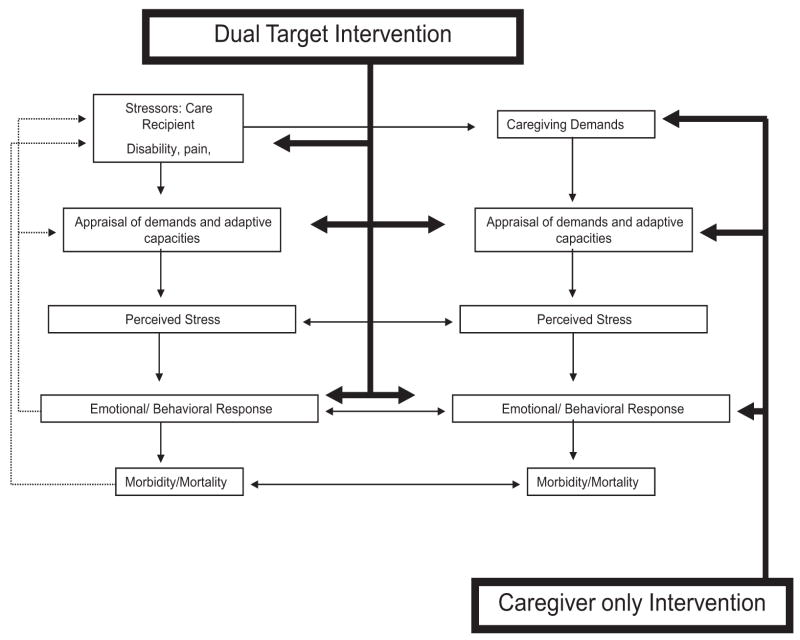
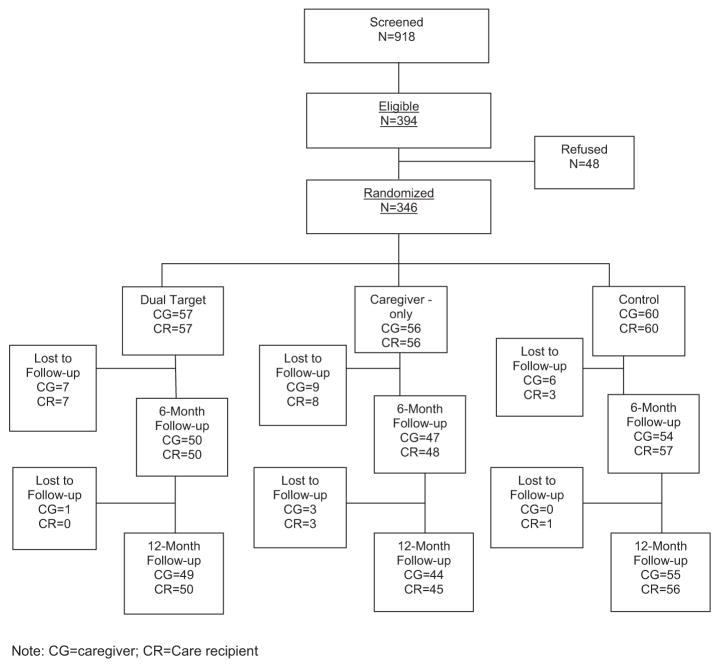
Design: A multisite, three-group, randomized controlled trial comparing two active intervention conditions with each other and to an information-only control group. One hundred seventy-three caregiver and care-recipient dyads were randomly assigned to one of three conditions: a caregiver-only treatment condition in which caregivers received a multicomponent intervention based on their risk profile; a dual-target condition in which the caregiver intervention was complemented by a treatment targeting the care recipient, designed to address both caregiver and care recipient risk factors; and an information-only control condition in which the caregiver received standard printed information about caregiving, SCI, and aging.
Outcome measures: A multivariate outcome comprised of six indicators linked to the goals of the interventions was the primary outcome of the study. The multivariate outcome included measures of depressive symptoms, burden, social support and integration, self-care problems, and physical health symptoms.
Results: At 12 months, caregivers in the dual-target condition had improved quality of life as measured by our multivariate outcome when compared to the control condition. Using the dyad as the unit of analysis, the dual-target condition was superior to both the control condition and the caregiver-only condition in our multivariate outcomes analysis. Dyads enrolled in the dual-target condition had significantly fewer health symptoms than control condition and caregiver-only condition participants and were less depressed when compared to participants in the caregiver-only condition. In follow-up analyses we found that a higher proportion of caregivers in the dual-target condition had clinically significant improvements in depression, burden, and health symptoms when compared with the caregiver-only condition.
Conclusion: Caregivers are in need of and can benefit from interventions that help them manage the medical and functional limitations of the care recipient. Intervention strategies that target both the caregiver and care recipient are particularly promising strategies for improving the quality of life of caregivers.
Figures
References
-
- Andresen EM, Malmgren JA, Carter WB, Patrick DL. Screening for depression in well older adults: Evaluation of a short form of the CES-D (Center for Epidemiologic Studies Depression Scale) American Journal of Preventive Medicine. 1994;10:77–84. - PubMed
-
- Bedard M, Molloy DW, Squire L, Dubois S, Lever JA, O’Donnell M. The Zarit Burden Interview: A new short version and screening version. The Gerontologist. 2001;41:652–657. - PubMed
-
- Bookwala J, Schulz R. Spousal similarity in subjective well-being. The cardiovascular health study. Psychology and Aging. 1996;11:582–591. - PubMed
-
- Boschen KA, Tonack M, Gargaro J. The impact of being a support provider to a person living in the community with a spinal cord injury. Rehabilitation Psychology. 2005;50:397–407.
Publication types
MeSH terms
Grants and funding
- R01 AG015321/AG/NIA NIH HHS/United States
- R01 AG026010/AG/NIA NIH HHS/United States
- AG026010/AG/NIA NIH HHS/United States
- R01 NR008272/NR/NINR NIH HHS/United States
- AG15321/AG/NIA NIH HHS/United States
- R24 HL076852/HL/NHLBI NIH HHS/United States
- MH071944/MH/NIMH NIH HHS/United States
- NR09573/NR/NINR NIH HHS/United States
- R24 HL076858/HL/NHLBI NIH HHS/United States
- HL076858/HL/NHLBI NIH HHS/United States
- P30 MH071944/MH/NIMH NIH HHS/United States
- MD000207/MD/NIMHD NIH HHS/United States
- NR08272/NR/NINR NIH HHS/United States
- HL076852/HL/NHLBI NIH HHS/United States
- R01 NR009573/NR/NINR NIH HHS/United States
- P60 MD000207/MD/NIMHD NIH HHS/United States
