


Nitroxyl radical plus hydroxylamine pseudo self-exchange reactions: tunneling in hydrogen atom transfer
- PMID: 19618933
- PMCID: PMC2775461
- DOI: 10.1021/ja904400d
Nitroxyl radical plus hydroxylamine pseudo self-exchange reactions: tunneling in hydrogen atom transfer
Abstract
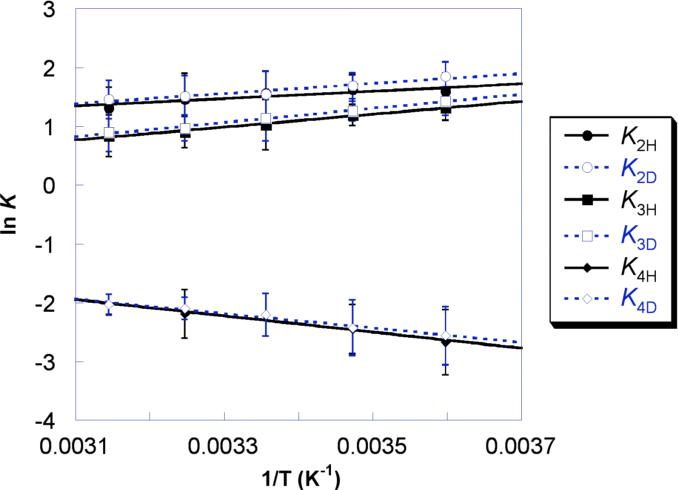
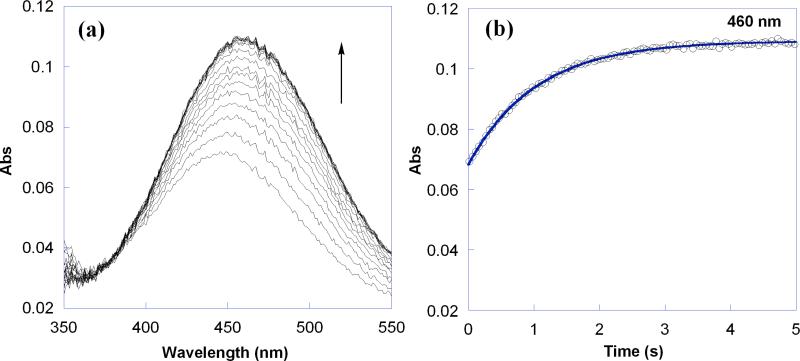
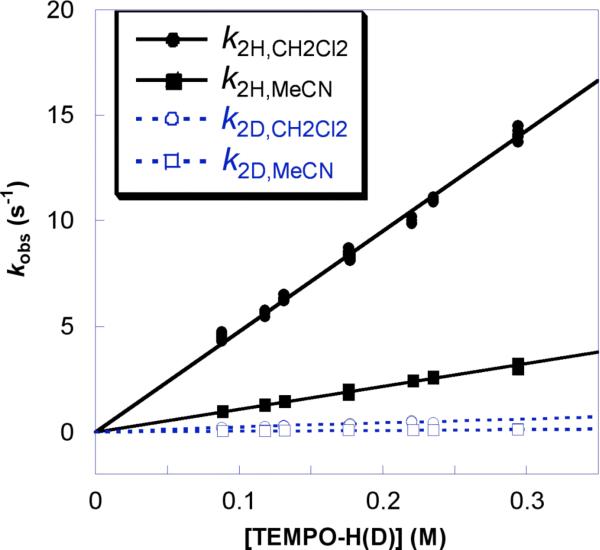
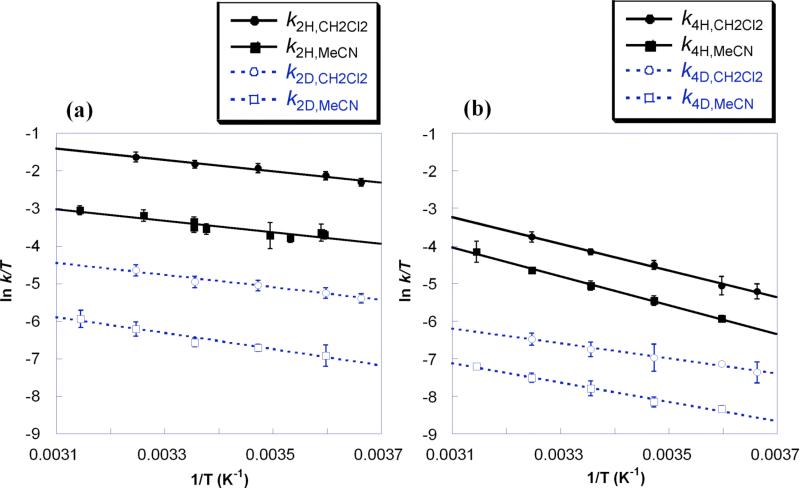
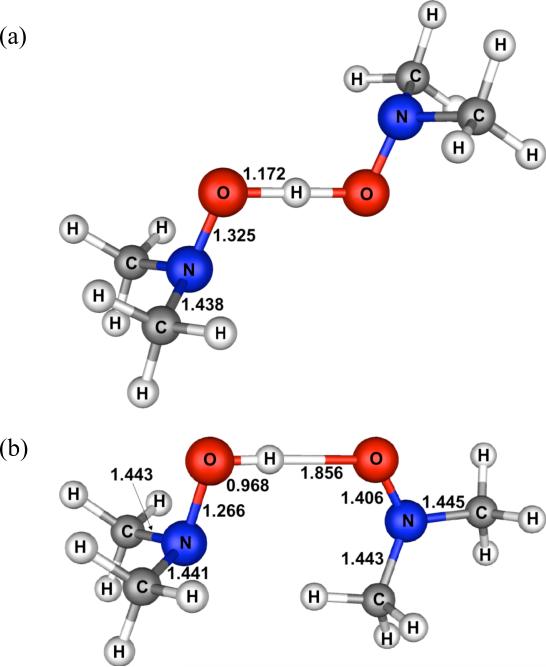
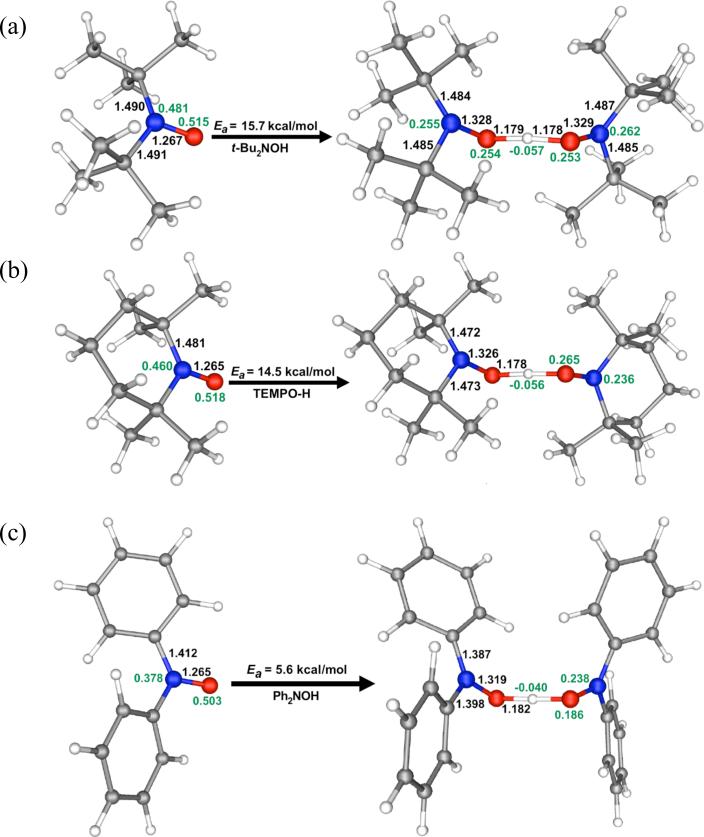
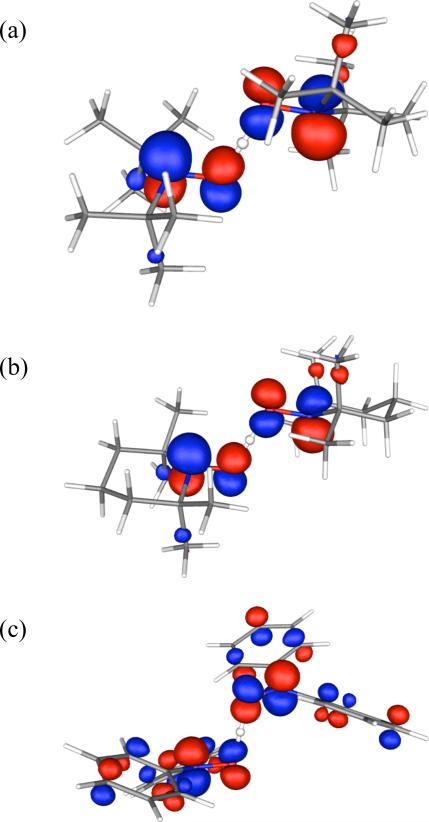
Bimolecular rate constants have been measured for reactions that involve hydrogen atom transfer (HAT) from hydroxylamines to nitroxyl radicals, using the stable radicals TEMPO(*) (2,2,6,6-tetramethylpiperidine-1-oxyl radical), 4-oxo-TEMPO(*) (2,2,6,6-tetramethyl-4-oxo-piperidine-1-oxyl radical), di-tert-butylnitroxyl ((t)Bu(2)NO(*)), and the hydroxylamines TEMPO-H, 4-oxo-TEMPO-H, 4-MeO-TEMPO-H (2,2,6,6-tetramethyl-N-hydroxy-4-methoxy-piperidine), and (t)Bu(2)NOH. The reactions have been monitored by UV-vis stopped-flow methods, using the different optical spectra of the nitroxyl radicals. The HAT reactions all have |DeltaG (o)| < or = 1.4 kcal mol(-1) and therefore are close to self-exchange reactions. The reaction of 4-oxo-TEMPO(*) + TEMPO-H --> 4-oxo-TEMPO-H + TEMPO(*) occurs with k(2H,MeCN) = 10 +/- 1 M(-1) s(-1) in MeCN at 298 K (K(2H,MeCN) = 4.5 +/- 1.8). Surprisingly, the rate constant for the analogous deuterium atom transfer reaction is much slower: k(2D,MeCN) = 0.44 +/- 0.05 M(-1) s(-1) with k(2H,MeCN)/k(2D,MeCN) = 23 +/- 3 at 298 K. The same large kinetic isotope effect (KIE) is found in CH(2)Cl(2), 23 +/- 4, suggesting that the large KIE is not caused by solvent dynamics or hydrogen bonding to solvent. The related reaction of 4-oxo-TEMPO(*) with 4-MeO-TEMPO-H(D) also has a large KIE, k(3H)/k(3D) = 21 +/- 3 in MeCN. For these three reactions, the E(aD) - E(aH) values, between 0.3 +/- 0.6 and 1.3 +/- 0.6 kcal mol(-1), and the log(A(H)/A(D)) values, between 0.5 +/- 0.7 and 1.1 +/- 0.6, indicate that hydrogen tunneling plays an important role. The related reaction of (t)Bu(2)NO(*) + TEMPO-H(D) in MeCN has a large KIE, 16 +/- 3 in MeCN, and very unusual isotopic activation parameters, E(aD) - E(aH) = -2.6 +/- 0.4 and log(A(H)/A(D)) = 3.1 +/- 0.6. Computational studies, using POLYRATE, also indicate substantial tunneling in the (CH(3))(2)NO(*) + (CH(3))(2)NOH model reaction for the experimental self-exchange processes. Additional calculations on TEMPO((*)/H), (t)Bu(2)NO((*)/H), and Ph(2)NO((*)/H) self-exchange reactions reveal why the phenyl groups make the last of these reactions several orders of magnitude faster than the first two. By inference, the calculations also suggest why tunneling appears to be more important in the self-exchange reactions of dialkylhydroxylamines than of arylhydroxylamines.
Figures
References
-
- Hynes JT, Klinman JP, Limbach H-H, Schowen RL, editors. Hydrogen-Transfer Reactions. Wiley-VCH; Weinheim: 2007.
-
-
Hammes-Schiffer S. pp. 479–502.Fernandez-Ramos A, Ellingson BA, Garrett BC, Truhlar DG. In: Reviews in Computational Chemistry. Cundari TR, Lipkowitz KB, editors. Vol. 23. Wiley-VCH; Hoboken, NJ: 2007. pp. 125–232. In ref.
-
-
- Bell RP. The Tunnel Effect in Chemistry. Chapman and Hall; London: 1980. pp. 77–105.
-
- Carpenter BK. Determination of Organic Reaction Mechanisms. John Wiley & Sons; 1984. pp. 83–111.
-
- cf.
- Klinman JP. Phil. Trans. R. Soc. B. 2006;361:1323. - PMC - PubMed
- Sutcliffe MJ, Masgrau L, Roujeinikova A, Johannissen LO, Hothi P, Basran J, Ranaghan KE, Mulholland AJ, Leys D, Scrutton NS. Phil. Trans. R. Soc. B. 2006;361:1375. - PMC - PubMed
- Barroso M, Arnaut LG, Formosinho SJ. J. Phys. Org. Chem. 2009;22:254–263.
- Meyer TJ, Huynh MHV. Inorg. Chem. 2003;42:8140–8160. - PubMed
- Reinaudt OM, Theopold KH. J. Am. Chem. Soc. 1994;116:6979–6980.
- Mahapatra S, Halfen JA, Tolman WB. J. Am. Chem. Soc. 1996;118:11575–11586.
- Zheng H, Lipscomb JD. Biochemistry. 2006;45:1685–1692. - PubMed
Publication types
MeSH terms
Substances
Grants and funding
LinkOut - more resources
Full Text Sources
