Fluorescent glycosylamides produced by microscale derivatization of free glycans for natural glycan microarrays
- PMID: 19618966
- PMCID: PMC2746876
- DOI: 10.1021/cb900067h
Fluorescent glycosylamides produced by microscale derivatization of free glycans for natural glycan microarrays
Abstract
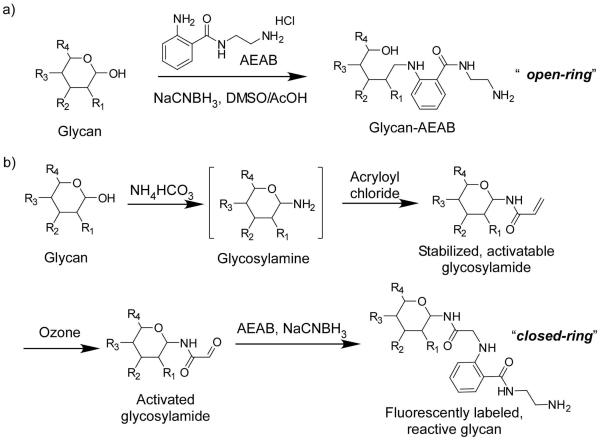
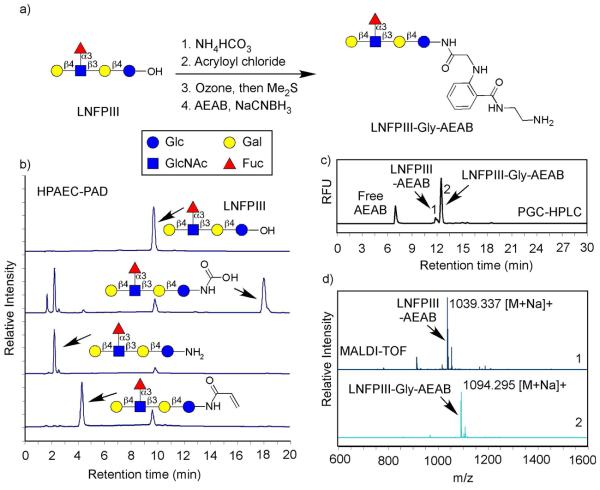
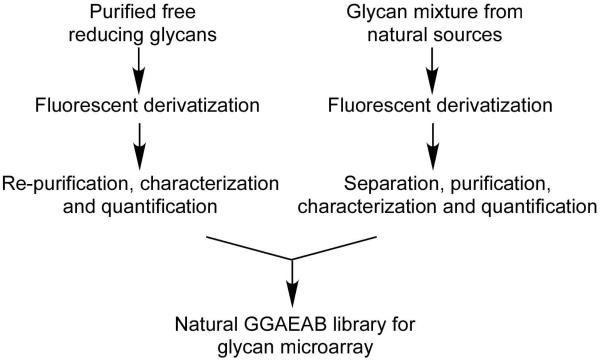
A novel strategy for creating naturally derived glycan microarrays has been developed. Glycosylamines are prepared from free reducing glycans and stabilized by reaction with acryloyl chloride to generate a glycosylamide in which the reducing monosaccharide has a closed-ring structure. Ozonolysis of the protected glycan yields an active aldehyde, to which a bifunctional fluorescent linker is coupled by reductive amination. The fluorescent derivatives are easily coupled through a residual primary alkylamine to generate glycan microarrays. This strategy preserves structural features of glycans required for antibody recognition and allows development of natural arrays of fluorescent glycans in which the cyclic pyranose structure of the reducing-end sugar residue is retained.
Figures
References
-
- Varki A, Cummings RD, Esko JD, Freeze HH, Stanley P, Bertozzi CR, Hart GW, Etzler ME. Essentials of Glycobiology. 2nd ed. Cold Spring Harbor Laboratory Press; Cold Spring Harbor, New York: 2009. - PubMed
-
- Taylor ME, Drickamer K. Paradigms for glycan-binding receptors in cell adhesion. Curr Opin Cell Biol. 2007;19:572–7. - PubMed
-
- Ohtsubo K, Marth JD. Glycosylation in cellular mechanisms of health and disease. Cell. 2006;126:855–67. - PubMed
-
- Lowe JB. Glycan-dependent leukocyte adhesion and recruitment in inflammation. Curr Opin Cell Biol. 2003;15:531–8. - PubMed
-
- Petrescu AJ, Wormald MR, Dwek RA. Structural aspects of glycomes with a focus on N-glycosylation and glycoprotein folding. Curr Opin Struct Biol. 2006;16:600–7. - PubMed
Publication types
MeSH terms
Substances
Grants and funding
LinkOut - more resources
Full Text Sources
Other Literature Sources