


The behavioral economics of choice and interval timing
- PMID: 19618985
- PMCID: PMC2743419
- DOI: 10.1037/a0016171
The behavioral economics of choice and interval timing
Abstract
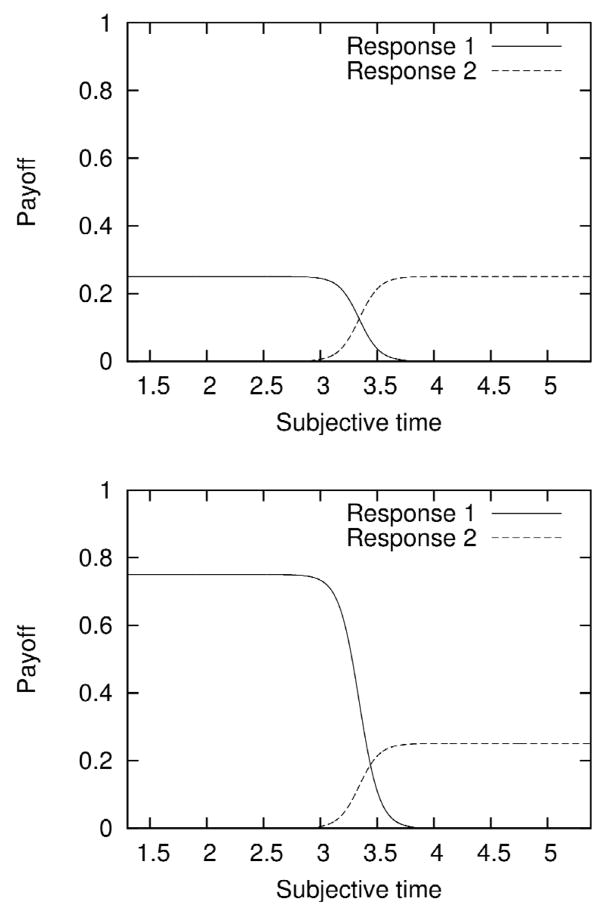
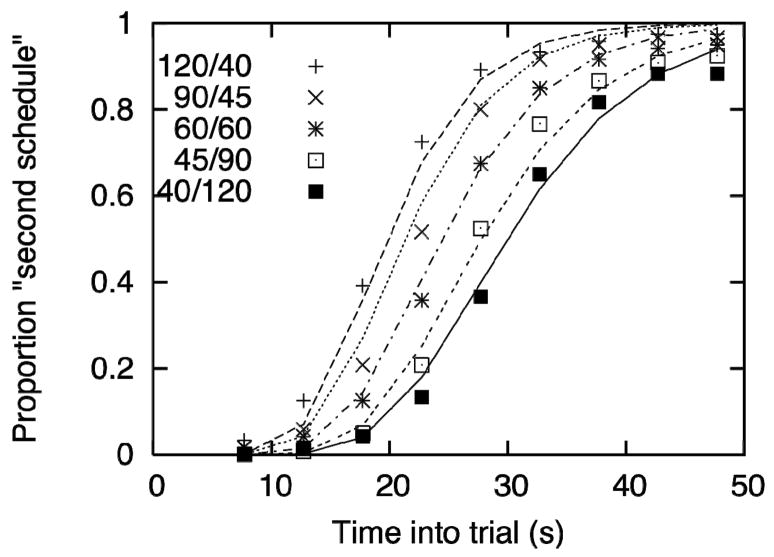
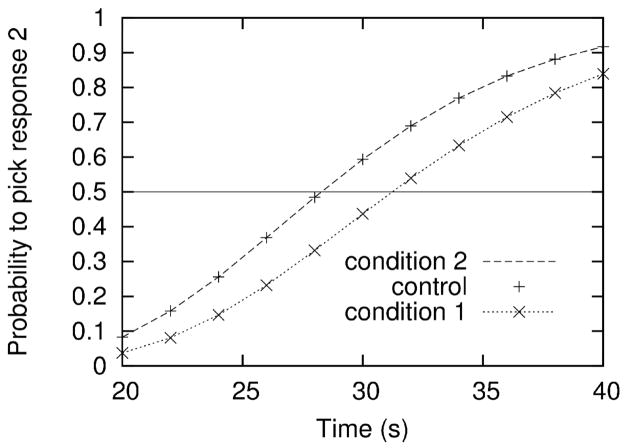
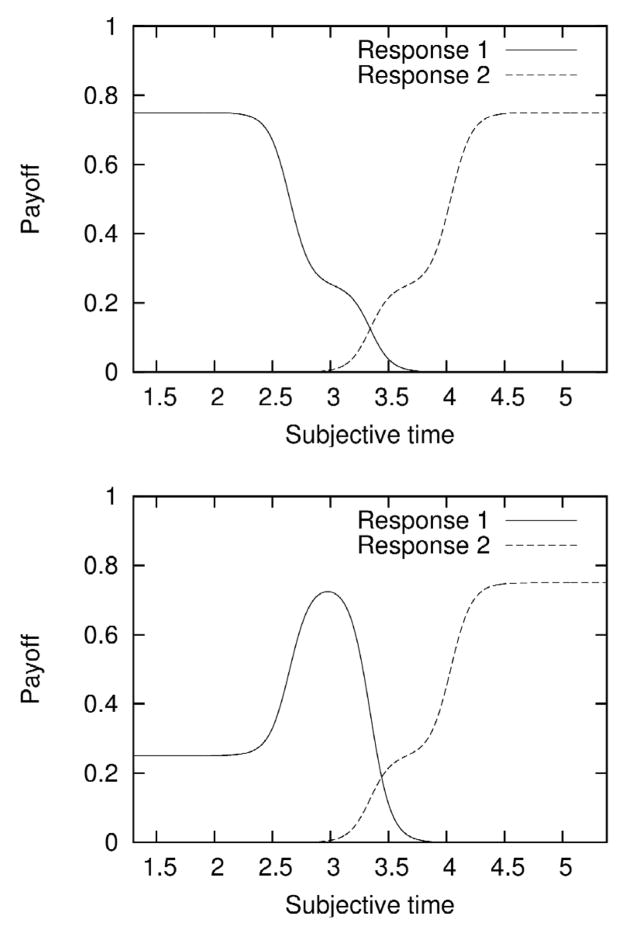
The authors propose a simple behavioral economic model (BEM) describing how reinforcement and interval timing interact. The model assumes a Weber-law-compliant logarithmic representation of time. Associated with each represented time value are the payoffs that have been obtained for each possible response. At a given real time, the response with the highest payoff is emitted. The model accounts for a wide range of data from procedures such as simple bisection, metacognition in animals, economic effects in free-operant psychophysical procedures, and paradoxical choice in double-bisection procedures. Although it assumes logarithmic time representation, it can also account for data from the time-left procedure usually cited in support of linear time representation. It encounters some difficulties in complex free-operant choice procedures, such as concurrent mixed fixed-interval schedules as well as some of the data on double bisection, which may involve additional processes. Overall, BEM provides a theoretical framework for understanding how reinforcement and interval timing work together to determine choice between temporally differentiated reinforcers.
Copyright (c) 2009 APA, all rights reserved.
Figures








References
-
- Ainslie G, Monterosso L. A marketplace in the brain? Science. 2004;306:421–423. - PubMed
-
- Bizo LA, Chu JYM, Sanabria F, Killeen PR. The failure of Weber’s law in time perception and production. Behavioural Processes. 2006;71:201–210. - PubMed
-
- Bizo LA, White KG. Pacemaker rate in the behavioral theory of timing. Journal of Experimental Psychology: Animal Behavior Processes. 1994b;20:308–321.
